

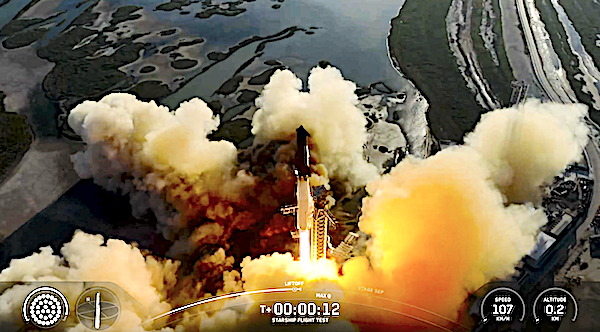
On Monday, October 13, 2025, at 6:23 p.m. CT, Starship lifted off from Starbase, Texas on its eleventh flight test. This was the final flight of the second-generation Starship and first generation Super Heavy booster, as well as the final launch from the current configuration of Pad 1. Every major objective of the flight test was achieved, providing valuable data as we prepare the next generation of Starship and Super Heavy to create a rapidly reusable vehicle with service to Earth orbit, the Moon, Mars, and beyond. All photos captured by Satnews.
The flight test began with Super Heavy igniting all 33 Raptor engines and ascending over the Gulf. The successful first-stage ascent was followed by a hot-staging maneuver, with Starship’s upper stage igniting its six Raptor engines to continue its flight to space.
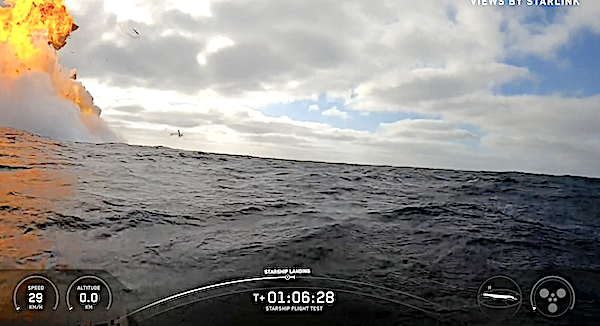
Following stage separation, the Super Heavy booster completed its boostback burn to put it on a course to a pre-planned splashdown zone off the coast of Texas using 12 of the 13 planned engines. Under the same angle of attack tested on the previous flight, the booster descended until successfully igniting all 13 planned engines (including one that did not relight during the boostback burn) for the high-thrust portion of the landing burn. The booster successfully executed a unique landing burn planned for use on the next generation booster. Super Heavy hovered above the water before shutting down its engines and splashing down.
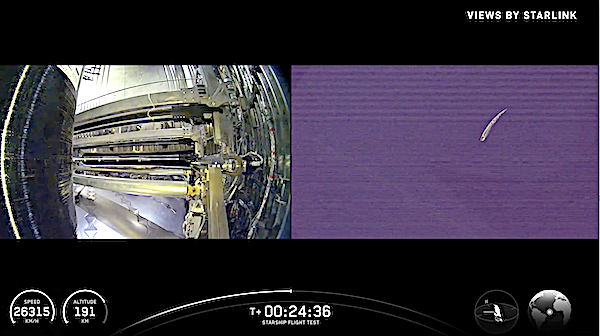
After completing a full-duration ascent burn, Starship achieved its planned velocity and trajectory. During flight, Starship successfully deployed eight Starlink simulators and executed the third in-space relight of a Raptor engine, demonstrating a critical capability for future deorbit burns.
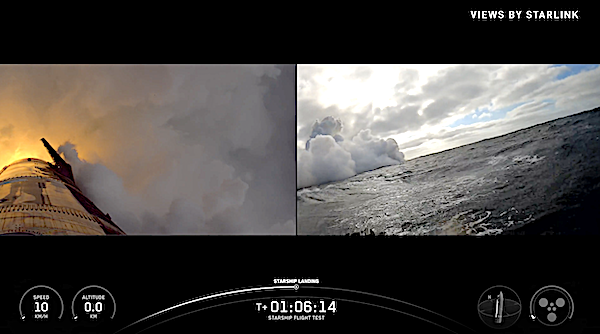
Starship re-entered the Earth’s atmosphere and was able to gather extensive data on the performance of its heatshield as it was intentionally stressed to test the limits of the vehicle’s capabilities. In the final minutes of flight, Starship performed a dynamic banking maneuver to mimic the trajectory that future missions returning to Starbase will fly. Starship then guided itself using its four flaps to the pre-planned splashdown zone in the Indian Ocean, successfully executing a landing flip, landing burn, and soft splashdown.
Focus now turns to the next generation of Starship and Super Heavy, with multiple vehicles currently in active build and preparing for tests. This next iteration will be used for the first Starship orbital flights, operational payload missions, propellant transfer, and more as we iterate to a fully and rapidly reusable vehicle with service to Earth orbit, the Moon, Mars, and beyond.
SpaceX plans Starship’s 11th flight test hopefully on Monday
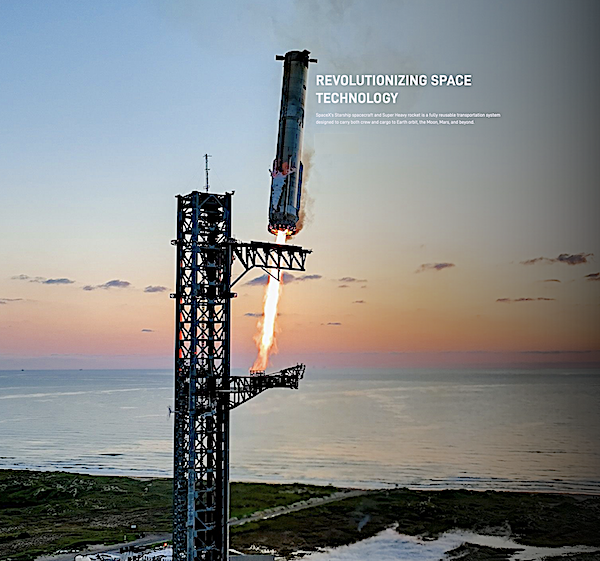
The eleventh flight test of Starship is preparing to launch as soon as Monday, October 13. The launch window will open at 6:15 p.m. CT.
A live webcast of the flight test will begin about 30 minutes before liftoff, which on X @SpaceX. You can also watch the webcast on the X TV app. As is the case with all developmental testing, the schedule is dynamic and likely to change, so be sure to check in here and stay tuned to our X account for updates.
The upcoming flight will build on the successful demonstrations from Starship’s tenth flight test with flight experiments gathering data for the next generation Super Heavy booster, stress-testing Starship’s heatshield, and demonstrating maneuvers that will mimic the upper stage’s final approach for a future return to launch site.
SpaceX works closely with FAA and international air traffic organizations to efficiently and safely integrate all launch and reentry operations into the airspace. During Starship Flight 10, FAA reopened all affected airspace within 9 minutes, with some portions reopening within 7 minutes, and there was no meaningful disruption to air traffic.
The booster on this flight test previously flew on Flight 8 and will launch with 24 flight-proven Raptor engines. Its primary test objective will be demonstrating a unique landing burn engine configuration planned to be used on the next generation Super Heavy. It will attempt this while on a trajectory to an offshore landing point in the Gulf of America and will not return to the launch site for catch.
Super Heavy will ignite 13 engines at the start of the landing burn and then transition to a new configuration with five engines running for the divert phase. Previously done with three engines, the planned baseline for V3 Super Heavy will use five engines during the section of the burn responsible for fine-tuning the booster’s path, adding additional redundancy for spontaneous engine shutdowns. The booster will then transition to its three center engines for the end of the landing burn, entering a full hover while still above the ocean surface, followed by shutdown and dropping into the Gulf of America. The primary goal on the flight test is to measure the real-world vehicle dynamics as engines shut down while transitioning between the different phases.
The Starship upper stage will target multiple in-space objectives, including the deployment of eight Starlink simulators, similar in size to next-generation Starlink satellites. The Starlink simulators will be on the same suborbital trajectory as Starship and are expected to demise upon entry. A relight of a single Raptor engine while in space is also planned.
The flight test includes several experiments and operational changes focused on enabling Starship’s upper stage to return to the launch site on future flights. For reentry, tiles have been removed from Starship to intentionally stress-test vulnerable areas across the vehicle. Several of the missing tiles are in areas where tiles are bonded to the vehicle and do not have a backup ablative layer. To mimic the path a ship will take on future flights returning to Starbase, the final phase of Starship’s trajectory on Flight 11 includes a dynamic banking maneuver and will test subsonic guidance algorithms prior to a landing burn and splashdown in the Indian Ocean.
