

• Skip to primary navigation
  • Skip to main content
  • Skip to primary sidebar
  • Skip to secondary sidebar
  • Skip to footer
  • NEWS:
  • SatNews
  • SatMagazine
  • MilSatMagazine
  • SmallSat News
  • |     EVENTS:
  • SmallSat Symposium
  • Satellite Innovation
  • MilSat Symposium
  • SmallSat Europe

SatNews

Satellite Industry Intelligence Since 1983

Subscribe
  • LATEST
  • SatNews Events
  • Magazines
  • Calendar
  • Subscribe
  • Missions & Constellations
    • Exploration & Science Missions
    • In-Orbit Servicing & Orbital Operations
    • LEO Constellations
    • Mission Autonomy & Onboard Systems
    • Mission Deployments & Manifests
    • Navigation & PNT
    • SmallSat
    • Spacecraft & Payload Technology
    View All in Missions & Constellations →
    GMV to Lead Mission Planning for ESA’s Next-Generation Copernicus ExpansionGMV to Lead Mission Planning for ESA’s Next-Generation Copernicus Expansion
    Canada Tightens Re-entry Regulations as SpaceX Starlink Constellations DescendCanada Tightens Re-entry Regulations as SpaceX Starlink Constellations Descend
    The waiver was the policy. Thursday is the paperwork.The waiver was the policy. Thursday is the paperwork.
    NanoAvionics to Launch Trio of Milestone Payloads on SpaceX CAS500-2 MissionNanoAvionics to Launch Trio of Milestone Payloads on SpaceX CAS500-2 Mission
  • Business
    • Contracts & Commercial Deals
    • Earnings & Financial Reporting
    • Events & Conferences
    • Funding & Venture Capital
    • Market Forecasts
    • Mergers & Acquisitions
    • Personnel Moves & Appointments
    View All in Business & Finance →
    SmallSat Europe Speaker Focus: Dr. Jakob Stöber, McKinsey & CompanySmallSat Europe Speaker Focus: Dr. Jakob Stöber, McKinsey & Company
    Bright Ascension Finalizes Leadership Transition with John Baughn as CEOBright Ascension Finalizes Leadership Transition with John Baughn as CEO
    Global Invacom Secures Exclusive Worldwide Distribution for Prodelin Antenna RangeGlobal Invacom Secures Exclusive Worldwide Distribution for Prodelin Antenna Range
    HTX and ST Engineering Launch Space Tech Program for Singapore Public SafetyHTX and ST Engineering Launch Space Tech Program for Singapore Public Safety
  • Defense
    • Counterspace & ASAT
    • Defense Budgets & Procurement
    • ISR & Reconnaissance
    • MILSATCOM
    • Missile Warning & Defense
    • National Security Programs
    • Space Domain Awareness
    View All in Military & Defense →
    BAE Systems Enters Production for NavGuide M-Code GPS ReceiverBAE Systems Enters Production for NavGuide M-Code GPS Receiver
    Space Force Awards $3.2 Billion in Golden Dome Contracts for Orbital Interceptor ConstellationSpace Force Awards $3.2 Billion in Golden Dome Contracts for Orbital Interceptor Constellation
    USSF Finalizes GPS III Constellation with Successful SV-10 DeploymentUSSF Finalizes GPS III Constellation with Successful SV-10 Deployment
    Meink: Space Force Programs Ready to Execute Once FY27 Budget LandsMeink: Space Force Programs Ready to Execute Once FY27 Budget Lands
  • Gov
    • Export Controls & Compliance
    • International Space Agreements
    • National Space Policy
    • Space Law & Treaties
    • Space Sustainability & Debris Policy
    • Space Traffic Management / Debris Removal
    View All in Government & Regulation →
    SmallSat Europe Speaker Focus: Tanja Masson-Zwaan, Leiden UniversitySmallSat Europe Speaker Focus: Tanja Masson-Zwaan, Leiden University
    How CubeSat Proliferation is Redefining Sovereignty and Diplomatic Leverage at the United NationsHow CubeSat Proliferation is Redefining Sovereignty and Diplomatic Leverage at the United Nations
    FCC Modernization of Spectrum Rules Unlocks Sevenfold Gain in Satellite CapacityFCC Modernization of Spectrum Rules Unlocks Sevenfold Gain in Satellite Capacity
    The Smartest Money in the Room Is Looking UpThe Smartest Money in the Room Is Looking Up
  • Launch
    • Launch Providers
    • Launch Schedule & Calendars
    • Launch Sites & Infrastructure
    • Rocket Technology & Vehicles
    View All in Launch →
    Astrobotic Achieves Record 300-Second Burn with New Detonation EngineAstrobotic Achieves Record 300-Second Burn with New Detonation Engine
    Bad news, but good news followedBad news, but good news followed
    Rocket Lab Successfully Launches “Kakushin Rising” Mission for JAXARocket Lab Successfully Launches “Kakushin Rising” Mission for JAXA
    Blue Origin CEO Attributes BlueBird 7 Satellite Loss to Second-Stage Thrust AnomalyBlue Origin CEO Attributes BlueBird 7 Satellite Loss to Second-Stage Thrust Anomaly
  • Software
    • Autonomous Ground Operations
    • Data Processing & AI/ML
    • Digital Twins & Modeling
    • Ground Segment & Teleports
    • Mission Planning & Simulation
    • Space Systems Software Engineering
    • Spectrum & Licensing
    View All in Software Automation & Ground Systems →
    SmallSat Europe Speaker Focus: Giovanni Pandolfi Bortoletto, Leaf SpaceSmallSat Europe Speaker Focus: Giovanni Pandolfi Bortoletto, Leaf Space
    SpinLaunch Selects Equinix to Deploy Global Ground Infrastructure for Meridian Space ConstellationSpinLaunch Selects Equinix to Deploy Global Ground Infrastructure for Meridian Space Constellation
    RF-Design Launches FiberLink CompactLine FCLR1811S4 for Ground Segment OptimizationRF-Design Launches FiberLink CompactLine FCLR1811S4 for Ground Segment Optimization
    Sat-Lite Technologies adds  Richard Rader to Spearhead Sales ExpansionSat-Lite Technologies adds Richard Rader to Spearhead Sales Expansion
  • Services & Apps
    • Climate & Environmental Monitoring
    • Disaster Response & Security Mapping
    • Earth Observation & Imaging
    • Maritime & Aviation Satcom
    • Satellite Communications
    View All in Services & Applications →
    Solstar Confirms Successful On-Orbit Operation of Deke Space Communicator Following Launch on SpaceX Transporter-16 MissionSolstar Confirms Successful On-Orbit Operation of Deke Space Communicator Following Launch on SpaceX Transporter-16 Mission
    IEC Telecom Unveils Voucher-Based Connectivity Solution at Singapore Maritime Week 2026IEC Telecom Unveils Voucher-Based Connectivity Solution at Singapore Maritime Week 2026
    GomSpace and STETMAN Establish UASAT Joint Venture for Ukrainian Sovereign CommunicationsGomSpace and STETMAN Establish UASAT Joint Venture for Ukrainian Sovereign Communications
    Market Dynamics and Non-Terrestrial Network (NTN) ChipsetsMarket Dynamics and Non-Terrestrial Network (NTN) Chipsets

New year. New ship. New lessons.

February 24, 2025

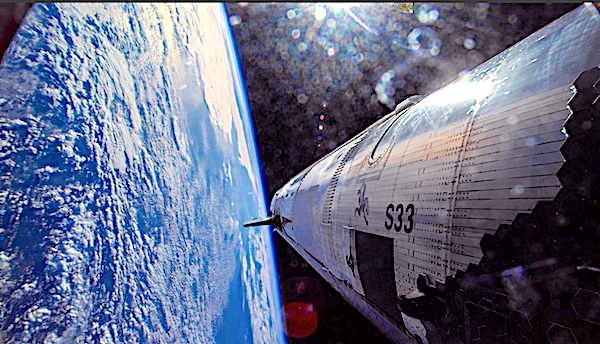
The seventh flight test of Starship and Super Heavy flew with ambitious goals, aiming to successfully repeat the core capability of returning and catching a booster while launching an upgraded design of the upper stage. While not every test objective was completed, the lessons learned will roll directly into future vehicles to make them more capable as Starship advances toward full and rapid reuse.

On January 16, 2025, Starship successfully lifted off at 4:37 p.m. CT from Starbase in Texas. At launch, all 33 Raptor engines on the Super Heavy booster started up successfully and completed a full duration burn during ascent. After powering down all but the three center engines on Super Heavy, Starship ignited all six of its Raptor engines to separate in a hot-staging maneuver and continue its ascent to space.

Following stage separation, Super Heavy initiated its boostback burn to propel the rocket toward its intended landing location. It successfully lit 12 of the 13 engines commanded to start, with a single Raptor on the middle ring safely aborting on startup due to a low-power condition in the igniter system. Raptor engines on upcoming flights have a pre-planned igniter upgrade to mitigate this issue. The boostback burn was completed successfully and sent Super Heavy back to the launch site for catch.
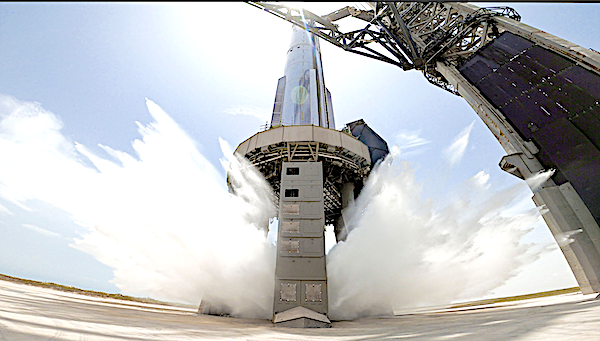
OLM full pressure water deluge test.

The booster successfully relit all 13 planned middle ring and center Raptor engines for its landing burn, including the engine that did not relight for boostback burn. The landing burn slowed the booster down and maneuvered it to the launch and catch tower arms at Starbase, resulting in the second ever successful catch of Super Heavy.

After vehicle separation, Starship’s six second stage Raptor engines powered the vehicle along its expected trajectory. Approximately two minutes into its burn, a flash was observed in the aft section of the vehicle near one of the Raptor vacuum engines. This aft section, commonly referred to as the attic, is an unpressurized area between the bottom of the liquid oxygen tank and the aft heatshield. Sensors in the attic detected a pressure rise indicative of a leak after the flash was seen.

Roughly two minutes later, another flash was observed followed by sustained fires in the attic. These eventually caused all but one of Starship’s engines to execute controlled shut down sequences and ultimately led to a loss of communication with the ship. Telemetry from the vehicle was last received just over eight minutes and 20 seconds into flight.

Contact with Starship was lost prior to triggering any destruct rules for its Autonomous Flight Safety System, which was fully healthy when communication was lost. The vehicle was observed to break apart approximately three minutes after loss of contact during descent. Post-flight analysis indicates that the safety system did trigger autonomously, and breakup occurred within Flight Termination System expectations.

The most probable root cause for the loss of ship was identified as a harmonic response several times stronger in flight than had been seen during testing, which led to increased stress on hardware in the propulsion system. The subsequent propellant leaks exceeded the venting capability of the ship’s attic area and resulted in sustained fires.

Immediately following the anomaly, the pre-coordinated response plan developed by SpaceX, the FAA, and ATO (air traffic control) went into effect. All debris came down within the pre-planned Debris Response Area, and there were no hazardous materials present in the debris and no significant impacts expected to occur to marine species or water quality. SpaceX reached out immediately to the government of Turks and Caicos and worked with them and the United Kingdom to coordinate recovery and cleanup efforts. While an early end to the flight test is never a desired outcome, the measures put in place ahead of launch demonstrated their ability to keep the public safe.

SpaceX led the investigation efforts with oversight from the FAA and participation from NASA, the National Transportation Safety Board, and the U.S. Space Force. SpaceX is working with the FAA to either close the mishap investigation or receive a flight safety determination, along with working on a license authorization to enable its next flight of Starship.

As part of the investigation, an extended duration static fire was completed with the Starship flying on the eighth flight test. The 60-second firing was used to test multiple engine thrust levels and three separate hardware configurations in the Raptor vacuum engine feedlines to recreate and address the harmonic response seen during Flight 7. Findings from the static fire informed hardware changes to the fuel feedlines to vacuum engines, adjustments to propellant temperatures, and a new operating thrust target that will be used on the upcoming flight test.

To address flammability potential in the attic section on Starship, additional vents and a new purge system utilizing gaseous nitrogen are being added to the current generation of ships to make the area more robust to propellant leakage. Future upgrades to Starship will introduce the Raptor 3 engine, reducing the attic volume and eliminating the majority of joints that can leak into this volume.

Starship’s seventh flight test was a reminder that developmental progress is not always linear, and putting flight hardware in a flight environment is the fastest way to demonstrate how thousands of distinct parts come together to reach space. Upcoming flights will continue to target ambitious goals in the pursuit of full and rapid reusability.

Filed Under: International Space Agreements, Launch Providers

Primary Sidebar

Coverage

  • Missions & Constellations
  • Business & Finance
  • Military & Defense
  • Launch
  • Software Automation & Ground Systems
  • Government & Regulation
  • Services & Applications

Most Read Stories

  • Planet Labs Imposes Indefinite Blackout on Iran Satellite Imagery at U.S. Request
  • Amazon in Reported Talks to Acquire Globalstar in $9 Billion Move to Challenge Starlink
  • What the SpaceX IPO Changes for Every Satellite Operator
  • Russia Replaces Starlink With European-Built Satellites
  • The Downlink Deficit: The Pentagon's Optical Mesh Network and the Terrestrial Bottleneck

Secondary Sidebar

Footer


Satnews is a leading provider of satellite news, events, publications, research and other satellite industry information in both commercial and military enterprises worldwide.

Stories By Category

  • Business & Finance
  • Government & Regulation
  • Launch
  • Military & Defense
  • Missions & Constellations
  • Services & Applications
  • Software Automation & Ground Systems
  • Spectrum & Licensing
  • Startups & NewSpace Business

About Us

  • Leadership & Editorial Team
  • SatNews History
  • Free Satnews Subscription
  • SatNews Events
  • Magazines

Navigation

  • Latest Stories
  • Magazines
  • Events
  • Contact
  • Cookie & Privacy Policy for Satnews

We use cookies to ensure that we give you the best experience on our website. If you continue to use this site we will assume that you are happy with it.
x
Sign up Now (For Free)
Access daily or weekly satellite news updates covering all aspects of the commercial and military satellite industry.
Invalid email address
Notify Me Regarding ( At least one ):
We value your privacy and will not sell or share your email or other information with any other company. You may also unsubscribe at anytime.

Click Here to see our full privacy policy.
Thanks for subscribing!