

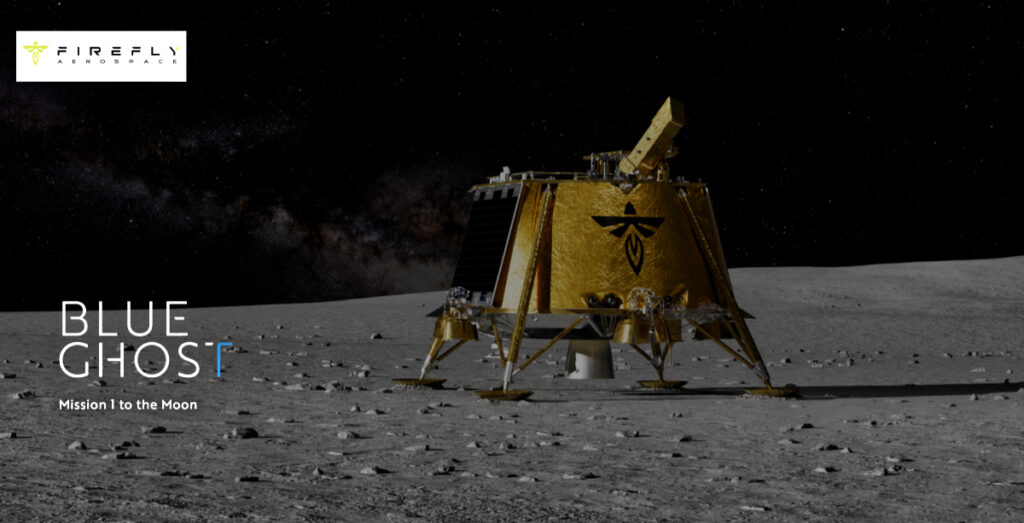
Firefly’s first Blue Ghost mission, named Ghost Riders in the Sky, will deliver 10 science and technology instruments to the lunar surface as part of NASA’s Commercial Lunar Payload Services (CLPS) initiative. The mission will launch from Launch Complex 39A at Kennedy Space Center aboard a SpaceX Falcon 9 for NASA.
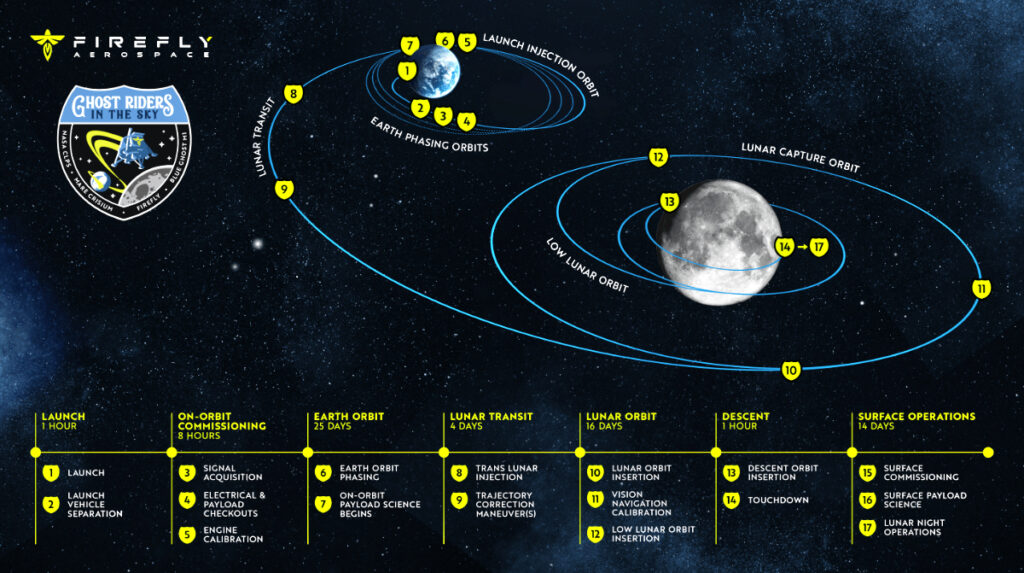
Upon launching, Blue Ghost will spend approximately 45 days in transit to the Moon, allowing ample time to conduct health checks on each subsystem and begin payload science. Blue Ghost will then land in Mare Crisium and operate payloads for a complete lunar day (about 14 Earth days). Following payload operations, Blue Ghost will capture imagery of the lunar sunset and provide critical data on how lunar regolith reacts to solar influences during lunar dusk conditions. The lander will then operate for several hours into the lunar night.
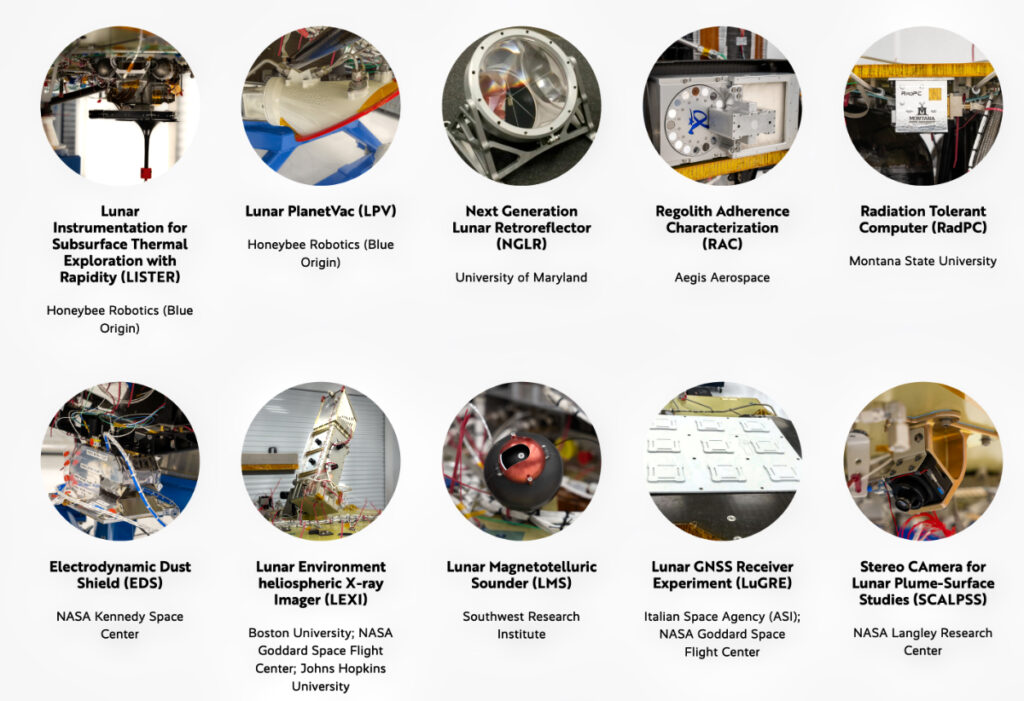
The payloads on Blue Ghost Mission 1 will help advance lunar research and conduct several first-of-its-kind demonstrations, including testing regolith sample collection, Global Navigation Satellite System (GNSS) abilities, radiation tolerant computing, and lunar dust mitigation. These investigations will help pave the way for humanity’s return to the Moon. The data captured will also benefit humans on Earth by providing insights into how space weather and other cosmic forces impact Earth, among other valuable research.
Standing 2 meters (6.6 ft) tall and 3.5 meters (11.5 ft) wide, Blue Ghost is designed to stick the landing with shock absorbing feet, a low center of mass, and a wide footprint. Blue Ghost’s core components, including the panels, struts, legs, harnesses, avionics, batteries, and thrusters, were built using many of the same flight-proven technologies common to all of Firefly’s launch and orbital vehicles, enabling lower costs and improved reliability.
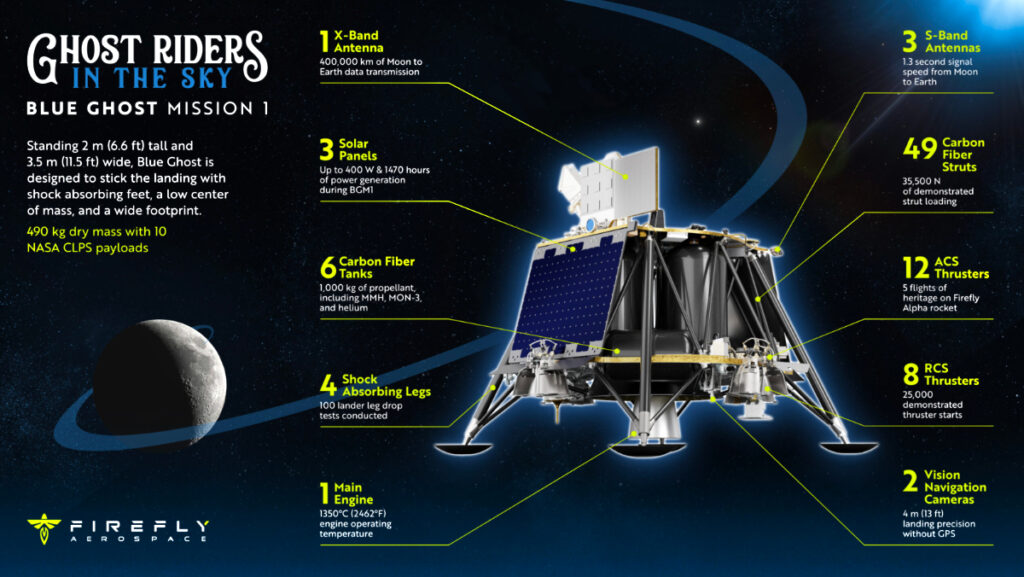
During the final hour of descent, Blue Ghost uses vision-based terrain relative navigation and hazard avoidance to measure the lander’s position and identify craters, slopes, and rocks before selecting the final hazard-free target within the landing zone. Blue Ghost’s RCS thrusters pulse as needed throughout the descent for a soft landing.

Blue Ghost will land in early March near a volcanic feature called Mons Latreille within Mare Crisium, a large basin located in the northeast quadrant of the Moon’s near side. Mare Crisium was created by early volcanic eruptions and flooded with basaltic lava more than three billion years ago. This unique landing site will allow our payload partners to gather critical data about the Moon’s regolith, geophysical characteristics, and the interaction of solar wind and Earth’s magnetic field.
All imagery is courtesy of Firefly Aerospace.
