

• Skip to primary navigation
  • Skip to main content
  • Skip to primary sidebar
  • Skip to secondary sidebar
  • Skip to footer
  • NEWS:
  • SatNews
  • SatMagazine
  • MilSatMagazine
  • SmallSat News
  • |     EVENTS:
  • SmallSat Symposium
  • Satellite Innovation
  • MilSat Symposium
  • SmallSat Europe

SatNews

Satellite Industry Intelligence Since 1983

Subscribe
  • LATEST
  • SatNews Events
  • Magazines
  • Calendar
  • Subscribe
  • Missions & Constellations
    • Exploration & Science Missions
    • In-Orbit Servicing & Orbital Operations
    • LEO Constellations
    • Mission Autonomy & Onboard Systems
    • Mission Deployments & Manifests
    • Navigation & PNT
    • SmallSat
    • Spacecraft & Payload Technology
    View All in Missions & Constellations →
    Eutelsat Q1 LEO Revenue Rises 30% to €70.9M as OneWeb Offsets Video DeclineEutelsat Q1 LEO Revenue Rises 30% to €70.9M as OneWeb Offsets Video Decline
    NASA’s Swift Observatory Expected to Burn Up in Atmospheric Reentry Following Failed Commercial RescueNASA’s Swift Observatory Expected to Burn Up in Atmospheric Reentry Following Failed Commercial Rescue
    Telesat Delays Lightspeed Constellation Service to Mid-2028 Following Pathfinder Software DelaysTelesat Delays Lightspeed Constellation Service to Mid-2028 Following Pathfinder Software Delays
    FCC Proposes 25 MHz Mid-Band Spectrum Auction with Dual 5G and Direct-to-Device AllocationsFCC Proposes 25 MHz Mid-Band Spectrum Auction with Dual 5G and Direct-to-Device Allocations
  • Business
    • Contracts & Commercial Deals
    • Earnings & Financial Reporting
    • Events & Conferences
    • Funding & Venture Capital
    • Market Forecasts
    • Mergers & Acquisitions
    • Personnel Moves & Appointments
    View All in Business & Finance →
    Satellites Can’t Wait for the 2030 Post-Quantum Deadline, MilSat Panel SaysSatellites Can’t Wait for the 2030 Post-Quantum Deadline, MilSat Panel Says
    War in Space Isn’t Insurable Yet, Gallagher’s Rush SaysWar in Space Isn’t Insurable Yet, Gallagher’s Rush Says
    Xona Is in Orbit. Its CEO Says U.S. GPS Backup Leans on China.Xona Is in Orbit. Its CEO Says U.S. GPS Backup Leans on China.
    RG-XX Bids Are In. The Award Is a Year Away.RG-XX Bids Are In. The Award Is a Year Away.
  • Defense
    • Counterspace & ASAT
    • Defense Budgets & Procurement
    • ISR & Reconnaissance
    • MILSATCOM
    • Missile Warning & Defense
    • National Security Programs
    • Space Domain Awareness
    View All in Military & Defense →
    Golden Dome Panel Splits on the Program’s Political RiskGolden Dome Panel Splits on the Program’s Political Risk
    MUOS Gets Two More Satellites and a Life to 2040MUOS Gets Two More Satellites and a Life to 2040
    SDA’s First Tracking Satellites Slip to Spring, Sandhoo SaysSDA’s First Tracking Satellites Slip to Spring, Sandhoo Says
    Hughes Secures $42.5M Space Systems Command Award for Multi-Orbit Automated EM&C ArchitectureHughes Secures $42.5M Space Systems Command Award for Multi-Orbit Automated EM&C Architecture
  • Gov
    • Export Controls & Compliance
    • International Space Agreements
    • National Space Policy
    • Space Law & Treaties
    • Space Sustainability & Debris Policy
    • Space Traffic Management / Debris Removal
    View All in Government & Regulation →
    Part 100 Puts FCC Satellite Licensing on an Assembly LinePart 100 Puts FCC Satellite Licensing on an Assembly Line
    FCC Proposes Modernized Direct-to-Device Rules, Explores 482 MHz Expansion for Satellite CellularFCC Proposes Modernized Direct-to-Device Rules, Explores 482 MHz Expansion for Satellite Cellular
    Canada’s Satellite-to-Phone Network Can’t Go It Alone, So Terrestar Joined EquatysCanada’s Satellite-to-Phone Network Can’t Go It Alone, So Terrestar Joined Equatys
    NTIA’s 500 MHz Mandate Is Its Top Job, Patrick SaysNTIA’s 500 MHz Mandate Is Its Top Job, Patrick Says
  • Launch
    • Launch Providers
    • Launch Schedule & Calendars
    • Launch Sites & Infrastructure
    • Rocket Technology & Vehicles
    View All in Launch →
    HIMERA and GomSpace Begin Orbital Operations of OBRIA NANO Test Satellite for Sovereign Ukrainian NetworkHIMERA and GomSpace Begin Orbital Operations of OBRIA NANO Test Satellite for Sovereign Ukrainian Network
    Blue Origin Reconstructs Launch Complex 36 Tower, Targets November Return to Flight for New GlennBlue Origin Reconstructs Launch Complex 36 Tower, Targets November Return to Flight for New Glenn
    DIA Space Security Report Reveals Detailed Orbital Imagery of China’s Shenlong SpaceplaneDIA Space Security Report Reveals Detailed Orbital Imagery of China’s Shenlong Spaceplane
    The Launch Crunch Is Coming as Falcon 9 Winds DownThe Launch Crunch Is Coming as Falcon 9 Winds Down
  • Software
    • Autonomous Ground Operations
    • Data Processing & AI/ML
    • Digital Twins & Modeling
    • Ground Segment & Teleports
    • Mission Planning & Simulation
    • Space Systems Software Engineering
    • Spectrum & Licensing
    View All in Software Automation & Ground Systems →
    MBSat Selects ST Engineering iDirect Intuition Platform for Ground Infrastructure in OmanMBSat Selects ST Engineering iDirect Intuition Platform for Ground Infrastructure in Oman
    AnySignal Co-Founder Urges Ground Station Interoperability to Resolve Orbital Data BottlenecksAnySignal Co-Founder Urges Ground Station Interoperability to Resolve Orbital Data Bottlenecks
    Arqiva Secures Three-Year Satellite Services Agreement with Kuwait’s GulfsatArqiva Secures Three-Year Satellite Services Agreement with Kuwait’s Gulfsat
    TrustPoint and Calian Deliver Industry’s First Mass-Market Ready C-band GNSS AntennaTrustPoint and Calian Deliver Industry’s First Mass-Market Ready C-band GNSS Antenna
  • Services & Apps
    • Climate & Environmental Monitoring
    • Disaster Response & Security Mapping
    • Earth Observation & Imaging
    • Maritime & Aviation Satcom
    • Satellite Communications
    View All in Services & Applications →
    Tim Farrar: Carriers Are Finding Few Will Pay for Direct-to-DeviceTim Farrar: Carriers Are Finding Few Will Pay for Direct-to-Device
    Scanway and Pixxel Sign Pact to Expand Optical Payload and Earth Observation Data ServicesScanway and Pixxel Sign Pact to Expand Optical Payload and Earth Observation Data Services
    KTL Selects Keysight NR-NTN Test Suite to Accelerate Satellite Acceptance TestingKTL Selects Keysight NR-NTN Test Suite to Accelerate Satellite Acceptance Testing
    Leonardo Infrared Sensor Returns to Orbit Aboard SatVu HotSat-3 Thermal Imaging SatelliteLeonardo Infrared Sensor Returns to Orbit Aboard SatVu HotSat-3 Thermal Imaging Satellite

Hats off to NASA’s Webb: Sombrero Galaxy dazzles in new image

November 25, 2024

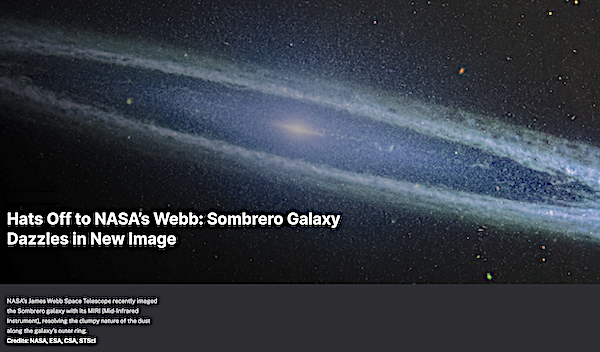
In a new image from NASA’s James Webb Space Telescope, a galaxy named for its resemblance to a broad-brimmed Mexican hat appears more like an archery target.

In Webb’s mid-infrared view of the Sombrero galaxy, also known as Messier 104 (M104), the signature, glowing core seen in visible-light images does not shine, and instead a smooth inner disk is revealed. The sharp resolution of Webb’s MIRI (Mid-Infrared Instrument) also brings into focus details of the galaxy’s outer ring, providing insights into how the dust, an essential building block for astronomical objects in the universe, is distributed. The galaxy’s outer ring, which appeared smooth like a blanket in imaging from NASA’s retired Spitzer Space Telescope, shows intricate clumps in the infrared for the first time.
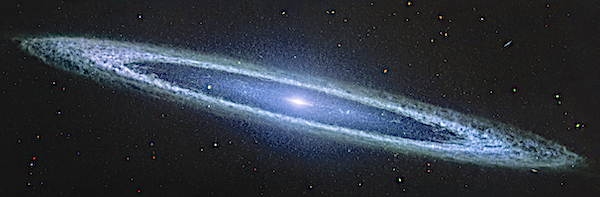
NASA’s James Webb Space Telescope recently imaged the Sombrero galaxy with its MIRI (Mid-Infrared Instrument), resolving the clumpy nature of the dust along the galaxy’s outer ring. This image includes filters representing 7.7-micron light as blue, 11.3-micron light as green, and 12.8-micron light as red. NASA, ESA, CSA, STScI

Image B: Sombrero Galaxy (Hubble and Webb Image)

Hubble (Visible), Hubble’s view of the Sombrero galaxy. In this view, the galaxy is an oblong, pale white disk with a glowing core over the inner disk. The outer disk is darker and clumpy.

Webb (MIRI) , Webb’s view of the Sombrero galaxy. In this view, the galaxy is a very oblong, blue disk that extends from left to right at an angle (from about 10 o’clock to 5 o’clock). The galaxy has a small bright core at the center. There is clear inner disk that has speckles of stars scattered throughout. The outer disk of the galaxy is whiteish-blue, and clumpy, like clouds in the sky.
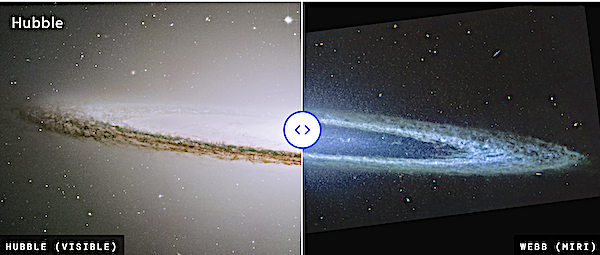
Before and After Sombrero Galaxy (Hubble and Webb Image) Nov 25, 2024

Researchers say the clumpy nature of the dust, where MIRI detects carbon-containing molecules called polycyclic aromatic hydrocarbons, can indicate the presence of young star-forming regions. However, unlike some galaxies studied with Webb, including Messier 82, where 10 times as many stars are born than the Milky Way galaxy, the Sombrero galaxy is not a particular hotbed of star formation. The rings of the Sombrero galaxy produce less than one solar mass of stars per year, in comparison to the Milky Way’s roughly two solar masses a year.

Even the supermassive black hole, also known as an active galactic nucleus, at the center of the Sombrero galaxy is rather docile, even at a hefty 9-billion-solar masses. It’s classified as a low luminosity active galactic nucleus, slowly snacking on infalling material from the galaxy, while sending off a bright, relatively small, jet.

Also within the Sombrero galaxy dwell some 2,000 globular clusters, collections of hundreds of thousands of old stars held together by gravity. This type of system serves as a pseudo laboratory for astronomers to study stars — thousands of stars within one system with the same age, but varying masses and other properties is an intriguing opportunity for comparison studies.

In the MIRI image, galaxies of varying shapes and colors litter the background of space. The different colors of these background galaxies can tell astronomers about their properties, including how far away they are.

The Sombrero galaxy is around 30 million light-years from Earth in the constellation Virgo.

A Bright Future Ahead

Stunning images like this, and an array of discoveries in the study of exoplanets, galaxies through time, star formation, and our own solar system, are still just the beginning. Recently, scientists from all over the world applied for observation time with Webb during its fourth year of science operations, which begins in July 2025.

General Observer time with Webb is more competitive than ever. A record-breaking 2,377 proposals were submitted by the Oct. 15, 2024, deadline, requesting about 78,000 hours of observation time. This is an oversubscription rate, the ratio defining the observation hours requested versus the actual time available in one year of Webb’s operations, of around 9 to 1.

The proposals cover a wide array of science topics, with distant galaxies being among the most requested observation time, followed by exoplanet atmospheres, stars and stellar populations, then exoplanet systems.

The Space Telescope Science Institute manages the proposal and program selection process for NASA. The submissions will now be evaluated by a Telescope Allocation Committee, a group of hundreds of members of the worldwide astronomical community, on a dual-anonymous basis, with selections announced in March 2025.

While time on Webb is limited, data from all of Webb’s programs is publicly archived, immediately after it’s taken, or after a time of exclusive access, in the Mikulski Archive for Space Telescopes (MAST) so it can be used by anyone in the world.

The James Webb Space Telescope is the world’s premier space science observatory. Webb is solving mysteries in our solar system, looking beyond to distant worlds around other stars, and probing the mysterious structures and origins of our universe and our place in it.

Webb is an international program led by NASA with its partners, ESA (European Space Agency) and CSA (Canadian Space Agency).

Filed Under: Government & Regulation

Primary Sidebar

Coverage

  • Missions & Constellations
  • Business & Finance
  • Military & Defense
  • Launch
  • Software Automation & Ground Systems
  • Government & Regulation
  • Services & Applications

Most Read Stories

  • AT&T, T-Mobile, and Verizon Form Joint Venture to Standardize Satellite Direct-to-Device Connectivity
  • SpaceX Acquires Grain Management’s 800 MHz Spectrum Portfolio to Launch Standalone Starlink Mobile Carrier
  • SpaceX Unveils 250 kW Starlink Gen3 AI Satellites Featuring 10 Tbps Throughput and Onboard Edge Compute
  • FCC Grants SpaceX Approval for 15,000-Satellite Very Low Earth Orbit Direct-to-Device Constellation
  • Rocket Lab Challenges NASA’s $700M Mars Orbiter Award to Blue Origin While Scaling Vertical Integration via $8B Iridium Acquisition

Secondary Sidebar

Footer


Satnews is a leading provider of satellite news, events, publications, research and other satellite industry information in both commercial and military enterprises worldwide.

Stories By Category

  • Business & Finance
  • Government & Regulation
  • Launch
  • Military & Defense
  • Missions & Constellations
  • Services & Applications
  • Software Automation & Ground Systems
  • Spectrum & Licensing
  • Startups & NewSpace Business

About Us

  • Leadership & Editorial Team
  • SatNews History
  • Free Satnews Subscription
  • SatNews Events
  • Magazines

Navigation

  • Latest Stories
  • Magazines
  • Events
  • Contact
  • Cookie & Privacy Policy for Satnews

We use cookies to ensure that we give you the best experience on our website. If you continue to use this site we will assume that you are happy with it.
x
Sign up Now (For Free)
Access daily or weekly satellite news updates covering all aspects of the commercial and military satellite industry.
Invalid email address
Notify Me Regarding ( At least one ):
We value your privacy and will not sell or share your email or other information with any other company. You may also unsubscribe at anytime.

Click Here to see our full privacy policy.
Thanks for subscribing!