

• Skip to primary navigation
  • Skip to main content
  • Skip to primary sidebar
  • Skip to secondary sidebar
  • Skip to footer
  • NEWS:
  • SatNews
  • SatMagazine
  • MilSatMagazine
  • SmallSat News
  • |     EVENTS:
  • SmallSat Symposium
  • Satellite Innovation
  • MilSat Symposium
  • SmallSat Europe

SatNews

Satellite Industry Intelligence Since 1983

Subscribe
  • LATEST
  • SatNews Events
  • Magazines
  • Calendar
  • Subscribe
  • Missions & Constellations
    • Exploration & Science Missions
    • In-Orbit Servicing & Orbital Operations
    • LEO Constellations
    • Mission Autonomy & Onboard Systems
    • Mission Deployments & Manifests
    • Navigation & PNT
    • SmallSat
    • Spacecraft & Payload Technology
    View All in Missions & Constellations →
    AST SpaceMobile Unveils Blacklift Rocket Under $1.3B Firefly Engine AgreementAST SpaceMobile Unveils Blacklift Rocket Under $1.3B Firefly Engine Agreement
    CesiumAstro Secures $730M Series D at $4.5B Valuation to Deploy Synchronicity ConstellationCesiumAstro Secures $730M Series D at $4.5B Valuation to Deploy Synchronicity Constellation
    Pentagon Commits $150M OSC Loan to LeoLabs in $300M Radar Network ExpansionPentagon Commits $150M OSC Loan to LeoLabs in $300M Radar Network Expansion
    Redwire Wins $20M DARPA Contract for Scaled SabreSat VLEO Precursor FlightRedwire Wins $20M DARPA Contract for Scaled SabreSat VLEO Precursor Flight
  • Business
    • Contracts & Commercial Deals
    • Earnings & Financial Reporting
    • Events & Conferences
    • Funding & Venture Capital
    • Market Forecasts
    • Mergers & Acquisitions
    • Personnel Moves & Appointments
    View All in Business & Finance →
    SES Posts 4.2% Q3 Growth Driven by Defense Contracts and Books 53 Satellites Through 2030SES Posts 4.2% Q3 Growth Driven by Defense Contracts and Books 53 Satellites Through 2030
    SpaceX Selects Qualcomm to Supply Terrestrial Base Stations for Starlink Mobile NetworkSpaceX Selects Qualcomm to Supply Terrestrial Base Stations for Starlink Mobile Network
    SpaceX Explores Boost Mobile Acquisition in Push to Build Hybrid Terrestrial-Satellite NetworkSpaceX Explores Boost Mobile Acquisition in Push to Build Hybrid Terrestrial-Satellite Network
    MDA Space Secures C$100M+ Thales Alenia Space Award for First 66 IRIS² SatellitesMDA Space Secures C$100M+ Thales Alenia Space Award for First 66 IRIS² Satellites
  • Defense
    • Counterspace & ASAT
    • Defense Budgets & Procurement
    • ISR & Reconnaissance
    • MILSATCOM
    • Missile Warning & Defense
    • National Security Programs
    • Space Domain Awareness
    View All in Military & Defense →
    ThinKom and Space Systems Command Demonstrate GECKO Multi-Orbit Containerized SATCOM SystemThinKom and Space Systems Command Demonstrate GECKO Multi-Orbit Containerized SATCOM System
    Vantor Cuts Satellite Imagery Delivery Time to Seven Minutes in Ukrainian Field DemonstrationVantor Cuts Satellite Imagery Delivery Time to Seven Minutes in Ukrainian Field Demonstration
    L3Harris Secures $36M Army SATCOM Order for Hawkeye 4 Lite Terminals Supporting C2NOWL3Harris Secures $36M Army SATCOM Order for Hawkeye 4 Lite Terminals Supporting C2NOW
    Space Force Awards Lockheed Martin $95M GPS IIIF Modification, Bringing Contract Face Value to $4.73BSpace Force Awards Lockheed Martin $95M GPS IIIF Modification, Bringing Contract Face Value to $4.73B
  • Gov
    • Export Controls & Compliance
    • International Space Agreements
    • National Space Policy
    • Space Law & Treaties
    • Space Sustainability & Debris Policy
    • Space Traffic Management / Debris Removal
    View All in Government & Regulation →
    Globalstar Petitions FCC to Scrutinize Rocket Lab Supplier Conflict Over $8B Iridium DealGlobalstar Petitions FCC to Scrutinize Rocket Lab Supplier Conflict Over $8B Iridium Deal
    Russia Files ITU Plan for 374-Satellite Rassvet-4 Constellation Following Rassvet-3 Orbital SetbacksRussia Files ITU Plan for 374-Satellite Rassvet-4 Constellation Following Rassvet-3 Orbital Setbacks
    FCC Proposes 25 MHz Mid-Band Spectrum Auction with Dual 5G and Direct-to-Device AllocationsFCC Proposes 25 MHz Mid-Band Spectrum Auction with Dual 5G and Direct-to-Device Allocations
    Part 100 Puts FCC Satellite Licensing on an Assembly LinePart 100 Puts FCC Satellite Licensing on an Assembly Line
  • Launch
    • Launch Providers
    • Launch Schedule & Calendars
    • Launch Sites & Infrastructure
    • Rocket Technology & Vehicles
    View All in Launch →
    Amazon Navigates Launch Delays with Under 400 Satellites in Orbit Ahead of Nov. 13 Vulcan ReturnAmazon Navigates Launch Delays with Under 400 Satellites in Orbit Ahead of Nov. 13 Vulcan Return
    NASA Outlines Artemis IV Starship Refueling Architecture as Launch Estimates VaryNASA Outlines Artemis IV Starship Refueling Architecture as Launch Estimates Vary
    HIMERA and GomSpace Begin Orbital Operations of OBRIA NANO Test Satellite for Sovereign Ukrainian NetworkHIMERA and GomSpace Begin Orbital Operations of OBRIA NANO Test Satellite for Sovereign Ukrainian Network
    Blue Origin Reconstructs Launch Complex 36 Tower, Targets November Return to Flight for New GlennBlue Origin Reconstructs Launch Complex 36 Tower, Targets November Return to Flight for New Glenn
  • Software
    • Autonomous Ground Operations
    • Data Processing & AI/ML
    • Digital Twins & Modeling
    • Ground Segment & Teleports
    • Mission Planning & Simulation
    • Space Systems Software Engineering
    • Spectrum & Licensing
    View All in Software Automation & Ground Systems →
    Northwood Space Secures $375M Series C at $2B Valuation to Expand Shared Ground Station NetworkNorthwood Space Secures $375M Series C at $2B Valuation to Expand Shared Ground Station Network
    MBSat Selects ST Engineering iDirect Intuition Platform for Ground Infrastructure in OmanMBSat Selects ST Engineering iDirect Intuition Platform for Ground Infrastructure in Oman
    AnySignal Co-Founder Urges Ground Station Interoperability to Resolve Orbital Data BottlenecksAnySignal Co-Founder Urges Ground Station Interoperability to Resolve Orbital Data Bottlenecks
    Arqiva Secures Three-Year Satellite Services Agreement with Kuwait’s GulfsatArqiva Secures Three-Year Satellite Services Agreement with Kuwait’s Gulfsat
  • Services & Apps
    • Climate & Environmental Monitoring
    • Disaster Response & Security Mapping
    • Earth Observation & Imaging
    • Maritime & Aviation Satcom
    • Satellite Communications
    View All in Services & Applications →
    Ubotica Demonstrates Autonomous Onboard Satellite Scheduling for Maritime SurveillanceUbotica Demonstrates Autonomous Onboard Satellite Scheduling for Maritime Surveillance
    UniSQ Demonstrates Tomographic Spectrometer During KREPE-3 Re-Entry CampaignUniSQ Demonstrates Tomographic Spectrometer During KREPE-3 Re-Entry Campaign
    Orbital Sentry Develops Persistent Geostationary Infrared Sensor for Real-Time Wildfire DetectionOrbital Sentry Develops Persistent Geostationary Infrared Sensor for Real-Time Wildfire Detection
    NASA’s Swift Observatory Expected to Burn Up in Atmospheric Reentry Following Failed Commercial RescueNASA’s Swift Observatory Expected to Burn Up in Atmospheric Reentry Following Failed Commercial Rescue

SpaceX UPDATE: Starship’s second flight test delayed in need of a replacement part

November 17, 2023

UPDATE: The second flight test of a fully integrated was originally set for November 17, but SpaceX delayed it by 24 hours to replace a grid fin actuator on the launch stack. The launch is currently scheduled to occur from the company’s Starbase site near Boca Chica, Texas.

SpaceX launched its first Starship on April 20, but the rocket was intentionally exploded after its stages failed to separate as planned. The 33 engines of the Super Heavy first stage carved a huge crater beneath its launch mount, which SpaceX spent months repairing and upgrading. 
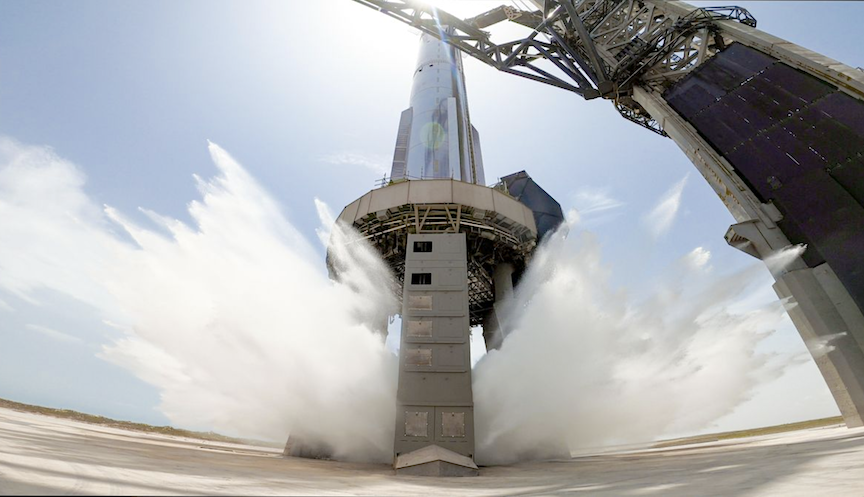
SpaceX has since installed a water deluge system beneath the launch pad to avoid creating another crater on this launch. Additionally there is now a hot-staging technique for stage separation, in which the upper Starship stage begins firing its engines before separating from the Super Heavy.

“This is another chance to put Starship in a true flight environment, maximizing how much we learn,” SpaceX wrote in a November 16 update on X, formerly known as Twitter. “This is another chance to put Starship in a true flight environment, maximizing how much we learn. Rapid iterative development is essential as we work to build a fully reusable launch system capable of carrying satellites, payloads, crew, and cargo to a variety of orbits and Earth, lunar, and Martian landing sites.”
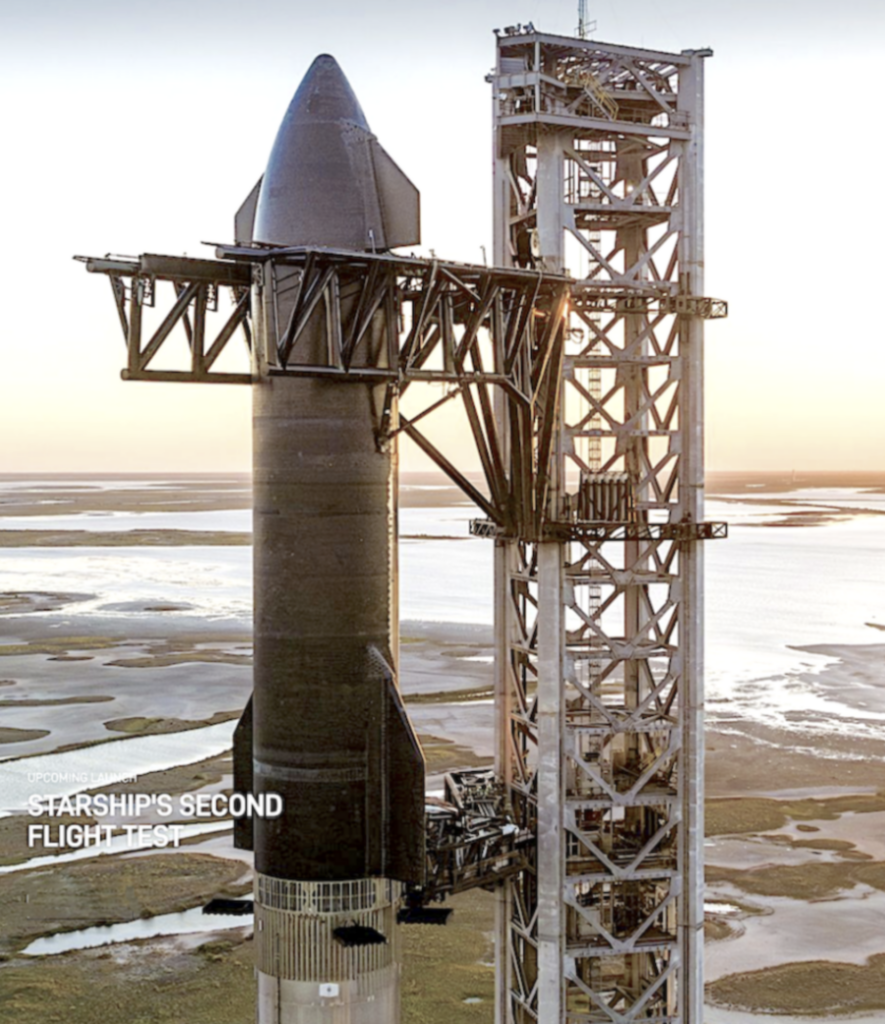
The second flight test of a fully integrated Starship is set to launch Friday, November 17. A two-hour launch window opens at 7:00 a.m. CT.

A live webcast of the flight test will begin about 35 minutes before liftoff, which you can watch on X @SpaceX. Be aware of possible updates as is the case with all developmental testing, the schedule is dynamic and likely to change.

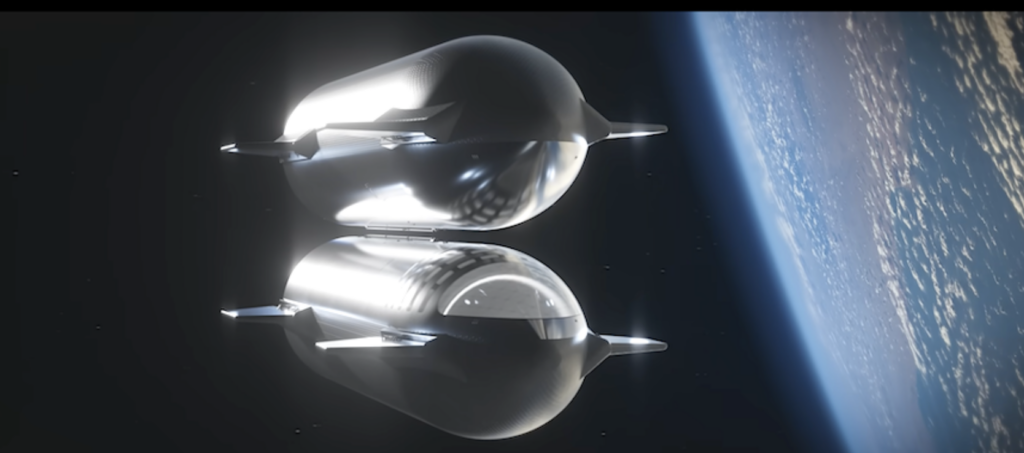
As the most powerful launch system ever developed, Starship will be able to carry up to 100 people on long-duration, interplanetary flights. Starship will also help enable satellite delivery, the development of a Moon base, and point-to-point transport on Earth.
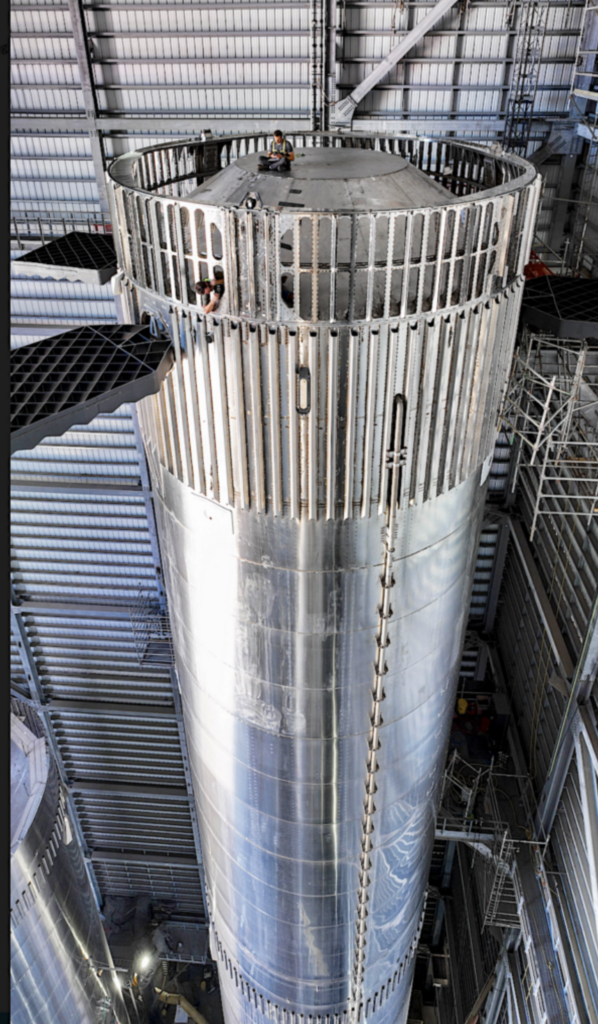
Hot-stage separation system

Starship’s first flight test provided numerous lessons learned that directly contributed to several upgrades to both the vehicle and ground infrastructure to improve the probability of success on future flights. The second flight test will debut a hot-stage separation system and a new electronic Thrust Vector Control (TVC) system for Super Heavy Raptor engines, in addition to reinforcements to the pad foundation and a water-cooled steel flame deflector, among many other enhancements.

UPGRADES AHEAD OF STARSHIP’S SECOND FLIGHT TEST

The first flight test of a fully integrated Starship and Super Heavy was a critical step in advancing the capabilities of the most powerful launch system ever developed. Starship’s first flight test provided numerous lessons learned that are directly contributing to several upgrades being made to both the vehicle and ground infrastructure to improve the probability of success on future Starship flights. This rapid iterative development approach has been the basis for all of SpaceX’s major innovative advancements, including Falcon, Dragon, and Starlink. SpaceX has led the investigation efforts following the flight with oversight from the FAA and participation from NASA and the National Transportation and Safety Board.
Starship and Super Heavy successfully lifted off for the first time on April 20, 2023 at 8:33 a.m. CT (13:33:09 UTC) from the orbital launch pad at Starbase in Texas. Starship climbed to a maximum altitude of ~39 km (24 mi) over the Gulf of Mexico. During ascent, the vehicle sustained fires from leaking propellant in the aft end of the Super Heavy booster, which eventually severed connection with the vehicle’s primary flight computer. This led to a loss of communications to the majority of booster engines and, ultimately, control of the vehicle. SpaceX has since implemented leak mitigations and improved testing on both engine and booster hardware. As an additional corrective action, SpaceX has significantly expanded Super Heavy’s pre-existing fire suppression system in order to mitigate against future engine bay fires.
The Autonomous Flight Safety System (AFSS) automatically issued a destruct command, which fired all detonators as expected, after the vehicle deviated from the expected trajectory, lost altitude and began to tumble. After an unexpected delay following AFSS activation, Starship ultimately broke up 237.474 seconds after engine ignition. SpaceX has enhanced and requalified the AFSS to improve system reliability.
SpaceX is also implementing a full suite of system performance upgrades unrelated to any issues observed during the first flight test. For example, SpaceX has built and tested a hot-stage separation system, in which Starship’s second stage engines will ignite to push the ship away from the booster. Additionally, SpaceX has engineered a new electronic Thrust Vector Control (TVC) system for Super Heavy Raptor engines. Using fully electric motors, the new system has fewer potential points of failure and is significantly more energy efficient than traditional hydraulic systems.
SpaceX also made significant upgrades to the orbital launch mount and pad system in order to prevent a recurrence of the pad foundation failure observed during the first flight test. These upgrades include significant reinforcements to the pad foundation and the addition of a flame deflector, which SpaceX has successfully tested multiple times.

Testing development flight hardware in a flight environment is what enables our teams to quickly learn and execute design changes and hardware upgrades to improve the probability of success in the future. We learned a tremendous amount about the vehicle and ground systems during Starship’s first flight test. Recursive improvement is essential as we work to build a fully reusable launch system capable of carrying satellites, payloads, crew, and cargo to a variety of orbits and Earth, lunar, or Martian landing sites.

This rapid iterative development approach has been the basis for all of SpaceX’s major innovative advancements, including Falcon, Dragon, and Starlink. Recursive improvement is essential as we work to build a fully reusable transportation system capable of carrying both crew and cargo to Earth orbit, help humanity return to the Moon, and ultimately travel to Mars and beyond.

Filed Under: Exploration & Science Missions, Launch Providers

Primary Sidebar

Coverage

  • Missions & Constellations
  • Business & Finance
  • Military & Defense
  • Launch
  • Software Automation & Ground Systems
  • Government & Regulation
  • Services & Applications

Most Read Stories

  • SpaceX Acquires Grain Management’s 800 MHz Spectrum Portfolio to Launch Standalone Starlink Mobile Carrier
  • Amazon Leo Plans Prime Subscription Bundling to Challenge Starlink in Consumer Satellite Broadband Market
  • SpaceX Restricts Military Starshield Speeds in Ukraine, Disrupting Pentagon-Funded Tactical Drone Operations
  • SpaceX Requests FAA Approval for Up to 456 Starship Launches Annually at Starbase
  • Kratos Defense Demonstrates Multi-Vendor 5G Satellite Connectivity Using Virtualized OpenSpace Ground Platform

Secondary Sidebar

Footer


Satnews is a leading provider of satellite news, events, publications, research and other satellite industry information in both commercial and military enterprises worldwide.

Stories By Category

  • Business & Finance
  • Government & Regulation
  • Launch
  • Military & Defense
  • Missions & Constellations
  • Services & Applications
  • Software Automation & Ground Systems
  • Spectrum & Licensing
  • Startups & NewSpace Business

About Us

  • Leadership & Editorial Team
  • SatNews History
  • Free Satnews Subscription
  • SatNews Events
  • Magazines

Navigation

  • Latest Stories
  • Magazines
  • Events
  • Contact
  • Cookie & Privacy Policy for Satnews

We use cookies to ensure that we give you the best experience on our website. If you continue to use this site we will assume that you are happy with it.
x
Sign up Now (For Free)
Access daily or weekly satellite news updates covering all aspects of the commercial and military satellite industry.
Invalid email address
Notify Me Regarding ( At least one ):
We value your privacy and will not sell or share your email or other information with any other company. You may also unsubscribe at anytime.

Click Here to see our full privacy policy.
Thanks for subscribing!