

• Skip to primary navigation
  • Skip to main content
  • Skip to primary sidebar
  • Skip to secondary sidebar
  • Skip to footer
  • NEWS:
  • SatNews
  • SatMagazine
  • MilSatMagazine
  • SmallSat News
  • |     EVENTS:
  • SmallSat Symposium
  • Satellite Innovation
  • MilSat Symposium
  • SmallSat Europe

SatNews

Satellite Industry Intelligence Since 1983

Subscribe
  • LATEST
  • SatNews Events
  • Magazines
  • Calendar
  • Subscribe
  • Missions & Constellations
    • Exploration & Science Missions
    • In-Orbit Servicing & Orbital Operations
    • LEO Constellations
    • Mission Autonomy & Onboard Systems
    • Mission Deployments & Manifests
    • Navigation & PNT
    • SmallSat
    • Spacecraft & Payload Technology
    View All in Missions & Constellations →
    Scientists and Regulators Weigh 150x Emission Claims Around SpaceX’s One-Million-Satellite Data Center ProposalScientists and Regulators Weigh 150x Emission Claims Around SpaceX’s One-Million-Satellite Data Center Proposal
    A Second LEO Network Has Paying Customers and a Launch ProblemA Second LEO Network Has Paying Customers and a Launch Problem
    GAO Finds Pentagon Lacks Coordinated View of Military Space Supply Chain RisksGAO Finds Pentagon Lacks Coordinated View of Military Space Supply Chain Risks
    Orbital Proximity Incidents Mask Broader Satellite Jamming ThreatOrbital Proximity Incidents Mask Broader Satellite Jamming Threat
  • Business
    • Contracts & Commercial Deals
    • Earnings & Financial Reporting
    • Events & Conferences
    • Funding & Venture Capital
    • Market Forecasts
    • Mergers & Acquisitions
    • Personnel Moves & Appointments
    View All in Business & Finance →
    RBC Signals Secures $10 Million Strategic Growth Investment Led by Washington Harbour PartnersRBC Signals Secures $10 Million Strategic Growth Investment Led by Washington Harbour Partners
    GomSpace Secures €8 Million Phase 2 Contract for North American Dual-Satellite Lunar Prospecting MissionGomSpace Secures €8 Million Phase 2 Contract for North American Dual-Satellite Lunar Prospecting Mission
    Telesat Secures Six-Week Debt Standstill From GEO Lenders Through Jan. 18, 2027Telesat Secures Six-Week Debt Standstill From GEO Lenders Through Jan. 18, 2027
    SES Targets Middle Corridor and Central Asia Amid €623 Million EU Infrastructure PushSES Targets Middle Corridor and Central Asia Amid €623 Million EU Infrastructure Push
  • Defense
    • Counterspace & ASAT
    • Defense Budgets & Procurement
    • ISR & Reconnaissance
    • MILSATCOM
    • Missile Warning & Defense
    • National Security Programs
    • Space Domain Awareness
    View All in Military & Defense →
    Lite Coms Secures Over $100 Million in Q3 2026 Defense SATCOM OrdersLite Coms Secures Over $100 Million in Q3 2026 Defense SATCOM Orders
    NATO Stands Up Starlift Launch Brokerage to Connect Alliance Demand With Allied SpaceportsNATO Stands Up Starlift Launch Brokerage to Connect Alliance Demand With Allied Spaceports
    Senate Appropriators Move to Bar Sole-Source Awards Over $100 Million for Space Data Network and SB-AMTISenate Appropriators Move to Bar Sole-Source Awards Over $100 Million for Space Data Network and SB-AMTI
    Space Force Awards $10 Million in SEWOL Prototype Contracts to Three FirmsSpace Force Awards $10 Million in SEWOL Prototype Contracts to Three Firms
  • Gov
    • Export Controls & Compliance
    • International Space Agreements
    • National Space Policy
    • Space Law & Treaties
    • Space Sustainability & Debris Policy
    • Space Traffic Management / Debris Removal
    View All in Government & Regulation →
    FCC Upper C-Band Auction 115 Creates Indirect Spectrum and Market Shifts for SmallSat and LEO OperatorsFCC Upper C-Band Auction 115 Creates Indirect Spectrum and Market Shifts for SmallSat and LEO Operators
    FCC Sets April 27, 2027 Start Date for Upper C-Band Auction, Pressuring BroadcastersFCC Sets April 27, 2027 Start Date for Upper C-Band Auction, Pressuring Broadcasters
    Starlink Satellites Pass Over South Africa, But Licensing Approval Remains StalledStarlink Satellites Pass Over South Africa, But Licensing Approval Remains Stalled
    Satellogic Reports Record Revenue and Largest-Ever $37 Million Sovereign Satellite OrderSatellogic Reports Record Revenue and Largest-Ever $37 Million Sovereign Satellite Order
  • Launch
    • Launch Providers
    • Launch Schedule & Calendars
    • Launch Sites & Infrastructure
    • Rocket Technology & Vehicles
    View All in Launch →
    ULA Clears Blue Origin BE-4 Engines, Focuses Vulcan Failure Probe on Core Stage Fuel SupplyULA Clears Blue Origin BE-4 Engines, Focuses Vulcan Failure Probe on Core Stage Fuel Supply
    Google Selects Blue Origin’s New Glenn Rocket for 2029 AI Satellite LaunchGoogle Selects Blue Origin’s New Glenn Rocket for 2029 AI Satellite Launch
    NASA’s Voyager 1 Reaches One Light-Day From Earth at 16.1 Billion MilesNASA’s Voyager 1 Reaches One Light-Day From Earth at 16.1 Billion Miles
    PLD Space Signs First Commercial MIURA 5 Launch Contract With Mitsubishi ElectricPLD Space Signs First Commercial MIURA 5 Launch Contract With Mitsubishi Electric
  • Software
    • Autonomous Ground Operations
    • Data Processing & AI/ML
    • Digital Twins & Modeling
    • Ground Segment & Teleports
    • Mission Planning & Simulation
    • Space Systems Software Engineering
    • Spectrum & Licensing
    View All in Software Automation & Ground Systems →
    Ramon.Space Raises $124 Million Series B to Scale Orbital Computing InfrastructureRamon.Space Raises $124 Million Series B to Scale Orbital Computing Infrastructure
    Gilat Cuts 2026 Growth Forecast to 3% Amid Launch and IFC DelaysGilat Cuts 2026 Growth Forecast to 3% Amid Launch and IFC Delays
    U.S. Navy Expands ALL.SPACE Terminal Fleet to 108 with Follow-On Hydra MAX 2 OrderU.S. Navy Expands ALL.SPACE Terminal Fleet to 108 with Follow-On Hydra MAX 2 Order
    SpaceX Selects Qualcomm to Supply Terrestrial Base Stations for Starlink Mobile NetworkSpaceX Selects Qualcomm to Supply Terrestrial Base Stations for Starlink Mobile Network
  • Services & Apps
    • Climate & Environmental Monitoring
    • Disaster Response & Security Mapping
    • Earth Observation & Imaging
    • Maritime & Aviation Satcom
    • Satellite Communications
    View All in Services & Applications →
    Thales Alenia Space Awarded DGA Contract for French IRIS Military Optical ConstellationThales Alenia Space Awarded DGA Contract for French IRIS Military Optical Constellation
    Ubotica Demonstrates Autonomous Onboard Satellite Scheduling for Maritime SurveillanceUbotica Demonstrates Autonomous Onboard Satellite Scheduling for Maritime Surveillance
    UniSQ Demonstrates Tomographic Spectrometer During KREPE-3 Re-Entry CampaignUniSQ Demonstrates Tomographic Spectrometer During KREPE-3 Re-Entry Campaign
    MDA Space Secures C$100M+ Thales Alenia Space Award for First 66 IRIS² SatellitesMDA Space Secures C$100M+ Thales Alenia Space Award for First 66 IRIS² Satellites

Journey to a Metal-Rich World: NASA’s Psyche Is Ready to Launch

October 11, 2023

A SpaceX Falcon Heavy rocket with the Psyche spacecraft onboard is seen at Launch Complex 39A as preparations continue for the Psyche mission, Wednesday, Oct. 11, 2023, at NASA’s Kennedy Space Center in Florida. NASA’s Psyche spacecraft will travel to a metal-rich asteroid by the same name orbiting the Sun between Mars and Jupiter to study its composition. The spacecraft also carries the agency’s Deep Space Optical Communications technology demonstration, which will test laser communications beyond the Moon.

A SpaceX Falcon Heavy rocket with the Psyche spacecraft onboard is seen at Launch Complex 39A as preparations continue for the Psyche mission, Wednesday, Oct. 11, 2023, at NASA’s Kennedy Space Center in Florida. NASA’s Psyche spacecraft will travel to a metal-rich asteroid by the same name orbiting the Sun between Mars and Jupiter to study its composition. The spacecraft also carries the agency’s Deep Space Optical Communications technology demonstration, which will test laser communications beyond the Moon.

The spacecraft is targeting an Oct. 12 liftoff atop a Falcon Heavy rocket. Its destination, a metal-rich asteroid, may tell us more about how planets form.
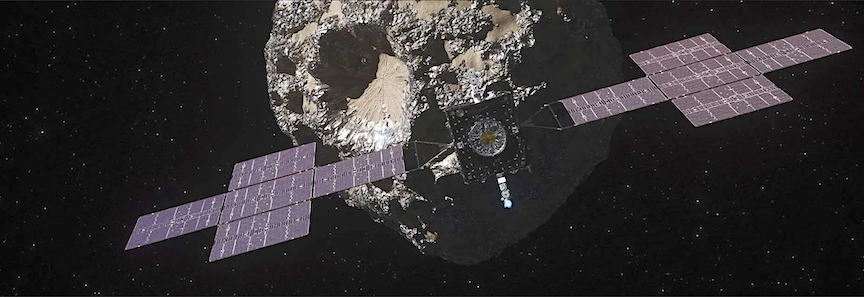
In less than 24 hours, NASA’s Psyche spacecraft is slated to launch from the agency’s Kennedy Space Center in Florida. With its sights set on a mysterious asteroid of the same name, Psyche is NASA’s first scientific mission to be launched on a SpaceX Falcon Heavy rocket.

Launch is set for 10:16 a.m. EDT on Thursday, October 12, with additional opportunities identified each day through October 25. Each opportunity is instantaneous, meaning there is only one exact time per day when launch can occur.

“The team has worked tirelessly to prepare the spacecraft for its journey to a one-of-a-kind asteroid,” said Henry Stone, Psyche’s project manager at NASA’s Jet Propulsion Laboratory in Southern California. “All spacecraft systems, science instruments, and software have been integrated and extensively tested, and the spacecraft is fully configured for flight. We look forward to the launch and – more importantly – to accomplishing the mission’s objectives, marking yet another historic voyage of scientific discovery.”

The orbiter’s solar arrays are folded and stowed for launch. All systems have been tested and re-tested many times, along with the payload of three science instruments. Loaded with 2,392 pounds (1,085 kilograms) of the neutral gas xenon – the propellant that will get Psyche to the asteroid belt – the spacecraft sits inside the launch vehicle’s cone-shaped payload fairing, which protects it from aerodynamic pressure and heat during launch. The spacecraft and fairing have been mated to the SpaceX Falcon Heavy, which is poised for takeoff from Kennedy Space Center’s historic Launch Complex 39A.

Integrated onto the spacecraft is a technology demonstration called Deep Space Optical Communications (DSOC). DSOC will test high-data-rate laser communications – which could be used by future NASA missions – beyond the Moon for the first time. The tech demo will not relay Psyche mission data.

Launch Sequences

The rocket has two stages and two side boosters. After the side boosters separate and return to land, the core stage will be expended into the Atlantic Ocean. Then the second stage of the rocket, which will help Psyche escape Earth’s gravity, will fire its engine.

Once the rocket is out of Earth’s atmosphere, about four minutes after launch, the fairing will separate from its ride and split into two halves, which are jettisoned back to Earth. The spacecraft will then separate from the upper stage about an hour after launch. Soon after, it will deploy its twin solar arrays, one at a time, and direct them at the Sun. At this point, the spacecraft is in a planned “safe mode” (a precautionary standby status), with the Sun illuminating the deployed solar panels, and will begin to direct the low-gain antenna toward Earth for communications.

It could take up to two hours after separation from the rocket before the first signal is received.

Once stable communications have been established, mission controllers will begin to reconfigure the spacecraft into its planned operating mode. The ensuing three months of initial checkout include a commissioning phase to confirm that all hardware and software is operating as expected, including the electric thrusters. Starting about five months after launch, the thrusters will fire, one at a time, during long stretches of the trajectory to get to the asteroid.

Psyche’s efficient solar electric propulsion system works by accelerating and expelling charged atoms, or ions, of the neutral gas xenon – creating a thrust that will gently push the spacecraft on a journey of nearly six years and about 2.2 billion miles (3.6 billion kilometers) to the asteroid Psyche in the main asteroid belt between Mars and Jupiter.

Along the way, in May 2026, the spacecraft will fly by Mars and use the Red Planet’s gravity to slingshot itself toward Psyche, saving propellant while gaining speed and changing direction.

After the spacecraft reaches the asteroid in 2029, it will spend about 26 months in orbit, gathering images and other data.

Scientists believe Psyche could be part of the core of a planetesimal – an early planetary building block – and composed of a mixture of rock and iron-nickel metal. The metal will not be mined; it will be studied to give researchers a better idea of what makes up Earth’s core and how rocky planets formed in our solar system. Humans can’t bore a path to our planet’s core – or the cores of the other rocky planets – so visiting Psyche could provide a one-of-a-kind window into the violent history of collisions and accumulation of matter that created planets like our own.

More About the Mission

Arizona State University leads the Psyche mission. A division of Caltech in Pasadena, JPL is responsible for the mission’s overall management, system engineering, integration and test, and mission operations. Maxar Technologies in Palo Alto, California, provided the high-power solar electric propulsion spacecraft chassis.

JPL manages DSOC for the Technology Demonstration Missions program within NASA’s Space Technology Mission Directorate and the Space Communications and Navigation program within the Space Operations Mission Directorate.

NASA’s Launch Services Program, based at Kennedy Space Center, is responsible for the insight and approval of the launch vehicle and manages the launch service for the Psyche mission. LSP certified the SpaceX Falcon Heavy rocket for use with the agency’s most complex and highest priority missions in early 2023 at the conclusion of a 2 ½-year effort.

Psyche is the 14th mission selected as part of NASA’s Discovery Program, managed by the agency’s Marshall Space Flight Center in Huntsville, Alabama.

For more information about NASA’s Psyche mission go to: https://www.nasa.gov/psyche

Filed Under: Exploration & Science Missions, Government & Regulation

Primary Sidebar

Coverage

  • Missions & Constellations
  • Business & Finance
  • Military & Defense
  • Launch
  • Software Automation & Ground Systems
  • Government & Regulation
  • Services & Applications

Most Read Stories

  • Blue Origin Reconstructs Launch Complex 36 Tower, Targets November Return to Flight for New Glenn
  • Amazon Navigates Launch Delays with Under 400 Satellites in Orbit Ahead of Nov. 13 Vulcan Return
  • Satellite Bus Maker Apex in Talks to Raise $500M at $4B Valuation
  • NASA Outlines Artemis IV Starship Refueling Architecture as Launch Estimates Vary
  • Northwood Space Secures $375M Series C at $2B Valuation to Expand Shared Ground Station Network

Secondary Sidebar

Footer


Satnews is a leading provider of satellite news, events, publications, research and other satellite industry information in both commercial and military enterprises worldwide.

Stories By Category

  • Business & Finance
  • Government & Regulation
  • Launch
  • Military & Defense
  • Missions & Constellations
  • Services & Applications
  • Software Automation & Ground Systems
  • Spectrum & Licensing
  • Startups & NewSpace Business

About Us

  • Leadership & Editorial Team
  • SatNews History
  • Free Satnews Subscription
  • SatNews Events
  • Magazines

Navigation

  • Latest Stories
  • Magazines
  • Events
  • Contact
  • Cookie & Privacy Policy for Satnews

We use cookies to ensure that we give you the best experience on our website. If you continue to use this site we will assume that you are happy with it.
x
Sign up Now (For Free)
Access daily or weekly satellite news updates covering all aspects of the commercial and military satellite industry.
Invalid email address
Notify Me Regarding ( At least one ):
We value your privacy and will not sell or share your email or other information with any other company. You may also unsubscribe at anytime.

Click Here to see our full privacy policy.
Thanks for subscribing!