

• Skip to primary navigation
  • Skip to main content
  • Skip to primary sidebar
  • Skip to secondary sidebar
  • Skip to footer
  • NEWS:
  • SatNews
  • SatMagazine
  • MilSatMagazine
  • SmallSat News
  • |     EVENTS:
  • SmallSat Symposium
  • Satellite Innovation
  • MilSat Symposium
  • SmallSat Europe

SatNews

Satellite Industry Intelligence Since 1983

Subscribe
  • LATEST
  • SatNews Events
  • Magazines
  • Calendar
  • Subscribe
  • Missions & Constellations
    • Exploration & Science Missions
    • In-Orbit Servicing & Orbital Operations
    • LEO Constellations
    • Mission Autonomy & Onboard Systems
    • Mission Deployments & Manifests
    • Navigation & PNT
    • SmallSat
    • Spacecraft & Payload Technology
    View All in Missions & Constellations →
    Eutelsat Q1 LEO Revenue Rises 30% to €70.9M as OneWeb Offsets Video DeclineEutelsat Q1 LEO Revenue Rises 30% to €70.9M as OneWeb Offsets Video Decline
    NASA’s Swift Observatory Expected to Burn Up in Atmospheric Reentry Following Failed Commercial RescueNASA’s Swift Observatory Expected to Burn Up in Atmospheric Reentry Following Failed Commercial Rescue
    Telesat Delays Lightspeed Constellation Service to Mid-2028 Following Pathfinder Software DelaysTelesat Delays Lightspeed Constellation Service to Mid-2028 Following Pathfinder Software Delays
    FCC Proposes 25 MHz Mid-Band Spectrum Auction with Dual 5G and Direct-to-Device AllocationsFCC Proposes 25 MHz Mid-Band Spectrum Auction with Dual 5G and Direct-to-Device Allocations
  • Business
    • Contracts & Commercial Deals
    • Earnings & Financial Reporting
    • Events & Conferences
    • Funding & Venture Capital
    • Market Forecasts
    • Mergers & Acquisitions
    • Personnel Moves & Appointments
    View All in Business & Finance →
    Satellites Can’t Wait for the 2030 Post-Quantum Deadline, MilSat Panel SaysSatellites Can’t Wait for the 2030 Post-Quantum Deadline, MilSat Panel Says
    War in Space Isn’t Insurable Yet, Gallagher’s Rush SaysWar in Space Isn’t Insurable Yet, Gallagher’s Rush Says
    Xona Is in Orbit. Its CEO Says U.S. GPS Backup Leans on China.Xona Is in Orbit. Its CEO Says U.S. GPS Backup Leans on China.
    RG-XX Bids Are In. The Award Is a Year Away.RG-XX Bids Are In. The Award Is a Year Away.
  • Defense
    • Counterspace & ASAT
    • Defense Budgets & Procurement
    • ISR & Reconnaissance
    • MILSATCOM
    • Missile Warning & Defense
    • National Security Programs
    • Space Domain Awareness
    View All in Military & Defense →
    Golden Dome Panel Splits on the Program’s Political RiskGolden Dome Panel Splits on the Program’s Political Risk
    MUOS Gets Two More Satellites and a Life to 2040MUOS Gets Two More Satellites and a Life to 2040
    SDA’s First Tracking Satellites Slip to Spring, Sandhoo SaysSDA’s First Tracking Satellites Slip to Spring, Sandhoo Says
    Hughes Secures $42.5M Space Systems Command Award for Multi-Orbit Automated EM&C ArchitectureHughes Secures $42.5M Space Systems Command Award for Multi-Orbit Automated EM&C Architecture
  • Gov
    • Export Controls & Compliance
    • International Space Agreements
    • National Space Policy
    • Space Law & Treaties
    • Space Sustainability & Debris Policy
    • Space Traffic Management / Debris Removal
    View All in Government & Regulation →
    Part 100 Puts FCC Satellite Licensing on an Assembly LinePart 100 Puts FCC Satellite Licensing on an Assembly Line
    FCC Proposes Modernized Direct-to-Device Rules, Explores 482 MHz Expansion for Satellite CellularFCC Proposes Modernized Direct-to-Device Rules, Explores 482 MHz Expansion for Satellite Cellular
    Canada’s Satellite-to-Phone Network Can’t Go It Alone, So Terrestar Joined EquatysCanada’s Satellite-to-Phone Network Can’t Go It Alone, So Terrestar Joined Equatys
    NTIA’s 500 MHz Mandate Is Its Top Job, Patrick SaysNTIA’s 500 MHz Mandate Is Its Top Job, Patrick Says
  • Launch
    • Launch Providers
    • Launch Schedule & Calendars
    • Launch Sites & Infrastructure
    • Rocket Technology & Vehicles
    View All in Launch →
    HIMERA and GomSpace Begin Orbital Operations of OBRIA NANO Test Satellite for Sovereign Ukrainian NetworkHIMERA and GomSpace Begin Orbital Operations of OBRIA NANO Test Satellite for Sovereign Ukrainian Network
    Blue Origin Reconstructs Launch Complex 36 Tower, Targets November Return to Flight for New GlennBlue Origin Reconstructs Launch Complex 36 Tower, Targets November Return to Flight for New Glenn
    DIA Space Security Report Reveals Detailed Orbital Imagery of China’s Shenlong SpaceplaneDIA Space Security Report Reveals Detailed Orbital Imagery of China’s Shenlong Spaceplane
    The Launch Crunch Is Coming as Falcon 9 Winds DownThe Launch Crunch Is Coming as Falcon 9 Winds Down
  • Software
    • Autonomous Ground Operations
    • Data Processing & AI/ML
    • Digital Twins & Modeling
    • Ground Segment & Teleports
    • Mission Planning & Simulation
    • Space Systems Software Engineering
    • Spectrum & Licensing
    View All in Software Automation & Ground Systems →
    MBSat Selects ST Engineering iDirect Intuition Platform for Ground Infrastructure in OmanMBSat Selects ST Engineering iDirect Intuition Platform for Ground Infrastructure in Oman
    AnySignal Co-Founder Urges Ground Station Interoperability to Resolve Orbital Data BottlenecksAnySignal Co-Founder Urges Ground Station Interoperability to Resolve Orbital Data Bottlenecks
    Arqiva Secures Three-Year Satellite Services Agreement with Kuwait’s GulfsatArqiva Secures Three-Year Satellite Services Agreement with Kuwait’s Gulfsat
    TrustPoint and Calian Deliver Industry’s First Mass-Market Ready C-band GNSS AntennaTrustPoint and Calian Deliver Industry’s First Mass-Market Ready C-band GNSS Antenna
  • Services & Apps
    • Climate & Environmental Monitoring
    • Disaster Response & Security Mapping
    • Earth Observation & Imaging
    • Maritime & Aviation Satcom
    • Satellite Communications
    View All in Services & Applications →
    Tim Farrar: Carriers Are Finding Few Will Pay for Direct-to-DeviceTim Farrar: Carriers Are Finding Few Will Pay for Direct-to-Device
    Scanway and Pixxel Sign Pact to Expand Optical Payload and Earth Observation Data ServicesScanway and Pixxel Sign Pact to Expand Optical Payload and Earth Observation Data Services
    KTL Selects Keysight NR-NTN Test Suite to Accelerate Satellite Acceptance TestingKTL Selects Keysight NR-NTN Test Suite to Accelerate Satellite Acceptance Testing
    Leonardo Infrared Sensor Returns to Orbit Aboard SatVu HotSat-3 Thermal Imaging SatelliteLeonardo Infrared Sensor Returns to Orbit Aboard SatVu HotSat-3 Thermal Imaging Satellite

Airbus European Service Modules — Three in a row!

February 14, 2023

Europe is powering humankind’s return to the Moon through Artemis’ Orion ESM
– Copyright NASA2022 –

Three European Service Modules (ESMs) are being integrated in parallel in Airbus’ Bremen cleanrooms. Integration of ESM-3 is almost complete and ESM-4 is well under way, and the newly arrived ESM-5 structure is now the focus of initial integration steps.

Each ESM requires the integration of more than 22,000 elements. This is the first time ever that NASA has entrusted a non-U.S. prime, Airbus through ESA, to build a mission-critical element for an American human spaceflight mission.

“Together with the European Space Agency, Airbus is providing half the spacecraft that will return humans to the Moon – taking them further than ever before into space and of course returning them safely to Earth,” said Marc Steckling, Head of Space Exploration at Airbus. “We have already delivered the first two ESMs, with ESM-2 currently being integrated in Orion at Kennedy Space Center. With the arrival of the ESM-4 structure last summer and that of ESM-5 just before Christmas, we have now started the serial production phase. Our cleanroom facilities have been optimized to accommodate three ESMs at the same time, and we are on track to meet NASA’s requirement to deliver one ESM per year going forward.”
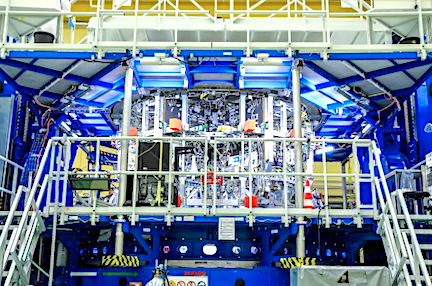
ESM-3 under final integration in the cleanroom at Airbus in Bremen. – Copyright Airbus2023 –

The ESM is a critical element of NASA’s crewed Orion spaceship as it provides the spacecraft’s main propulsion system while also enabling orbital maneuvering and positioning control. Electrical power generation and distribution are also provided by the ESM along with supplying the crew with the central elements of life support such as water and oxygen. The ESM also regulates thermal control while it is connected to the crew module. In addition, the unpressurized service module can be used to carry additional payloads. ESA has invested about €2 billion in the Orion program and contracted Airbus to lead the European consortium and build six ESMs to date.

2022 saw the first Artemis mission with the first Orion spacecraft powered by the ESM-1. The spacecraft traveled more than 2 million kilometers, was exposed to a temperature range wider than 200°C and flew at a maximum speed of 40,000 km/h (or 11 km/s). All systems were tested and performed well and reliable, some even better than expected.

ESM-2 was delivered to Florida in October 2021. It is now being tested and integrated at the Kennedy Space Center. It will be part of the crewed Artemis II Mission, which will fly the first astronauts around the Moon and back to Earth since 1972. The Artemis II launch is currently planned for 2024.

ESM-3, undergoing final integration, will power the Artemis III Mission, set to see the first woman and first person of color setting foot on the Moon. The delivery of ESM-3 is planned for the second half of 2023. This mission is envisaged for no earlier than 2025.
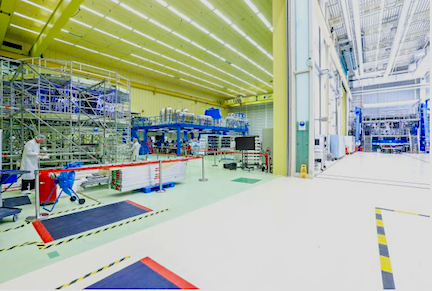
ESM-3, -4 and -5 in the cleanroom at Airbus in Bremen
– Copyright Airbus2023 –

The ESM-4 structure arrived at Airbus’ Bremen cleanroom in June 2022 and is currently being integrated. The recently arrived ESM-5 structure is already being worked on.

ESMs 4, 5 and 6 will be used for the Artemis IV to VI missions, the first two of which are part of the European contribution to the international Gateway, a space station planned to be assembled in lunar orbit. ESA and NASA are aiming to establish a Moon ecosystem (Gateway, Argonaut) to better understand and explore all the Moon has to offer and in the longer-term to prepare for crewed missions to Mars.

Further ESMs 7, 8 and 9 were authorized at the ESA ministerial council in November 2022, and Airbus is currently finalizing its offer to provide them.

The Orion ESM is cylindrical in shape and approximately four meters in diameter and height. At launch, it weighs just over 13 tonnes, making up roughly 60% of the Orion spacecraft’s total mass. Its 8.6 tonnes of fuel power the main engine, eight auxiliary thrusters and 24 smaller thrusters used for attitude control. The European Service Module is installed underneath the crew module at Kennedy Space Center in the USA. Together, they form the Orion spacecraft.

Airbus engineers produce the ESMs together with ESA and industry partners, including suppliers from 10 countries. ESM manufacturing builds on Airbus’ experience gained on the Automated Transfer Vehicle (ATV), which flew five times to the ISS between 2008 and 2015.

Artemis I was the first in a series of increasingly complex missions to provide a foundation for human exploration in deep space and a major step toward returning astronauts to the Moon with Europe as a leading player in humankind’s greatest space adventure to date.

This first flight was a huge source of information and all mission objectives linked to the ESM were fully achieved. Initial evaluation of the test data has confirmed that the Orion spacecraft consumed much less propellant and electrical power, while producing much more power than calculated. The propulsion subsystem performed as expected delivering the thrust for precise orbital maneuvers and vehicle attitude control. The good performance of the propulsion system allowed the execution of additional flight test objectives to better characterizxe the vehicle. The ESM main engine was fired multiple times with an accumulated total burn duration of 10 minutes, as planned. NASA has confirmed that the overall mission performance achieved was above expectations with almost 2 tonnes of propellant remaining at the end of mission. This will allow future missions of longer duration or higher mass (e.g. Gateway modules being transported by ESM). Most impressively, the solar arrays generated 15% more electrical power than specified. At the same time, the spacecraft consumed less electricity due to smaller fluctuations in temperature than expected.

Filed Under: Contracts & Commercial Deals, Exploration & Science Missions

Primary Sidebar

Coverage

  • Missions & Constellations
  • Business & Finance
  • Military & Defense
  • Launch
  • Software Automation & Ground Systems
  • Government & Regulation
  • Services & Applications

Most Read Stories

  • AT&T, T-Mobile, and Verizon Form Joint Venture to Standardize Satellite Direct-to-Device Connectivity
  • SpaceX Acquires Grain Management’s 800 MHz Spectrum Portfolio to Launch Standalone Starlink Mobile Carrier
  • SpaceX Unveils 250 kW Starlink Gen3 AI Satellites Featuring 10 Tbps Throughput and Onboard Edge Compute
  • FCC Grants SpaceX Approval for 15,000-Satellite Very Low Earth Orbit Direct-to-Device Constellation
  • Rocket Lab Challenges NASA’s $700M Mars Orbiter Award to Blue Origin While Scaling Vertical Integration via $8B Iridium Acquisition

Secondary Sidebar

Footer


Satnews is a leading provider of satellite news, events, publications, research and other satellite industry information in both commercial and military enterprises worldwide.

Stories By Category

  • Business & Finance
  • Government & Regulation
  • Launch
  • Military & Defense
  • Missions & Constellations
  • Services & Applications
  • Software Automation & Ground Systems
  • Spectrum & Licensing
  • Startups & NewSpace Business

About Us

  • Leadership & Editorial Team
  • SatNews History
  • Free Satnews Subscription
  • SatNews Events
  • Magazines

Navigation

  • Latest Stories
  • Magazines
  • Events
  • Contact
  • Cookie & Privacy Policy for Satnews

We use cookies to ensure that we give you the best experience on our website. If you continue to use this site we will assume that you are happy with it.
x
Sign up Now (For Free)
Access daily or weekly satellite news updates covering all aspects of the commercial and military satellite industry.
Invalid email address
Notify Me Regarding ( At least one ):
We value your privacy and will not sell or share your email or other information with any other company. You may also unsubscribe at anytime.

Click Here to see our full privacy policy.
Thanks for subscribing!