

• Skip to primary navigation
  • Skip to main content
  • Skip to primary sidebar
  • Skip to secondary sidebar
  • Skip to footer
  • NEWS:
  • SatNews
  • SatMagazine
  • MilSatMagazine
  • SmallSat News
  • |     EVENTS:
  • SmallSat Symposium
  • Satellite Innovation
  • MilSat Symposium
  • SmallSat Europe

SatNews

Satellite Industry Intelligence Since 1983

Subscribe
  • LATEST
  • SatNews Events
  • Magazines
  • Calendar
  • Subscribe
  • Missions & Constellations
    • Exploration & Science Missions
    • In-Orbit Servicing & Orbital Operations
    • LEO Constellations
    • Mission Autonomy & Onboard Systems
    • Mission Deployments & Manifests
    • Navigation & PNT
    • SmallSat
    • Spacecraft & Payload Technology
    View All in Missions & Constellations →
    NanoAvionics to Launch Trio of Milestone Payloads on SpaceX CAS500-2 MissionNanoAvionics to Launch Trio of Milestone Payloads on SpaceX CAS500-2 Mission
    Satellite Connectivity Becomes the New Anchor for a Fragmenting Wearables MarketSatellite Connectivity Becomes the New Anchor for a Fragmenting Wearables Market
    AI Investments in Extreme Environment Materials Surpass $262 MillionAI Investments in Extreme Environment Materials Surpass $262 Million
    Air Inuit Modernizes Operations with SKYTRAC TrooTrax Mission SoftwareAir Inuit Modernizes Operations with SKYTRAC TrooTrax Mission Software
  • Business
    • Contracts & Commercial Deals
    • Earnings & Financial Reporting
    • Events & Conferences
    • Funding & Venture Capital
    • Market Forecasts
    • Mergers & Acquisitions
    • Personnel Moves & Appointments
    View All in Business & Finance →
    HTX and ST Engineering Launch Space Tech Program for Singapore Public SafetyHTX and ST Engineering Launch Space Tech Program for Singapore Public Safety
    SmallSat Europe Speaker Focus: Tanja Masson-Zwaan, Leiden UniversitySmallSat Europe Speaker Focus: Tanja Masson-Zwaan, Leiden University
    HawkEye 360 Files for Initial Public Offering at $2.4 Billion ValuationHawkEye 360 Files for Initial Public Offering at $2.4 Billion Valuation
    SmallSat Europe Speaker Focus: Jean-François Morizur, CailabsSmallSat Europe Speaker Focus: Jean-François Morizur, Cailabs
  • Defense
    • Counterspace & ASAT
    • Defense Budgets & Procurement
    • ISR & Reconnaissance
    • MILSATCOM
    • Missile Warning & Defense
    • National Security Programs
    • Space Domain Awareness
    View All in Military & Defense →
    BAE Systems Enters Production for NavGuide M-Code GPS ReceiverBAE Systems Enters Production for NavGuide M-Code GPS Receiver
    Space Force Awards $3.2 Billion in Golden Dome Contracts for Orbital Interceptor ConstellationSpace Force Awards $3.2 Billion in Golden Dome Contracts for Orbital Interceptor Constellation
    USSF Finalizes GPS III Constellation with Successful SV-10 DeploymentUSSF Finalizes GPS III Constellation with Successful SV-10 Deployment
    Meink: Space Force Programs Ready to Execute Once FY27 Budget LandsMeink: Space Force Programs Ready to Execute Once FY27 Budget Lands
  • Gov
    • Export Controls & Compliance
    • International Space Agreements
    • National Space Policy
    • Space Law & Treaties
    • Space Sustainability & Debris Policy
    • Space Traffic Management / Debris Removal
    View All in Government & Regulation →
    How CubeSat Proliferation is Redefining Sovereignty and Diplomatic Leverage at the United NationsHow CubeSat Proliferation is Redefining Sovereignty and Diplomatic Leverage at the United Nations
    FCC Modernization of Spectrum Rules Unlocks Sevenfold Gain in Satellite CapacityFCC Modernization of Spectrum Rules Unlocks Sevenfold Gain in Satellite Capacity
    The Smartest Money in the Room Is Looking UpThe Smartest Money in the Room Is Looking Up
    NASA’s Shift to CLPS 2.0 Signals Structural Transformation of Lunar Logistics MarketNASA’s Shift to CLPS 2.0 Signals Structural Transformation of Lunar Logistics Market
  • Launch
    • Launch Providers
    • Launch Schedule & Calendars
    • Launch Sites & Infrastructure
    • Rocket Technology & Vehicles
    View All in Launch →
    Astrobotic Achieves Record 300-Second Burn with New Detonation EngineAstrobotic Achieves Record 300-Second Burn with New Detonation Engine
    Bad news, but good news followedBad news, but good news followed
    Rocket Lab Successfully Launches “Kakushin Rising” Mission for JAXARocket Lab Successfully Launches “Kakushin Rising” Mission for JAXA
    Blue Origin CEO Attributes BlueBird 7 Satellite Loss to Second-Stage Thrust AnomalyBlue Origin CEO Attributes BlueBird 7 Satellite Loss to Second-Stage Thrust Anomaly
  • Software
    • Autonomous Ground Operations
    • Data Processing & AI/ML
    • Digital Twins & Modeling
    • Ground Segment & Teleports
    • Mission Planning & Simulation
    • Space Systems Software Engineering
    • Spectrum & Licensing
    View All in Software Automation & Ground Systems →
    SmallSat Europe Speaker Focus: Giovanni Pandolfi Bortoletto, Leaf SpaceSmallSat Europe Speaker Focus: Giovanni Pandolfi Bortoletto, Leaf Space
    SpinLaunch Selects Equinix to Deploy Global Ground Infrastructure for Meridian Space ConstellationSpinLaunch Selects Equinix to Deploy Global Ground Infrastructure for Meridian Space Constellation
    RF-Design Launches FiberLink CompactLine FCLR1811S4 for Ground Segment OptimizationRF-Design Launches FiberLink CompactLine FCLR1811S4 for Ground Segment Optimization
    Sat-Lite Technologies adds  Richard Rader to Spearhead Sales ExpansionSat-Lite Technologies adds Richard Rader to Spearhead Sales Expansion
  • Services & Apps
    • Climate & Environmental Monitoring
    • Disaster Response & Security Mapping
    • Earth Observation & Imaging
    • Maritime & Aviation Satcom
    • Satellite Communications
    View All in Services & Applications →
    Solstar Confirms Successful On-Orbit Operation of Deke Space Communicator Following Launch on SpaceX Transporter-16 MissionSolstar Confirms Successful On-Orbit Operation of Deke Space Communicator Following Launch on SpaceX Transporter-16 Mission
    IEC Telecom Unveils Voucher-Based Connectivity Solution at Singapore Maritime Week 2026IEC Telecom Unveils Voucher-Based Connectivity Solution at Singapore Maritime Week 2026
    GomSpace and STETMAN Establish UASAT Joint Venture for Ukrainian Sovereign CommunicationsGomSpace and STETMAN Establish UASAT Joint Venture for Ukrainian Sovereign Communications
    Market Dynamics and Non-Terrestrial Network (NTN) ChipsetsMarket Dynamics and Non-Terrestrial Network (NTN) Chipsets

Methane satellites will be watching California’s dairies…but mostly its oil fields and landfills

August 23, 2022

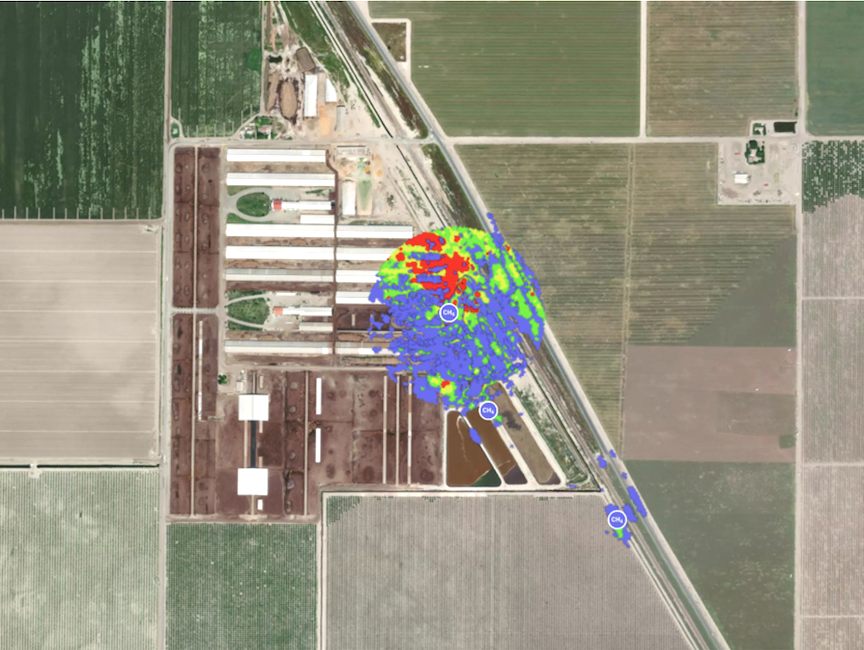
A methane plume emerges from a dairy in the San Joaquin Valley. (photo: Carbon Mapper)

California is doubling down on its spending for launching new satellites to capture images of methane leaks throughout the state. But the dairy sector—long in the regulatory crosshairs for climate emissions—is taking a backseat on this space mission, according to some sources.

The state budget has allocated $100 million in revenue from California’s cap-and-trade program to invest in expanding the number of satellites launched for methane observations. The information gathered from the monitoring enables the Air Resources Board (CARB) to identify the sources of these emissions and hold polluters accountable for violations. It also advances the state’s goals for reducing the short-lived climate pollutant—a way to slash the overall impact of greenhouse gas emissions more quickly than through carbon dioxide emissions, which linger in the atmosphere longer and are more prominent but less potent.

According to researchers at UC Davis, Agriculture contributes just 11% of the total GHG emissions in the U.S., making it the smallest GHG emissions contributor of any sector tracked by the Environmental Protection Agency. Of the 11% of GHG emissions from agriculture, research indicates about 3% of agricultural GHG emissions come from livestock, according to a blog post.

But, according to CalEPA Secretary Jared Blumenfeld, who lauded the governor’s proposal in May, the “most egregious methane leaks” are “destroying our climate and polluting our communities.”

Dairies initially stood at the center of CARB’s efforts to survey methane emissions. In 2016 the agency collaborated with NASA’s Jet Propulsion Laboratory, University of Arizona scientists and the California Energy Commission to outfit planes with sensitive remote sensing cameras—a technology 30 years in the making.

After surveying more than 300,000 pieces of infrastructure, they found that less than 2% of those facilities were responsible for as much as half of the state’s entire contribution of methane emissions. A subsequent study in 2019 pointed to landfills as the largest contributor, at 41 percent, while dairies and the oil and gas sector tied for second, with 26% each.

Detecting and repairing those initial leaks was the low-hanging fruit in solving the problem, according to Riley Duran, a research scientist and CEO of Carbon Mapper, a nonprofit organization leading public-private partnerships in this area. Speaking at a State Board of Food and Agriculture hearing this month, Duran explained how the effort boils down to two types of emissions.

Oil and gas production, natural gas transmission lines, landfills and wastewater treatment plants make up high-emission point sources—along with confined animal feeding operations, particularly those involving wet manure management. Area emissions, meanwhile, would include enteric fermentation from hundreds of head of cattle that may independently emit relatively small amounts through belching but collectively produce a significant source. Tracking down such sources in agriculture is less about fixing leaks—though dairy digesters capturing that methane do leak on occasion—and more about understanding systemic challenges across the sector.

After the initial flyovers in the pilot program, CARB notified facility operators of the leaks and about 40 of those operations immediately cut their emissions. The voluntary repair actions led to a reduction in enough methane to equal nearly 1.5 million metric tons of carbon dioxide emissions.

CARB shared the initial findings with the dairy sector as well. Follow-up flights over the San Joaquin Valley last fall showed that newly constructed digesters have led to substantial reductions. Of the many high-emitting dairies pinpointed in 2016, only a handful of plumes are still active, according to preliminary findings Duran shared.

Now Carbon Mapper and its partners across 15 states are looking to scale up the effort and expand into space. With the commercial satellite company Planet Labs and through philanthropic funding, Carbon Mapper plans to launch two methane satellites in late 2023.

“We’re in a hurry to do something about this,” said Duran. “Rather than try to fit this into existing federal research programs, we went out and sought and secured philanthropic funding to launch our satellites.”

In its search for dollars, the organization touts leading figures in the field on its board of directors, with former CARB Chair Mary Nichols and CARB’s recently retired executive officer, Richard Corey.

Meanwhile, the $100 million in state spending triggered concerns in the Legislature in May about the potential return on investment, indicating apprehension even within one of the nation’s most climate-forward governments. Sen. Bob Wieckowski of Fremont, who chairs a budget subcommittee, questioned why the state should spend so much on a technology that may or may not bring down emissions indirectly, when it could spend that on dairy digesters, a technology known to reduce emissions more than any other state program.

Yet headlines over major leaks and oil spills in California have solidified public sentiment around the issue. Realtime satellite monitoring would have quickly detected the massive Aliso Canyon rupture in 2015, when a natural gas pipeline released 109,000 metric tons of methane into the atmosphere.

The satellites present an opportunity to tackle more shovel-ready projects like repairing oil and gas leaks, which is why dairies are not a major focus in the latest prototyping from CARB, according to Duran.

“If they know where it is, in many cases they can fix it the next day,” he said. “It doesn’t require a big investment.”

The technology also allows CARB to monitor a much wider area from space and fifth generation instruments will capture more detail than the planes were able to. An average consumer camera captures light in three colors, explained Duran, but the satellite cameras will cover nearly 500 colors and at the same time quantify the amount of gas in the atmosphere.

The opportunities for monitoring greenhouse gas emissions have also piqued the interest of Vice President Kamala Harris, who visited the Chabot Space and Science Center in Oakland last week to announce a new public-private partnership for commercial space flight.

“Soon a new generation of satellites will help us fight the climate crisis by tracking and allowing us to see the patterns of greenhouse gas emissions and to see that in real time,” said Harris.

From Agri-Pulse
By Sara Wyant and Brad Hooker

Filed Under: Earth Observation & Imaging, Exploration & Science Missions

Primary Sidebar

Coverage

  • Missions & Constellations
  • Business & Finance
  • Military & Defense
  • Launch
  • Software Automation & Ground Systems
  • Government & Regulation
  • Services & Applications

Most Read Stories

  • SpaceX Loses Contact With Starlink Satellite
  • Planet Labs Imposes Indefinite Blackout on Iran Satellite Imagery at U.S. Request
  • Amazon in Reported Talks to Acquire Globalstar in $9 Billion Move to Challenge Starlink
  • What the SpaceX IPO Changes for Every Satellite Operator
  • Russia Replaces Starlink With European-Built Satellites

Secondary Sidebar

Footer


Satnews is a leading provider of satellite news, events, publications, research and other satellite industry information in both commercial and military enterprises worldwide.

Stories By Category

  • Business & Finance
  • Government & Regulation
  • Launch
  • Military & Defense
  • Missions & Constellations
  • Services & Applications
  • Software Automation & Ground Systems
  • Spectrum & Licensing
  • Startups & NewSpace Business

About Us

  • Leadership & Editorial Team
  • SatNews History
  • Free Satnews Subscription
  • SatNews Events
  • Magazines

Navigation

  • Latest Stories
  • Magazines
  • Events
  • Contact
  • Cookie & Privacy Policy for Satnews

We use cookies to ensure that we give you the best experience on our website. If you continue to use this site we will assume that you are happy with it.
x
Sign up Now (For Free)
Access daily or weekly satellite news updates covering all aspects of the commercial and military satellite industry.
Invalid email address
Notify Me Regarding ( At least one ):
We value your privacy and will not sell or share your email or other information with any other company. You may also unsubscribe at anytime.

Click Here to see our full privacy policy.
Thanks for subscribing!