

• Skip to primary navigation
  • Skip to main content
  • Skip to primary sidebar
  • Skip to secondary sidebar
  • Skip to footer
  • NEWS:
  • SatNews
  • SatMagazine
  • MilSatMagazine
  • SmallSat News
  • |     EVENTS:
  • SmallSat Symposium
  • Satellite Innovation
  • MilSat Symposium
  • SmallSat Europe

SatNews

Satellite Industry Intelligence Since 1983

Subscribe
  • LATEST
  • SatNews Events
  • Magazines
  • Calendar
  • Subscribe
  • Missions & Constellations
    • Exploration & Science Missions
    • In-Orbit Servicing & Orbital Operations
    • LEO Constellations
    • Mission Autonomy & Onboard Systems
    • Mission Deployments & Manifests
    • Navigation & PNT
    • SmallSat
    • Spacecraft & Payload Technology
    View All in Missions & Constellations →
    Rohde & Schwarz Introduces Pulsar Signal Simulation to Advance Next-Gen PNT TestingRohde & Schwarz Introduces Pulsar Signal Simulation to Advance Next-Gen PNT Testing
    China Accelerates Orbital Internet Deployment with Successful Smart Dragon-3 Sea LaunchChina Accelerates Orbital Internet Deployment with Successful Smart Dragon-3 Sea Launch
    Smallsats Dominate 2025 Launch Landscape as Mass Efficiency PeaksSmallsats Dominate 2025 Launch Landscape as Mass Efficiency Peaks
    MIT STAR Lab Expands Scope from Lasercom Innovation to Space Policy ArchitectureMIT STAR Lab Expands Scope from Lasercom Innovation to Space Policy Architecture
  • Business
    • Contracts & Commercial Deals
    • Earnings & Financial Reporting
    • Events & Conferences
    • Funding & Venture Capital
    • Market Forecasts
    • Mergers & Acquisitions
    • Personnel Moves & Appointments
    View All in Business & Finance →
    Global Defense Leaders Convene as Space Symposium 41 Addresses Orbital SecurityGlobal Defense Leaders Convene as Space Symposium 41 Addresses Orbital Security
    SmallSat Europe Speaker Focus: Chris Quilty, Quilty SpaceSmallSat Europe Speaker Focus: Chris Quilty, Quilty Space
    “SpaceX and the biggest IPO in history”“SpaceX and the biggest IPO in history”
    SmallSat Europe Speaker Focus: Chiara Manfletti, NeuraspaceSmallSat Europe Speaker Focus: Chiara Manfletti, Neuraspace
  • Defense
    • Counterspace & ASAT
    • Defense Budgets & Procurement
    • ISR & Reconnaissance
    • MILSATCOM
    • Missile Warning & Defense
    • National Security Programs
    • Space Domain Awareness
    View All in Military & Defense →
    NRL to Showcase Sovereign Space Capabilities at 41st Space SymposiumNRL to Showcase Sovereign Space Capabilities at 41st Space Symposium
    Northrop Grumman Minotaur IV Lofted USSF Tech Demonstration Payloads to OrbitNorthrop Grumman Minotaur IV Lofted USSF Tech Demonstration Payloads to Orbit
    The End of the VSAT Parts BinThe End of the VSAT Parts Bin
    Procurement Lag vs. Conflict Speed: Can Defense Buying Cycles Keep Up with Space Innovation?Procurement Lag vs. Conflict Speed: Can Defense Buying Cycles Keep Up with Space Innovation?
  • Gov
    • Export Controls & Compliance
    • International Space Agreements
    • National Space Policy
    • Space Law & Treaties
    • Space Sustainability & Debris Policy
    • Space Traffic Management / Debris Removal
    View All in Government & Regulation →
    FCC Modernizes Satellite Spectrum Rules to Unleash Next-Generation BroadbandFCC Modernizes Satellite Spectrum Rules to Unleash Next-Generation Broadband
    SmallSat Europe Speaker Focus: Daniel Bock, Morpheus SpaceSmallSat Europe Speaker Focus: Daniel Bock, Morpheus Space
    SmallSat Europe Speaker Focus: Dr. Ane Aanesland, ThrustMeSmallSat Europe Speaker Focus: Dr. Ane Aanesland, ThrustMe
    Isaacman’s Budget Math: How NASA Plans to Reach the Moon With a Quarter Less MoneyIsaacman’s Budget Math: How NASA Plans to Reach the Moon With a Quarter Less Money
  • Launch
    • Launch Providers
    • Launch Schedule & Calendars
    • Launch Sites & Infrastructure
    • Rocket Technology & Vehicles
    View All in Launch →
    What the SpaceX IPO Changes for Every Satellite OperatorWhat the SpaceX IPO Changes for Every Satellite Operator
    €30 million Financing for PLD Space’s Small Satellite Launcher€30 million Financing for PLD Space’s Small Satellite Launcher
    Satellite Deployers to be Used on JAXA Small Satellite Mission by ExolaunchSatellite Deployers to be Used on JAXA Small Satellite Mission by Exolaunch
    CAS Space Successfully Launches Kinetica-2, Aiming for Global Cost LeadershipCAS Space Successfully Launches Kinetica-2, Aiming for Global Cost Leadership
  • Software
    • Autonomous Ground Operations
    • Data Processing & AI/ML
    • Digital Twins & Modeling
    • Ground Segment & Teleports
    • Mission Planning & Simulation
    • Space Systems Software Engineering
    • Spectrum & Licensing
    View All in Software Automation & Ground Systems →
    Cloudcomputing Targets 1.5M Identities in Spain and Finalizes Innovate IT AcquisitionCloudcomputing Targets 1.5M Identities in Spain and Finalizes Innovate IT Acquisition
    Archangel Lightworks Secures £10M Series A to Scale Optical Ground InfrastructureArchangel Lightworks Secures £10M Series A to Scale Optical Ground Infrastructure
    Keysight and Sateliot Win ESA and GSMA Foundry Challenge for 6G InnovationKeysight and Sateliot Win ESA and GSMA Foundry Challenge for 6G Innovation
    Automation and Agility: How SSC Space Go is Designed for the New Age of GroundAutomation and Agility: How SSC Space Go is Designed for the New Age of Ground
  • Services & Apps
    • Climate & Environmental Monitoring
    • Disaster Response & Security Mapping
    • Earth Observation & Imaging
    • Maritime & Aviation Satcom
    • Satellite Communications
    View All in Services & Applications →
    Kraken Robotics Integrates KATFISH Sonar on SEFINE RD-22 USV Following Multi-Naval DemonstrationsKraken Robotics Integrates KATFISH Sonar on SEFINE RD-22 USV Following Multi-Naval Demonstrations
    Astroscale Plans World-First Multi-Orbit Satellite Inspection MissionAstroscale Plans World-First Multi-Orbit Satellite Inspection Mission
    The Downlink Deficit: The Pentagon’s Optical Mesh Network and the Terrestrial BottleneckThe Downlink Deficit: The Pentagon’s Optical Mesh Network and the Terrestrial Bottleneck
    Cinemo Reimagines the Vehicle as a Software-Defined Entertainment HubCinemo Reimagines the Vehicle as a Software-Defined Entertainment Hub

NASA’s MAVEN spacecraft exits safe mode + goes with stellar navigation

June 5, 2022

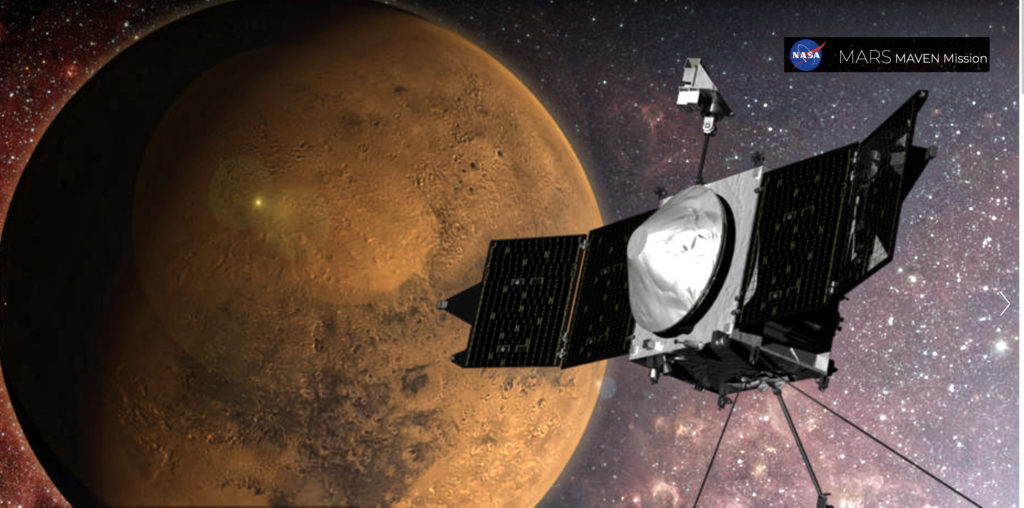
Artistic rendition of NASA’s MAVEN spacecraft orbiting Mars. Image is courtesy of NASA.

NASA’s Mars Atmosphere and Volatile EvolutioN, or MAVEN, mission returned to normal science and relay operations on May 28, 2022, after recovering from an extended safe mode event. The spacecraft encountered problems in February with its Inertial Measurement Units (IMUs). The mission team successfully diagnosed the issue with these navigation instruments and developed a system for the spacecraft to navigate by the stars, which should allow for continued MAVEN mission operations through the next decade.
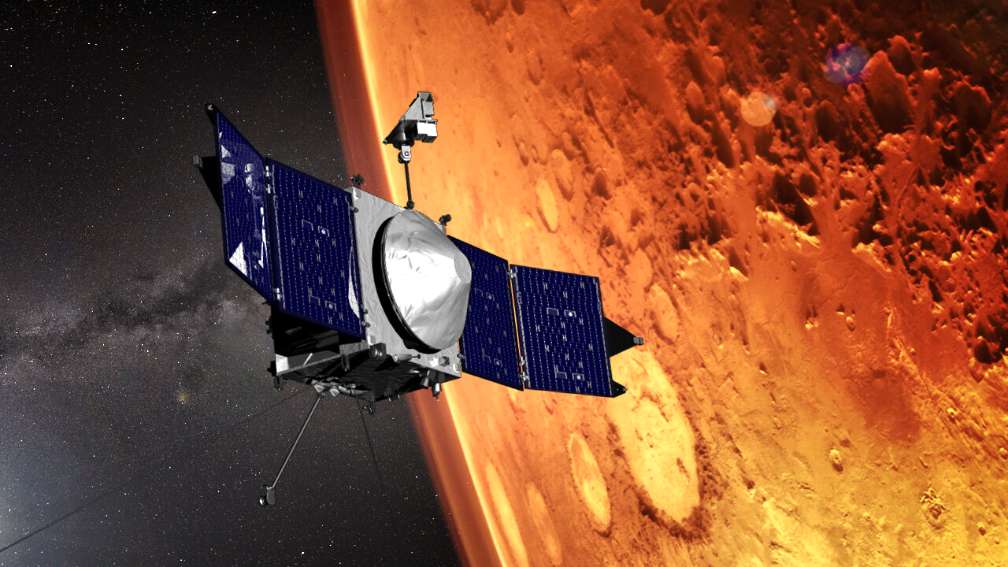
This illustration shows the MAVEN spacecraft and the limb of Mars. Image credits: NASA/GSFC

MAVEN launched in November 2013 and entered orbit around Mars in September 2014. The mission’s goal is to explore the planet’s upper atmosphere, ionosphere and interactions with the Sun and solar wind to explore the loss of the Martian atmosphere to space. Understanding atmospheric loss gives scientists insight into the history of Mars’ atmosphere and climate, liquid water, and planetary habitability. MAVEN’s primary mission was one year in duration. It has since far surpassed that and was recently approved for its fifth extended mission.

“This was a critical challenge facing the mission, but thanks to the work of our spacecraft and operations team, MAVEN will continue producing important science and operating as a relay for the surface assets through the end of the decade,” said Shannon Curry, MAVEN’s principal investigator at the University of California, Berkeley. “I couldn’t be prouder of our team.”

On Tuesday, February 22, 2022, the team lost contact with the spacecraft after it performed a routine scheduled power cycle of IMU-1. IMUs are used to determine the spacecraft’s attitude in space by measuring its rate of rotation. MAVEN has two identical IMUs on board: IMU-1 is the primary unit, and IMU-2 is the back-up unit.

Once contact with the spacecraft was restored, engineering telemetry showed that the spacecraft was unable to determine its attitude from either IMU. In response, the spacecraft performed a computer reboot but could still not determine its orientation. As a last resort, the spacecraft swapped to the backup computer, which allowed MAVEN to get accurate readings from IMU-2. The spacecraft entered “safe mode,” where it ceased all planned activities, including science and relay operations, and awaited further instructions from the ground.

The team had already been working to develop all-stellar mode – a system to navigate by the stars without IMUs – to be implemented in October of 2022 because IMU-1 had previously shown anomalies and IMU-2 was nearing the end of its lifespan. The development and switch to all-stellar mode is a standard practice when IMUs degrade on aging orbiters.

“This was a situation that no one initially anticipated, but the spacecraft performed as designed,” said Micheal Haggard, the Lockheed Martin MAVEN spacecraft team lead in Littleton, Colorado. “By the time we ended up on the backup computer, the spacecraft had been attempting to fix the problem with IMU-1 for about 78 minutes. We ended up on IMU-2, and the pressure was on to get the all-stellar mode ready as quickly as possible.”

In the following months, the spacecraft team at Lockheed Martin worked to expedite the development of software to enable all-stellar mode, since the predicted lifetime of IMU-2 would not last until October. On April 19, five months ahead of schedule, the spacecraft team completed development and uplinked the software patch to MAVEN. As soon as the code was uplinked, IMU-2 was powered off, preserving its remaining life for future spacecraft needs. Following the uplink, a series of tests were performed to verify the functionality of all-stellar mode, since the code had not previously been tested in flight.

“The team really stepped up to an existential threat,” said Rich Burns, the MAVEN project manager at NASA’s Goddard Space Flight Center in Greenbelt, Maryland. “When we recognized in the fall that IMU-2 was degrading, we knew we were going to have to shorten the schedule for all-stellar mode. The spacecraft team rose to the challenge, working under intense pressure after the anomaly.”

Once all-stellar mode was uplinked, the spacecraft and science teams powered on the instruments and configured them for science operation. All instruments were healthy and successfully resumed observations; however, the spacecraft was constrained to pointing at the Earth until testing of all-stellar mode was completed, so the instruments were not oriented as they normally would be during science operations. Nevertheless, some limited science was still possible, and MAVEN even observed a coronal mass ejection impact Mars less than two days after the instruments were powered on.

MAVEN returned to nominal science and relay operations on Saturday, May 28, 2022, after successfully transitioning to full all-stellar navigation.

The MAVEN spacecraft continues to operate successfully using all-stellar mode. Typically, there are certain times each year that IMUs must be used, so the team will need to continue finding innovative ways to control the spacecraft’s orientation. This will ensure that MAVEN can keep operating through its extended mission lifetime, which will enable the orbiter to continue to make observations during the most extreme conditions in the Martian atmosphere that the mission has so far encountered.

MAVEN’s principal investigator is based at the University of California, Berkeley, while NASA’s Goddard Space Flight Center in Greenbelt, Maryland, manages the MAVEN mission. Lockheed Martin Space built the spacecraft and is responsible for mission operations. NASA’s Jet Propulsion Laboratory in Pasadena, California, provides navigation and Deep Space Network support. The Laboratory for Atmospheric and Space Physics at the University of Colorado Boulder is responsible for managing science operations and public outreach and communication

Article author: Willow Reed, MAVEN Communications Lead Laboratory for Atmospheric and Space Physics, University of Colorado Boulder

Filed Under: Exploration & Science Missions, Government & Regulation

Primary Sidebar

Coverage

  • Missions & Constellations
  • Business & Finance
  • Military & Defense
  • Launch
  • Software Automation & Ground Systems
  • Government & Regulation
  • Services & Applications

Most Read Stories

  • L3Harris Unveils XL-300P: The First P25 Handheld with 5G and Satellite Direct-to-Device Connectivity
  • SpaceX Loses Contact With Starlink Satellite
  • Rheinmetall Walked Away. Germany Should Take the Hint.
  • Rocket Lab Emerging as Potential Bus Provider for 2,800-Satellite Equatys Constellation
  • SpaceX Accelerates Record-Breaking IPO Following Trillion-Dollar xAI Merger

Secondary Sidebar

Footer


Satnews is a leading provider of satellite news, events, publications, research and other satellite industry information in both commercial and military enterprises worldwide.

Stories By Category

  • Business & Finance
  • Government & Regulation
  • Launch
  • Military & Defense
  • Missions & Constellations
  • Services & Applications
  • Software Automation & Ground Systems
  • Spectrum & Licensing
  • Startups & NewSpace Business

About Us

  • Leadership & Editorial Team
  • SatNews History
  • Free Satnews Subscription
  • SatNews Events
  • Magazines

Navigation

  • Latest Stories
  • Magazines
  • Events
  • Contact
  • Cookie & Privacy Policy for Satnews

We use cookies to ensure that we give you the best experience on our website. If you continue to use this site we will assume that you are happy with it.
x
Sign up Now (For Free)
Access daily or weekly satellite news updates covering all aspects of the commercial and military satellite industry.
Invalid email address
Notify Me Regarding ( At least one ):
We value your privacy and will not sell or share your email or other information with any other company. You may also unsubscribe at anytime.

Click Here to see our full privacy policy.
Thanks for subscribing!