


• Skip to primary navigation
  • Skip to main content
  • Skip to primary sidebar
  • Skip to secondary sidebar
  • Skip to footer
  • NEWS:
  • SatNews
  • SatMagazine
  • MilSatMagazine
  • SmallSat News
  • |     EVENTS:
  • SmallSat Symposium
  • Satellite Innovation
  • MilSat Symposium
  • SmallSat Europe

SatNews

Satellite Industry Intelligence Since 1983

Subscribe
  • LATEST
  • SatNews Events
  • Magazines
  • Calendar
  • Subscribe
  • Missions & Constellations
    • Exploration & Science Missions
    • In-Orbit Servicing & Orbital Operations
    • LEO Constellations
    • Mission Autonomy & Onboard Systems
    • Mission Deployments & Manifests
    • Navigation & PNT
    • SmallSat
    • Spacecraft & Payload Technology
    View All in Missions & Constellations →
    Rohde & Schwarz Introduces Pulsar Signal Simulation to Advance Next-Gen PNT TestingRohde & Schwarz Introduces Pulsar Signal Simulation to Advance Next-Gen PNT Testing
    China Accelerates Orbital Internet Deployment with Successful Smart Dragon-3 Sea LaunchChina Accelerates Orbital Internet Deployment with Successful Smart Dragon-3 Sea Launch
    Smallsats Dominate 2025 Launch Landscape as Mass Efficiency PeaksSmallsats Dominate 2025 Launch Landscape as Mass Efficiency Peaks
    MIT STAR Lab Expands Scope from Lasercom Innovation to Space Policy ArchitectureMIT STAR Lab Expands Scope from Lasercom Innovation to Space Policy Architecture
  • Business
    • Contracts & Commercial Deals
    • Earnings & Financial Reporting
    • Events & Conferences
    • Funding & Venture Capital
    • Market Forecasts
    • Mergers & Acquisitions
    • Personnel Moves & Appointments
    View All in Business & Finance →
    Global Defense Leaders Convene as Space Symposium 41 Addresses Orbital SecurityGlobal Defense Leaders Convene as Space Symposium 41 Addresses Orbital Security
    SmallSat Europe Speaker Focus: Chris Quilty, Quilty SpaceSmallSat Europe Speaker Focus: Chris Quilty, Quilty Space
    “SpaceX and the biggest IPO in history”“SpaceX and the biggest IPO in history”
    SmallSat Europe Speaker Focus: Chiara Manfletti, NeuraspaceSmallSat Europe Speaker Focus: Chiara Manfletti, Neuraspace
  • Defense
    • Counterspace & ASAT
    • Defense Budgets & Procurement
    • ISR & Reconnaissance
    • MILSATCOM
    • Missile Warning & Defense
    • National Security Programs
    • Space Domain Awareness
    View All in Military & Defense →
    NRL to Showcase Sovereign Space Capabilities at 41st Space SymposiumNRL to Showcase Sovereign Space Capabilities at 41st Space Symposium
    Northrop Grumman Minotaur IV Lofted USSF Tech Demonstration Payloads to OrbitNorthrop Grumman Minotaur IV Lofted USSF Tech Demonstration Payloads to Orbit
    The End of the VSAT Parts BinThe End of the VSAT Parts Bin
    Procurement Lag vs. Conflict Speed: Can Defense Buying Cycles Keep Up with Space Innovation?Procurement Lag vs. Conflict Speed: Can Defense Buying Cycles Keep Up with Space Innovation?
  • Gov
    • Export Controls & Compliance
    • International Space Agreements
    • National Space Policy
    • Space Law & Treaties
    • Space Sustainability & Debris Policy
    • Space Traffic Management / Debris Removal
    View All in Government & Regulation →
    FCC Modernizes Satellite Spectrum Rules to Unleash Next-Generation BroadbandFCC Modernizes Satellite Spectrum Rules to Unleash Next-Generation Broadband
    SmallSat Europe Speaker Focus: Daniel Bock, Morpheus SpaceSmallSat Europe Speaker Focus: Daniel Bock, Morpheus Space
    SmallSat Europe Speaker Focus: Dr. Ane Aanesland, ThrustMeSmallSat Europe Speaker Focus: Dr. Ane Aanesland, ThrustMe
    Isaacman’s Budget Math: How NASA Plans to Reach the Moon With a Quarter Less MoneyIsaacman’s Budget Math: How NASA Plans to Reach the Moon With a Quarter Less Money
  • Launch
    • Launch Providers
    • Launch Schedule & Calendars
    • Launch Sites & Infrastructure
    • Rocket Technology & Vehicles
    View All in Launch →
    What the SpaceX IPO Changes for Every Satellite OperatorWhat the SpaceX IPO Changes for Every Satellite Operator
    €30 million Financing for PLD Space’s Small Satellite Launcher€30 million Financing for PLD Space’s Small Satellite Launcher
    Satellite Deployers to be Used on JAXA Small Satellite Mission by ExolaunchSatellite Deployers to be Used on JAXA Small Satellite Mission by Exolaunch
    CAS Space Successfully Launches Kinetica-2, Aiming for Global Cost LeadershipCAS Space Successfully Launches Kinetica-2, Aiming for Global Cost Leadership
  • Software
    • Autonomous Ground Operations
    • Data Processing & AI/ML
    • Digital Twins & Modeling
    • Ground Segment & Teleports
    • Mission Planning & Simulation
    • Space Systems Software Engineering
    • Spectrum & Licensing
    View All in Software Automation & Ground Systems →
    Cloudcomputing Targets 1.5M Identities in Spain and Finalizes Innovate IT AcquisitionCloudcomputing Targets 1.5M Identities in Spain and Finalizes Innovate IT Acquisition
    Archangel Lightworks Secures £10M Series A to Scale Optical Ground InfrastructureArchangel Lightworks Secures £10M Series A to Scale Optical Ground Infrastructure
    Keysight and Sateliot Win ESA and GSMA Foundry Challenge for 6G InnovationKeysight and Sateliot Win ESA and GSMA Foundry Challenge for 6G Innovation
    Automation and Agility: How SSC Space Go is Designed for the New Age of GroundAutomation and Agility: How SSC Space Go is Designed for the New Age of Ground
  • Services & Apps
    • Climate & Environmental Monitoring
    • Disaster Response & Security Mapping
    • Earth Observation & Imaging
    • Maritime & Aviation Satcom
    • Satellite Communications
    View All in Services & Applications →
    Kraken Robotics Integrates KATFISH Sonar on SEFINE RD-22 USV Following Multi-Naval DemonstrationsKraken Robotics Integrates KATFISH Sonar on SEFINE RD-22 USV Following Multi-Naval Demonstrations
    Astroscale Plans World-First Multi-Orbit Satellite Inspection MissionAstroscale Plans World-First Multi-Orbit Satellite Inspection Mission
    The Downlink Deficit: The Pentagon’s Optical Mesh Network and the Terrestrial BottleneckThe Downlink Deficit: The Pentagon’s Optical Mesh Network and the Terrestrial Bottleneck
    Cinemo Reimagines the Vehicle as a Software-Defined Entertainment HubCinemo Reimagines the Vehicle as a Software-Defined Entertainment Hub

A Rocket Lab Reveal: The Neutron Rocket + The Hungry Hippo

December 3, 2021

The well-produced Rocket Lab Neutron video with Peter Beck is available for viewing at this direct link…

Rocket Lab USA, Inc (Nasdaq: RKLB) has revealed new details about their next generation Neutron launch vehicle.

Neutron rocket specs revealed by Peter Beck.

This advanced, 8-ton, payload class Neutron launch vehicle is designed to transform space access by delivering reliable and cost-effective launch services for satellite mega-constellations, deep space missions and human spaceflight. During a live streamed Neutron update, Rocket Lab founder and CEO Peter Beck revealed new details about Neutron’s unique design, materials, propulsion, and reusability architecture for the first time.

Rocket Lab’s streaming presentation imagery.

Neutron will be the world’s first carbon composite large launch vehicle. Rocket Lab pioneered the use of carbon composite for orbital rockets with the Electron rocket, which has been delivering frequent and reliable access to space for government and commercial smallsats since 2018. Neutron’s structure will be comprised of a new, specially formulated carbon composite material that is lightweight, strong and can withstand the immense heat and forces of launch and re-entry again and again to enable frequent re-flight of the first stage. To enable rapid manufacturability, Neutron’s carbon composite structure will be made using an automated fiber placement system which can build meters of carbon rocket shell in minutes. 

Reusability is key to enabling frequent and affordable launch, so the ability to launch, land and lift-off again has been built into every aspect of Neutron’s design from day one. It starts with Neutron’s unique shape, a tapered rocket with a wide base to provide a robust, stable base for landing, eliminating the need for complex mechanisms and landing legs. This balanced structure also removes the need for bulky launch site infrastructure, including strongbacks and launch towers. Neutron will, instead, stand securely on its own legs for lift-off. After reaching space and deploying Neutron’s second stage, the first stage will return to Earth for a propulsive landing at the launch site, eliminating the high costs associated with ocean-based landing platforms and operations.

Artistic rendition of the Neutron rocket landing on its own legs.

Neutron will be powered by an entirely new rocket engine, Archimedes. Designed and manufactured in-house by Rocket Lab, Archimedes is a reusable liquid oxygen / methane gas generator cycle engine capable of 1 meganewton thrust and 320 seconds of ISP. Seven Archimedes engines will propel Neutron’s first stage, with a single vacuum optimized Archimedes engine on the second stage. Neutron’s lightweight carbon composite structure means Archimedes does not need the immense performance and complexity typically associated with larger rockets and their propulsion systems. By developing a simple engine with modest performance requirements, the timeline for development and testing can be drastically accelerated. 

Artistic rendition of Rocket Lab’s Archimedes rocket engine.

What makes Neutron’s design especially unique is the captive ‘Hungry Hippo’ fairing design. This innovative design will see the fairing form part of the first stage structure and remain fixed to the stage. Rather than separating from the stage and falling away to the ocean like traditional fairings, Neutron’s Hungry Hippo fairing jaws will open wide to release the second stage and payload, before closing again ready to return to Earth with the first stage. What lands back on the launch pad is a compete first stage with fairings attached, ready for a new second stage to be integrated and launched. This advanced design can speed up launch frequency, eliminates the high cost, low reliability method of capturing fairings at sea, and enables the second stage to be lightweight and nimble.

Screen capture of Neutron fairing opening to expel payload to orbit.

Thanks to Neutron’s ‘Hungry Hippo’ fairing design, the entire second stage will be completely enveloped within the Neutron’s first stage structure and fairing during launch. Thanks to this, Neutron’s second stage is designed to be the lightest in history to enable high performance for complex satellite deployments. Typically, a second stage forms part of the launch vehicle’s exterior structure and needs to provide strength to the vehicle from lift-off, exposing it to the harsh environments of the lower atmosphere during launch.
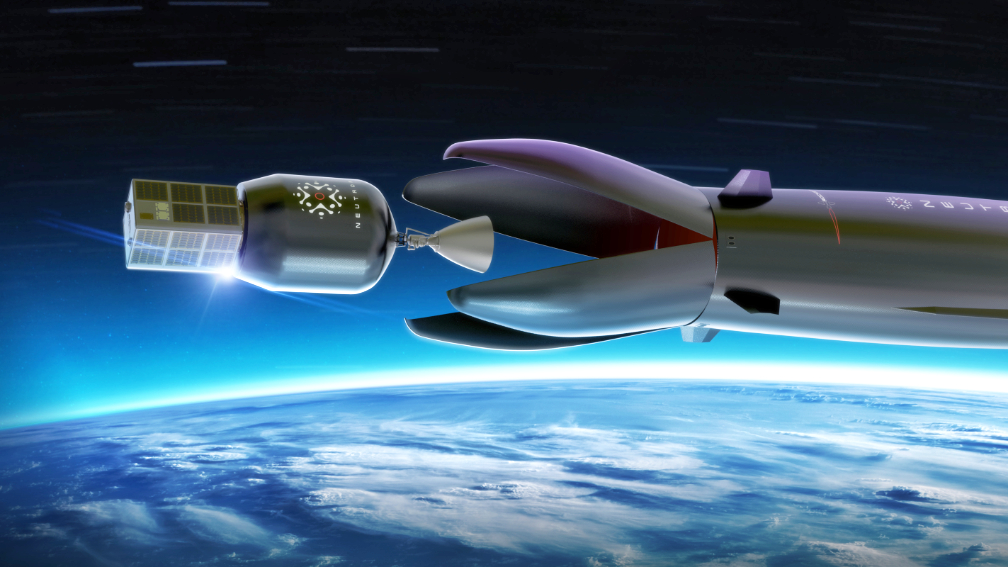
Artistic rendition of the Hungry Hippo releasing the payload to orbit.

By being housed inside the first stage and ‘Hungry Hippo’ fairing, the requirement for the second stage to withstand the launch environment is eliminated and the second stage can be made significantly lighter enabling higher performance in space. Designed as an expendable upper stage for now, Neutron’s second stage is a six-meter-long carbon composite structure with a single vacuum optimized Archimedes engine.
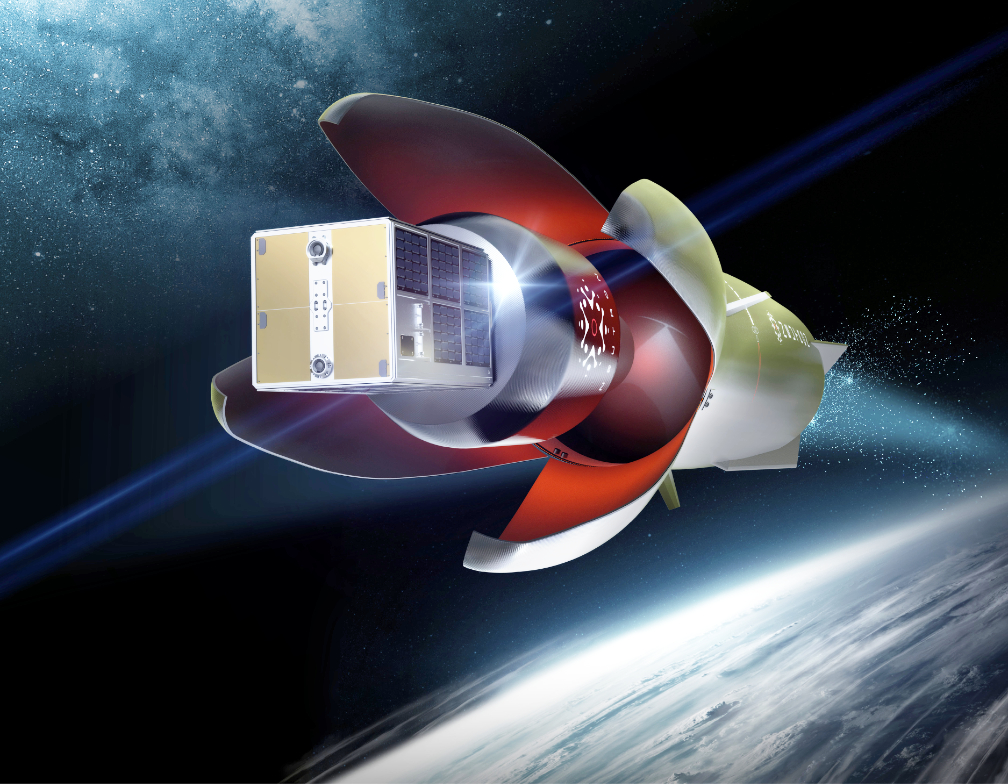
Artistic rendition of a closer view of the Hungry Hippo fairing payload release.

Rocket Lab is currently working through a competitive process to select launch site, rocket production facility and Archimedes engine test facility on the U.S. East Coast. Rocket Lab expects to create around 250 new jobs to support the Neutron program with many roles open for application now.

“Neutron is not a conventional rocket. It’s a new breed of launch vehicle with reliability, reusability and cost reduction is hard baked into the advanced design from day one. Neutron incorporates the best innovations of the past and marries them with cutting edge technology and materials to deliver a rocket for the future,” said Mr. Beck. “More than 80% of the satellites to be launched in the next decade are expected to be constellations, which have unique deployment needs that Neutron is the first vehicle to address specifically. Like we did with Electron, rather than starting with a traditional rocket design, we focused on our customers’ needs and worked back from there. The result is a rocket that is right-sized for market demand and can launch fast, frequently and affordably.”

Note: All imagery is courtesy of Rocket Lab.

Filed Under: LEO Constellations, Rocket Technology & Vehicles Tagged With: Featured

Primary Sidebar

Coverage

  • Missions & Constellations
  • Business & Finance
  • Military & Defense
  • Launch
  • Software Automation & Ground Systems
  • Government & Regulation
  • Services & Applications

Most Read Stories

  • L3Harris Unveils XL-300P: The First P25 Handheld with 5G and Satellite Direct-to-Device Connectivity
  • SpaceX Loses Contact With Starlink Satellite
  • Rheinmetall Walked Away. Germany Should Take the Hint.
  • Rocket Lab Emerging as Potential Bus Provider for 2,800-Satellite Equatys Constellation
  • SpaceX Accelerates Record-Breaking IPO Following Trillion-Dollar xAI Merger

Secondary Sidebar

Footer


Satnews is a leading provider of satellite news, events, publications, research and other satellite industry information in both commercial and military enterprises worldwide.

Stories By Category

  • Business & Finance
  • Government & Regulation
  • Launch
  • Military & Defense
  • Missions & Constellations
  • Services & Applications
  • Software Automation & Ground Systems
  • Spectrum & Licensing
  • Startups & NewSpace Business

About Us

  • Leadership & Editorial Team
  • SatNews History
  • Free Satnews Subscription
  • SatNews Events
  • Magazines

Navigation

  • Latest Stories
  • Magazines
  • Events
  • Contact
  • Cookie & Privacy Policy for Satnews

We use cookies to ensure that we give you the best experience on our website. If you continue to use this site we will assume that you are happy with it.
x
Sign up Now (For Free)
Access daily or weekly satellite news updates covering all aspects of the commercial and military satellite industry.
Invalid email address
Notify Me Regarding ( At least one ):
We value your privacy and will not sell or share your email or other information with any other company. You may also unsubscribe at anytime.

Click Here to see our full privacy policy.
Thanks for subscribing!