

• Skip to primary navigation
  • Skip to main content
  • Skip to primary sidebar
  • Skip to secondary sidebar
  • Skip to footer
  • NEWS:
  • SatNews
  • SatMagazine
  • MilSatMagazine
  • SmallSat News
  • |     EVENTS:
  • SmallSat Symposium
  • Satellite Innovation
  • MilSat Symposium
  • SmallSat Europe

SatNews

Satellite Industry Intelligence Since 1983

Subscribe
  • LATEST
  • SatNews Events
  • Magazines
  • Calendar
  • Subscribe
  • Missions & Constellations
    • Exploration & Science Missions
    • In-Orbit Servicing & Orbital Operations
    • LEO Constellations
    • Mission Autonomy & Onboard Systems
    • Mission Deployments & Manifests
    • Navigation & PNT
    • SmallSat
    • Spacecraft & Payload Technology
    View All in Missions & Constellations →
    NASA Shuts Off Instrument on Voyager 1 to Extend Interstellar MissionNASA Shuts Off Instrument on Voyager 1 to Extend Interstellar Mission
    Starlink Outages Disrupt Navy Drone Tests as Pentagon Dependency GrowsStarlink Outages Disrupt Navy Drone Tests as Pentagon Dependency Grows
    Iridium Unveils Role in Artemis II and Next-Gen PNT at Space Symposium 2026Iridium Unveils Role in Artemis II and Next-Gen PNT at Space Symposium 2026
    Boeing and Millennium Unveil Resolute Mid-Class Satellite PlatformBoeing and Millennium Unveil Resolute Mid-Class Satellite Platform
  • Business
    • Contracts & Commercial Deals
    • Earnings & Financial Reporting
    • Events & Conferences
    • Funding & Venture Capital
    • Market Forecasts
    • Mergers & Acquisitions
    • Personnel Moves & Appointments
    View All in Business & Finance →
    Meink: Space Force Programs Ready to Execute Once FY27 Budget LandsMeink: Space Force Programs Ready to Execute Once FY27 Budget Lands
    SDA’s Sandhoo: Tranche 1 Launches Resume in May or JuneSDA’s Sandhoo: Tranche 1 Launches Resume in May or June
    Gen. Stephen Whiting: First USSPACECOM Operational Staff Arrive at Redstone This WeekGen. Stephen Whiting: First USSPACECOM Operational Staff Arrive at Redstone This Week
    Saltzman Rolls Out Space Force Objective Force, Flags CR as Top RiskSaltzman Rolls Out Space Force Objective Force, Flags CR as Top Risk
  • Defense
    • Counterspace & ASAT
    • Defense Budgets & Procurement
    • ISR & Reconnaissance
    • MILSATCOM
    • Missile Warning & Defense
    • National Security Programs
    • Space Domain Awareness
    View All in Military & Defense →
    GMV Secures Lead Role in Seven 2025 European Defence Fund InitiativesGMV Secures Lead Role in Seven 2025 European Defence Fund Initiatives
    SmallSat Europe Speaker Focus: Gen. Michel Friedling, Look Up SpaceSmallSat Europe Speaker Focus: Gen. Michel Friedling, Look Up Space
    Saltzman Unveils 2040 Blueprint to Scale Space Force for Great Power CompetitionSaltzman Unveils 2040 Blueprint to Scale Space Force for Great Power Competition
    The Rise of Grey Zone Satellites: Ambiguity as a Tactical AdvantageThe Rise of Grey Zone Satellites: Ambiguity as a Tactical Advantage
  • Gov
    • Export Controls & Compliance
    • International Space Agreements
    • National Space Policy
    • Space Law & Treaties
    • Space Sustainability & Debris Policy
    • Space Traffic Management / Debris Removal
    View All in Government & Regulation →
    SmallSat Europe Speaker Focus: Col. Marcin Mazur, Polish Space AgencySmallSat Europe Speaker Focus: Col. Marcin Mazur, Polish Space Agency
    SmallSat Europe Speaker Focus: Chris Quilty, Quilty SpaceSmallSat Europe Speaker Focus: Chris Quilty, Quilty Space
    NRL to Showcase Sovereign Space Capabilities at 41st Space SymposiumNRL to Showcase Sovereign Space Capabilities at 41st Space Symposium
    FCC Modernizes Satellite Spectrum Rules to Unleash Next-Generation BroadbandFCC Modernizes Satellite Spectrum Rules to Unleash Next-Generation Broadband
  • Launch
    • Launch Providers
    • Launch Schedule & Calendars
    • Launch Sites & Infrastructure
    • Rocket Technology & Vehicles
    View All in Launch →
    Blue Origin Achieves First Booster Reuse but Satellite Enters Off-Nominal OrbitBlue Origin Achieves First Booster Reuse but Satellite Enters Off-Nominal Orbit
    Ensign-Bickford Hardware Supports Successful Artemis II Lunar MissionEnsign-Bickford Hardware Supports Successful Artemis II Lunar Mission
    China Accelerates Orbital Internet Deployment with Successful Smart Dragon-3 Sea LaunchChina Accelerates Orbital Internet Deployment with Successful Smart Dragon-3 Sea Launch
    What the SpaceX IPO Changes for Every Satellite OperatorWhat the SpaceX IPO Changes for Every Satellite Operator
  • Software
    • Autonomous Ground Operations
    • Data Processing & AI/ML
    • Digital Twins & Modeling
    • Ground Segment & Teleports
    • Mission Planning & Simulation
    • Space Systems Software Engineering
    • Spectrum & Licensing
    View All in Software Automation & Ground Systems →
    Sat-Lite Technologies adds  Richard Rader to Spearhead Sales ExpansionSat-Lite Technologies adds Richard Rader to Spearhead Sales Expansion
    Blue Origin Unveils Project Quartz Global Ground Station NetworkBlue Origin Unveils Project Quartz Global Ground Station Network
    Cloudcomputing Targets 1.5M Identities in Spain and Finalizes Innovate IT AcquisitionCloudcomputing Targets 1.5M Identities in Spain and Finalizes Innovate IT Acquisition
    Archangel Lightworks Secures £10M Series A to Scale Optical Ground InfrastructureArchangel Lightworks Secures £10M Series A to Scale Optical Ground Infrastructure
  • Services & Apps
    • Climate & Environmental Monitoring
    • Disaster Response & Security Mapping
    • Earth Observation & Imaging
    • Maritime & Aviation Satcom
    • Satellite Communications
    View All in Services & Applications →
    SmallSat Europe Speaker Focus: Martin Langer, OroraTechSmallSat Europe Speaker Focus: Martin Langer, OroraTech
    SmallSat Europe Speaker Focus: Jaume Sanpera, SateliotSmallSat Europe Speaker Focus: Jaume Sanpera, Sateliot
    NASA Targets Commercial Relays to Replace Aging TDRSS InfrastructureNASA Targets Commercial Relays to Replace Aging TDRSS Infrastructure
    OQ Technology Awarded ESA Contract to Adapt 5G Beamforming for SpaceOQ Technology Awarded ESA Contract to Adapt 5G Beamforming for Space

UPDATE: Lucy Launched

October 16, 2021

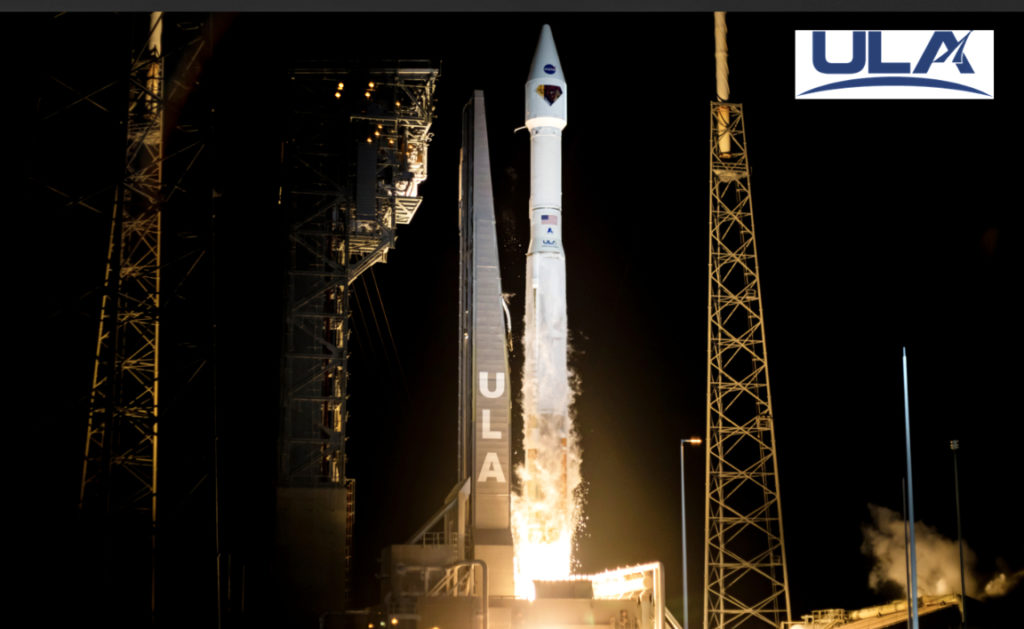
Humankind is one step closer to unlocking new knowledge about the formation of our solar system, thanks to a spacecraft named Lucy built by Lockheed Martin (NYSE: LMT). The NASA mission successfully was successfully launched from Cape Canaveral Air Force Station by United Launch Alliance at 5:34 a.m. ET on October 16, 2021.

NASA’s Lucy spacecraft launched aboard an Atlas V rocket starting it 12-year mission to the Trojan asteroids.

The spacecraft was designed, built and tested in Lockheed Martin’s Littleton facility, using transformative technology. The company’s mission operations team is now in communications with the spacecraft and will operate it through the end of its mission.

The Lucy mission is a joint mission of NASA’s Goddard Spaceflight Center, the Southwest Research Institute and NASA’s Launch Services Program (LSP) based at Kennedy Space Center.



The ULA Atlas V 401 configuration rocket delivered the Lucy spacecraft into an interplanetary trajectory, which included a 14 ft. (4-m) large payload fairing (LPF). The Atlas booster was powered by the RD AMROSS RD-180 engine. Aerojet Rocketdyne provided the RL10C-1 engine for the Centaur upper stage.
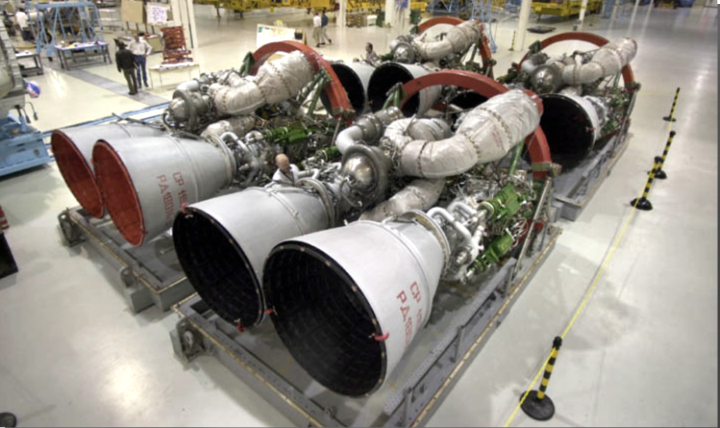
RD AMROSS RD-180 engine.


This was the 89th launch of an Atlas V rocket and 21st mission launched on an Atlas V and follows the launch of Landsat 9 from Vandenberg Space Force Base last month — ULA has launched 146 times with 100 percent mission success. ULA’s next launch is STP-3 for the U.S. Space Force, planned for November 22, 2021, from Cape Canaveral Space Force Station, Florida.
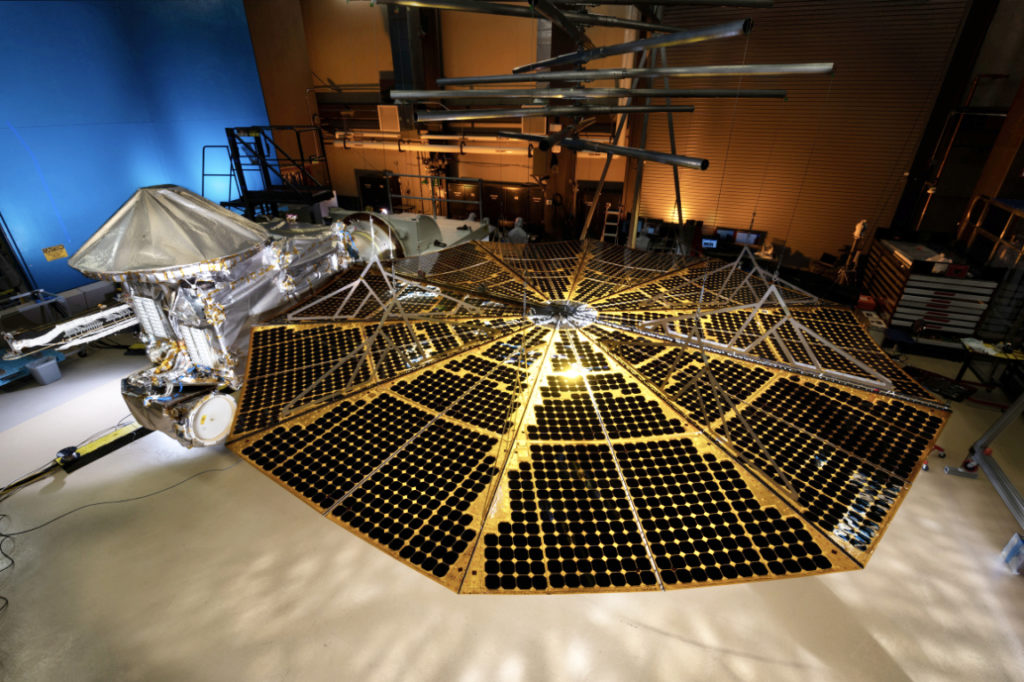
Lucy in the cleanroom. Photo is courtesy of Lockheed Martin.

Lucy will be the farthest solar-powered mission from the Sun and will visit a record-breaking number of asteroids — all in the name of studying them for clues about our own origins. Lucy’s 4-billion-mile odyssey through the solar system will last 12 years and fly by eight objects: one Main Belt asteroid and seven Trojan asteroids that lead and trail Jupiter in its orbit. Scientists are keen for an up-close look at these ancient rocks, which are believed to be pristinely preserved leftovers from the formation of our outer solar system 4 billion years ago.
These asteroids — which draw their name from a similarly epic story in Greek mythology — may contain carbon, water and other volatile compounds necessary for life and could possibly give us a glimpse into the physical environment that existed when the planets formed, as well as the conditions that fostered their formation.

Until now, scientists have only been able to study these small, primitive bodies with ground-based and Earth-orbiting telescopes. That changes with Lucy.
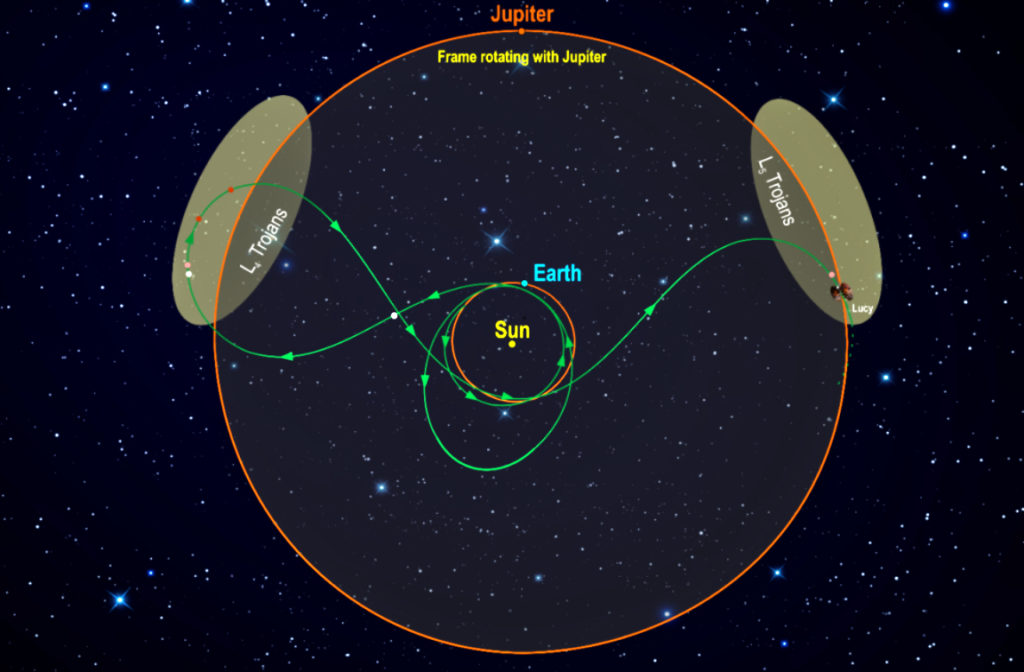
Lucy’s orbital trajectory is one of the most complex of any Discovery mission: 12 years, eight asteroids and two Earth-gravity slingshots. Southwest Research Institute’s Brian Sutter spent hours of work figuring out how to do this. Image credit: Southwest Research Institute

Key features of the Lucy spacecraft include:

  • Some 430 unique components, brought together by more than 2 miles of wire, 170 square feet of composite structure and more than 12,800 electrical connections
  • Three powerful, primary instruments to study the geology, composition and structure of the Trojan asteroids
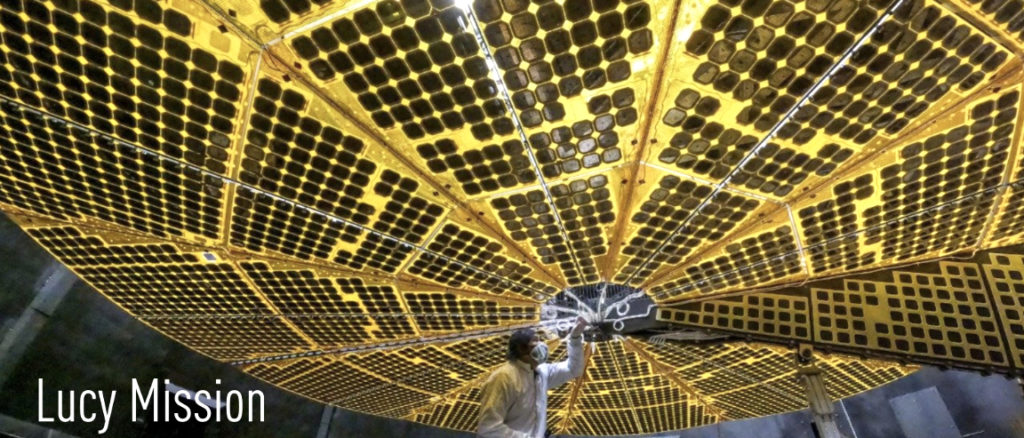
  • Two 24-foot diameter solar arrays built by Northrop Grumman, spanning more than a four-story building when unfurled
  • A robust thermal design that protects Lucy from extreme space temperatures ranging from -250⁰F to +300⁰F
  • Autonomous software that enables Lucy to track asteroid targets as it flies by at an average speed of 15,000 mph
  • Advanced production parts like 3D-printed brackets and harness clamps, made from three different materials

The team also made use of the latest collaborative tools and digital engineering techniques on Lucy, including automated testing, digital test review capability and remote collaboration. These tactics helped the team continue production without missing a shift throughout the pandemic.

The spacecraft carries updated versions of three heritage instruments…

  • L’Ralph, NASA Goddard Space Flight Center – This camera is capable of taking images of the Trojan asteroids on the visible and infrared spectrums. Its images will help scientists determine what the Trojans’ surfaces are made of as they look for the presence of things like ice, hydrated minerals and other organic materials.
  • L’LORRI (Long Range Reconnaissance Imager), Johns Hopkins Applied Physics Laboratory – Functioning like the Hubble Space Telescope, this telescopic camera will take black and white images of the Trojans from afar and produce incredibly detailed, high resolution visuals of things like craters on their surfaces — even though the asteroids are not illuminated by any light source. If you were standing on one end of a football field, you’d be able to see a fly on the other end of the field with L’LORRI.Thanks to its ability to look across large distances, L’LORRI will also help Lucy orient itself and navigate through space. 
  • L’TES (Thermal Emission Spectrometer), Arizona State University –Think of this as the world’s most sophisticated thermometer. It will measure the infrared energy emitted by the asteroids as the sun warms them and detect unique spectral signatures of individual minerals and other surface properties.  

Lucy builds on years of technology from numerous Lockheed Martin planetary missions, such as Mars Odyssey, OSIRIS-REx and InSight, among others.

“Seeing Lucy start her journey reinforces the strength of the 500 team members from NASA, Lockheed Martin, the Southwest Research Institute and many other teams who worked together to bring this mission to life,” said Rich Lipe, Lockheed Martin Lucy program manager. “It’s a tale centered on flexibility, collaboration and ingenuity, which is fitting for the voyage that lies ahead for this advanced spacecraft.”

“We are honored to partner with NASA to launch this one-of-a-kind mission and are proud to add the Lucy mission to the Trojan Asteroids to our list of exploration launch successes,” said Gary Wentz, ULA vice president of Government and Commercial Programs. “We are very proud to launch this spacecraft on its historic 12-year journey to eight different asteroids, and thank our mission partners for their teamwork.”

More About the Mission

Lockheed Martin Space designed, built, tested and operates Lucy out of its Littleton, Colorado, facility. NASA’s Goddard Space Flight Center in Greenbelt, Maryland, provides overall mission management, systems engineering and safety and mission assurance. The Boulder, Colorado branch of Southwest Research Institute, headquartered in San Antonio, TX, is the principal investigator institution. Instruments were contributed by NASA Goddard, Arizona State University and Johns Hopkins Applied Physics Laboratory. Marshall Space Flight Center in Huntsville, Alabama, manages the Discovery Program for the agency’s Science Mission Directorate in Washington, D.C.

Filed Under: Rocket Technology & Vehicles Tagged With: Featured

Primary Sidebar

Coverage

  • Missions & Constellations
  • Business & Finance
  • Military & Defense
  • Launch
  • Software Automation & Ground Systems
  • Government & Regulation
  • Services & Applications

Most Read Stories

  • SpaceX Loses Contact With Starlink Satellite
  • Rocket Lab Emerging as Potential Bus Provider for 2,800-Satellite Equatys Constellation
  • SpaceX Accelerates Record-Breaking IPO Following Trillion-Dollar xAI Merger
  • Planet Labs Imposes Indefinite Blackout on Iran Satellite Imagery at U.S. Request
  • Amazon in Reported Talks to Acquire Globalstar in $9 Billion Move to Challenge Starlink

Secondary Sidebar

Footer


Satnews is a leading provider of satellite news, events, publications, research and other satellite industry information in both commercial and military enterprises worldwide.

Stories By Category

  • Business & Finance
  • Government & Regulation
  • Launch
  • Military & Defense
  • Missions & Constellations
  • Services & Applications
  • Software Automation & Ground Systems
  • Spectrum & Licensing
  • Startups & NewSpace Business

About Us

  • Leadership & Editorial Team
  • SatNews History
  • Free Satnews Subscription
  • SatNews Events
  • Magazines

Navigation

  • Latest Stories
  • Magazines
  • Events
  • Contact
  • Cookie & Privacy Policy for Satnews

We use cookies to ensure that we give you the best experience on our website. If you continue to use this site we will assume that you are happy with it.
x
Sign up Now (For Free)
Access daily or weekly satellite news updates covering all aspects of the commercial and military satellite industry.
Invalid email address
Notify Me Regarding ( At least one ):
We value your privacy and will not sell or share your email or other information with any other company. You may also unsubscribe at anytime.

Click Here to see our full privacy policy.
Thanks for subscribing!