

• Skip to primary navigation
  • Skip to main content
  • Skip to primary sidebar
  • Skip to secondary sidebar
  • Skip to footer
  • NEWS:
  • SatNews
  • SatMagazine
  • MilSatMagazine
  • SmallSat News
  • |     EVENTS:
  • SmallSat Symposium
  • Satellite Innovation
  • MilSat Symposium
  • SmallSat Europe

SatNews

Satellite Industry Intelligence Since 1983

Subscribe
  • LATEST
  • SatNews Events
  • Magazines
  • Calendar
  • Subscribe
  • Missions & Constellations
    • Exploration & Science Missions
    • In-Orbit Servicing & Orbital Operations
    • LEO Constellations
    • Mission Autonomy & Onboard Systems
    • Mission Deployments & Manifests
    • Navigation & PNT
    • SmallSat
    • Spacecraft & Payload Technology
    View All in Missions & Constellations →
    Telesat Delays Lightspeed Constellation Service to Mid-2028 Following Pathfinder Software DelaysTelesat Delays Lightspeed Constellation Service to Mid-2028 Following Pathfinder Software Delays
    FCC Proposes 25 MHz Mid-Band Spectrum Auction with Dual 5G and Direct-to-Device AllocationsFCC Proposes 25 MHz Mid-Band Spectrum Auction with Dual 5G and Direct-to-Device Allocations
    Xona Is in Orbit. Its CEO Says U.S. GPS Backup Leans on China.Xona Is in Orbit. Its CEO Says U.S. GPS Backup Leans on China.
    City Labs Flew 20 Curies. Now It Wants FAA Approval for 10 Million.City Labs Flew 20 Curies. Now It Wants FAA Approval for 10 Million.
  • Business
    • Contracts & Commercial Deals
    • Earnings & Financial Reporting
    • Events & Conferences
    • Funding & Venture Capital
    • Market Forecasts
    • Mergers & Acquisitions
    • Personnel Moves & Appointments
    View All in Business & Finance →
    Satellites Can’t Wait for the 2030 Post-Quantum Deadline, MilSat Panel SaysSatellites Can’t Wait for the 2030 Post-Quantum Deadline, MilSat Panel Says
    War in Space Isn’t Insurable Yet, Gallagher’s Rush SaysWar in Space Isn’t Insurable Yet, Gallagher’s Rush Says
    RG-XX Bids Are In. The Award Is a Year Away.RG-XX Bids Are In. The Award Is a Year Away.
    Golden Dome Panel Splits on the Program’s Political RiskGolden Dome Panel Splits on the Program’s Political Risk
  • Defense
    • Counterspace & ASAT
    • Defense Budgets & Procurement
    • ISR & Reconnaissance
    • MILSATCOM
    • Missile Warning & Defense
    • National Security Programs
    • Space Domain Awareness
    View All in Military & Defense →
    MUOS Gets Two More Satellites and a Life to 2040MUOS Gets Two More Satellites and a Life to 2040
    SDA’s First Tracking Satellites Slip to Spring, Sandhoo SaysSDA’s First Tracking Satellites Slip to Spring, Sandhoo Says
    Hughes Secures $42.5M Space Systems Command Award for Multi-Orbit Automated EM&C ArchitectureHughes Secures $42.5M Space Systems Command Award for Multi-Orbit Automated EM&C Architecture
    “I Can’t Refuel You. I’m Sorry”: Satellite Servicers Can’t Agree on a Plug“I Can’t Refuel You. I’m Sorry”: Satellite Servicers Can’t Agree on a Plug
  • Gov
    • Export Controls & Compliance
    • International Space Agreements
    • National Space Policy
    • Space Law & Treaties
    • Space Sustainability & Debris Policy
    • Space Traffic Management / Debris Removal
    View All in Government & Regulation →
    Part 100 Puts FCC Satellite Licensing on an Assembly LinePart 100 Puts FCC Satellite Licensing on an Assembly Line
    FCC Proposes Modernized Direct-to-Device Rules, Explores 482 MHz Expansion for Satellite CellularFCC Proposes Modernized Direct-to-Device Rules, Explores 482 MHz Expansion for Satellite Cellular
    Canada’s Satellite-to-Phone Network Can’t Go It Alone, So Terrestar Joined EquatysCanada’s Satellite-to-Phone Network Can’t Go It Alone, So Terrestar Joined Equatys
    NTIA’s 500 MHz Mandate Is Its Top Job, Patrick SaysNTIA’s 500 MHz Mandate Is Its Top Job, Patrick Says
  • Launch
    • Launch Providers
    • Launch Schedule & Calendars
    • Launch Sites & Infrastructure
    • Rocket Technology & Vehicles
    View All in Launch →
    HIMERA and GomSpace Begin Orbital Operations of OBRIA NANO Test Satellite for Sovereign Ukrainian NetworkHIMERA and GomSpace Begin Orbital Operations of OBRIA NANO Test Satellite for Sovereign Ukrainian Network
    Blue Origin Reconstructs Launch Complex 36 Tower, Targets November Return to Flight for New GlennBlue Origin Reconstructs Launch Complex 36 Tower, Targets November Return to Flight for New Glenn
    DIA Space Security Report Reveals Detailed Orbital Imagery of China’s Shenlong SpaceplaneDIA Space Security Report Reveals Detailed Orbital Imagery of China’s Shenlong Spaceplane
    The Launch Crunch Is Coming as Falcon 9 Winds DownThe Launch Crunch Is Coming as Falcon 9 Winds Down
  • Software
    • Autonomous Ground Operations
    • Data Processing & AI/ML
    • Digital Twins & Modeling
    • Ground Segment & Teleports
    • Mission Planning & Simulation
    • Space Systems Software Engineering
    • Spectrum & Licensing
    View All in Software Automation & Ground Systems →
    MBSat Selects ST Engineering iDirect Intuition Platform for Ground Infrastructure in OmanMBSat Selects ST Engineering iDirect Intuition Platform for Ground Infrastructure in Oman
    AnySignal Co-Founder Urges Ground Station Interoperability to Resolve Orbital Data BottlenecksAnySignal Co-Founder Urges Ground Station Interoperability to Resolve Orbital Data Bottlenecks
    Arqiva Secures Three-Year Satellite Services Agreement with Kuwait’s GulfsatArqiva Secures Three-Year Satellite Services Agreement with Kuwait’s Gulfsat
    TrustPoint and Calian Deliver Industry’s First Mass-Market Ready C-band GNSS AntennaTrustPoint and Calian Deliver Industry’s First Mass-Market Ready C-band GNSS Antenna
  • Services & Apps
    • Climate & Environmental Monitoring
    • Disaster Response & Security Mapping
    • Earth Observation & Imaging
    • Maritime & Aviation Satcom
    • Satellite Communications
    View All in Services & Applications →
    Tim Farrar: Carriers Are Finding Few Will Pay for Direct-to-DeviceTim Farrar: Carriers Are Finding Few Will Pay for Direct-to-Device
    Scanway and Pixxel Sign Pact to Expand Optical Payload and Earth Observation Data ServicesScanway and Pixxel Sign Pact to Expand Optical Payload and Earth Observation Data Services
    KTL Selects Keysight NR-NTN Test Suite to Accelerate Satellite Acceptance TestingKTL Selects Keysight NR-NTN Test Suite to Accelerate Satellite Acceptance Testing
    Leonardo Infrared Sensor Returns to Orbit Aboard SatVu HotSat-3 Thermal Imaging SatelliteLeonardo Infrared Sensor Returns to Orbit Aboard SatVu HotSat-3 Thermal Imaging Satellite

Team of Japanese Space Enthusiasts Set To Launch Selfie-Taking satellite

February 21, 2021

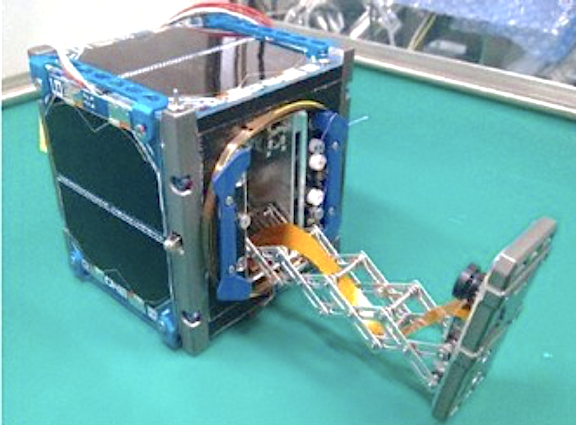
The miniature satellite which will attempt to take a selfie in space is seen with its camera arm extended in this image provided by Ryman Sat Project.

A miniature satellite capable of taking pictures of itself, developed as a passion project by company employees, students and others in Japan, is being launched in the United States during the early dawn hours of February 21 (Japan time).

The satellite has a built-in telescopic arm with a camera to take selfies. An earlier version was first developed and launched in 2018, but in that instance, communication between the satellite and equipment on the ground could not be established. Will the amateur group’s second attempt be a success, and will the satellite be able to send its selfies back to Earth?

The people behind the project’s development are members of space enthusiast group Ryman Sat Project, based in Tokyo’s Edogawa Ward. The satellite is a cube measuring 10 centimeters on each side, and it weighs a little over a kilogram. The funds to make it were raised through a mix of crowdfunding and members’ own contributions, and the team spent about three years developing it.

Members of the group are seen gathered together in a city workshop to try and make the satellite, in Edogawa Ward, Tokyo, in October 2019. (Mainichi/Etsuko Nagayama)

Ryman Sat Project was founded in 2014, and currently boasts about 790 members. Although a love of space brought them together, they’re all amateurs when it comes to space-related development. Through a mix of trial and error, along with reading essays and specialist books on the subject, they have challenged themselves in space-related activities, such as developing satellites.

They’ve nicknamed the current satellite “selfish” — partly a reference to the term selfie and partly from their “selfish” desire to see the project through.

The selfie idea came from their desire to see the satellite they had built floating in space. The unit’s arm for taking pictures can extend out about 10 centimeters and retract back in. Although there’s no need for it to retract for the photographs, the team said they decided to make it able to do both, because “it looks smarter if it can go back to its original position and close than it does if the arm is left stretched out.”
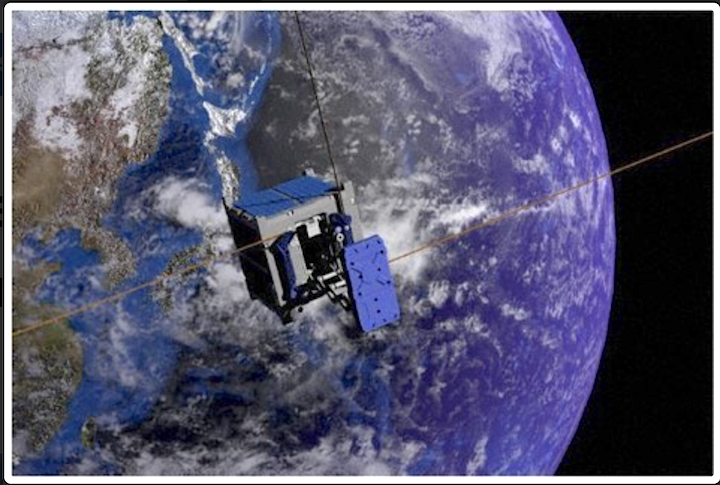
A visualization of the satellite taking a selfie in space is seen in this image provided by the Ryman Sat Project.

For the wireless equipment, the team decided it would be more interesting to make their own than to use existing products, and after toiling away they managed to create something about half the size of what had been available, at a cost of about two-thirds of what they would have paid. As a result, it became possible to put in new equipment such as position control mechanisms. The team also tried to devise cool designs for its solar energy panels and camera shutter.

In response to the failure of communications on the first satellite, among other issues, the team has done thorough tests ahead of the main event this time. They have also tried to foresee potential equipment failure, and incorporated the same kind of cause analysis and evaluation that experts use in their designing methods.

The completed satellite will first be delivered to the International Space Station via an Antares rocket launched by a U.S. firm. After arriving, it will be released into space from the Japanese Experiment Module Kibo. If all goes to plan, the satellite’s antenna should unfurl about 30 minutes later and send signals to Earth. From there, the arm should extend as per instructions issued from the ground, and its camera shutter is expected to release.

The Ryman Sat Project group’s project manager, Ryuichi Mitsui, told the Mainichi Shimbun, “This kind of selfish project is something you can’t do unless it’s a pursuit. We had to value our feeling of wanting to do it without fear of failure. But, to try and make it a success precisely because it’s our pursuit, our members had to review the project and discuss it not just on weekends, but on weeknights, too.”

With the spread of the new coronavirus, the team members are unable to see the launch at the spot where it will happen, but their project manager said, “I want to observe that moment online with the other members.”

At a press conference ahead of the launch, the team was asked if they had any plans for the selfies the satellite takes. Their project manager responded hesitantly, “We’re not considering anything in particular. Maybe it could be someone’s (desktop) wallpaper, or used in a calendar? If you have any good ideas, please let us know.” Rather than focusing on how the photos are used, it seems the very process of having pictures sent to Earth and being able to celebrate them together is everything for the team.

(Japanese original by Etsuko Nagayama, Opinion Group)

From Mainichi

Filed Under: SmallSat, Spacecraft & Payload Technology

Primary Sidebar

Coverage

  • Missions & Constellations
  • Business & Finance
  • Military & Defense
  • Launch
  • Software Automation & Ground Systems
  • Government & Regulation
  • Services & Applications

Most Read Stories

  • AT&T, T-Mobile, and Verizon Form Joint Venture to Standardize Satellite Direct-to-Device Connectivity
  • SpaceX Unveils 250 kW Starlink Gen3 AI Satellites Featuring 10 Tbps Throughput and Onboard Edge Compute
  • SpaceX Acquires Grain Management’s 800 MHz Spectrum Portfolio to Launch Standalone Starlink Mobile Carrier
  • FCC Grants SpaceX Approval for 15,000-Satellite Very Low Earth Orbit Direct-to-Device Constellation
  • Rocket Lab Challenges NASA’s $700M Mars Orbiter Award to Blue Origin While Scaling Vertical Integration via $8B Iridium Acquisition

Secondary Sidebar

Footer


Satnews is a leading provider of satellite news, events, publications, research and other satellite industry information in both commercial and military enterprises worldwide.

Stories By Category

  • Business & Finance
  • Government & Regulation
  • Launch
  • Military & Defense
  • Missions & Constellations
  • Services & Applications
  • Software Automation & Ground Systems
  • Spectrum & Licensing
  • Startups & NewSpace Business

About Us

  • Leadership & Editorial Team
  • SatNews History
  • Free Satnews Subscription
  • SatNews Events
  • Magazines

Navigation

  • Latest Stories
  • Magazines
  • Events
  • Contact
  • Cookie & Privacy Policy for Satnews

We use cookies to ensure that we give you the best experience on our website. If you continue to use this site we will assume that you are happy with it.
x
Sign up Now (For Free)
Access daily or weekly satellite news updates covering all aspects of the commercial and military satellite industry.
Invalid email address
Notify Me Regarding ( At least one ):
We value your privacy and will not sell or share your email or other information with any other company. You may also unsubscribe at anytime.

Click Here to see our full privacy policy.
Thanks for subscribing!