

• Skip to primary navigation
  • Skip to main content
  • Skip to primary sidebar
  • Skip to secondary sidebar
  • Skip to footer
  • NEWS:
  • SatNews
  • SatMagazine
  • MilSatMagazine
  • SmallSat News
  • |     EVENTS:
  • SmallSat Symposium
  • Satellite Innovation
  • MilSat Symposium
  • SmallSat Europe

SatNews

Satellite Industry Intelligence Since 1983

Subscribe
  • LATEST
  • SatNews Events
  • Magazines
  • Calendar
  • Subscribe
  • Missions & Constellations
    • Exploration & Science Missions
    • In-Orbit Servicing & Orbital Operations
    • LEO Constellations
    • Mission Autonomy & Onboard Systems
    • Mission Deployments & Manifests
    • Navigation & PNT
    • SmallSat
    • Spacecraft & Payload Technology
    View All in Missions & Constellations →
    Iridium Unveils Core Role in Artemis II and Next-Gen PNT at Space Symposium 2026Iridium Unveils Core Role in Artemis II and Next-Gen PNT at Space Symposium 2026
    Boeing and Millennium Unveil Resolute Mid-Class Satellite PlatformBoeing and Millennium Unveil Resolute Mid-Class Satellite Platform
    NASA Shifts Focus to Permanent Lunar Base and Nuclear PropulsionNASA Shifts Focus to Permanent Lunar Base and Nuclear Propulsion
    Kepler and Astrolight Secure ESA Contract for HydRON Optical NetworkKepler and Astrolight Secure ESA Contract for HydRON Optical Network
  • Business
    • Contracts & Commercial Deals
    • Earnings & Financial Reporting
    • Events & Conferences
    • Funding & Venture Capital
    • Market Forecasts
    • Mergers & Acquisitions
    • Personnel Moves & Appointments
    View All in Business & Finance →
    SmallSat Europe Speaker Focus: Jaume Sanpera, SateliotSmallSat Europe Speaker Focus: Jaume Sanpera, Sateliot
    Ericsson Initiates SEK 15 Billion Share Buyback ProgramEricsson Initiates SEK 15 Billion Share Buyback Program
    Saltzman Unveils 2040 Blueprint to Scale Space Force for Great Power CompetitionSaltzman Unveils 2040 Blueprint to Scale Space Force for Great Power Competition
    SmallSat Europe Speaker Focus: Col. Marcin Mazur, Polish Space AgencySmallSat Europe Speaker Focus: Col. Marcin Mazur, Polish Space Agency
  • Defense
    • Counterspace & ASAT
    • Defense Budgets & Procurement
    • ISR & Reconnaissance
    • MILSATCOM
    • Missile Warning & Defense
    • National Security Programs
    • Space Domain Awareness
    View All in Military & Defense →
    The Rise of Grey Zone Satellites: Ambiguity as a Tactical AdvantageThe Rise of Grey Zone Satellites: Ambiguity as a Tactical Advantage
    US Space Force Awards $68.6M Modification to Lockheed Martin for Next-Gen OPIRUS Space Force Awards $68.6M Modification to Lockheed Martin for Next-Gen OPIR
    General Atomics Completes Pre-Ship Review for Space Force Weather PayloadGeneral Atomics Completes Pre-Ship Review for Space Force Weather Payload
    Global Defense Leaders Convene as Space Symposium 41 Addresses Orbital SecurityGlobal Defense Leaders Convene as Space Symposium 41 Addresses Orbital Security
  • Gov
    • Export Controls & Compliance
    • International Space Agreements
    • National Space Policy
    • Space Law & Treaties
    • Space Sustainability & Debris Policy
    • Space Traffic Management / Debris Removal
    View All in Government & Regulation →
    SmallSat Europe Speaker Focus: Chris Quilty, Quilty SpaceSmallSat Europe Speaker Focus: Chris Quilty, Quilty Space
    NRL to Showcase Sovereign Space Capabilities at 41st Space SymposiumNRL to Showcase Sovereign Space Capabilities at 41st Space Symposium
    FCC Modernizes Satellite Spectrum Rules to Unleash Next-Generation BroadbandFCC Modernizes Satellite Spectrum Rules to Unleash Next-Generation Broadband
    SmallSat Europe Speaker Focus: Daniel Bock, Morpheus SpaceSmallSat Europe Speaker Focus: Daniel Bock, Morpheus Space
  • Launch
    • Launch Providers
    • Launch Schedule & Calendars
    • Launch Sites & Infrastructure
    • Rocket Technology & Vehicles
    View All in Launch →
    Ensign-Bickford Hardware Supports Successful Artemis II Lunar MissionEnsign-Bickford Hardware Supports Successful Artemis II Lunar Mission
    China Accelerates Orbital Internet Deployment with Successful Smart Dragon-3 Sea LaunchChina Accelerates Orbital Internet Deployment with Successful Smart Dragon-3 Sea Launch
    What the SpaceX IPO Changes for Every Satellite OperatorWhat the SpaceX IPO Changes for Every Satellite Operator
    €30 million Financing for PLD Space’s Small Satellite Launcher€30 million Financing for PLD Space’s Small Satellite Launcher
  • Software
    • Autonomous Ground Operations
    • Data Processing & AI/ML
    • Digital Twins & Modeling
    • Ground Segment & Teleports
    • Mission Planning & Simulation
    • Space Systems Software Engineering
    • Spectrum & Licensing
    View All in Software Automation & Ground Systems →
    Cloudcomputing Targets 1.5M Identities in Spain and Finalizes Innovate IT AcquisitionCloudcomputing Targets 1.5M Identities in Spain and Finalizes Innovate IT Acquisition
    Archangel Lightworks Secures £10M Series A to Scale Optical Ground InfrastructureArchangel Lightworks Secures £10M Series A to Scale Optical Ground Infrastructure
    Keysight and Sateliot Win ESA and GSMA Foundry Challenge for 6G InnovationKeysight and Sateliot Win ESA and GSMA Foundry Challenge for 6G Innovation
    Automation and Agility: How SSC Space Go is Designed for the New Age of GroundAutomation and Agility: How SSC Space Go is Designed for the New Age of Ground
  • Services & Apps
    • Climate & Environmental Monitoring
    • Disaster Response & Security Mapping
    • Earth Observation & Imaging
    • Maritime & Aviation Satcom
    • Satellite Communications
    View All in Services & Applications →
    NASA Targets Commercial Relays to Replace Aging TDRSS InfrastructureNASA Targets Commercial Relays to Replace Aging TDRSS Infrastructure
    OQ Technology Awarded ESA Contract to Adapt 5G Beamforming for SpaceOQ Technology Awarded ESA Contract to Adapt 5G Beamforming for Space
    Kraken Robotics Integrates KATFISH Sonar on SEFINE RD-22 USV Following Multi-Naval DemonstrationsKraken Robotics Integrates KATFISH Sonar on SEFINE RD-22 USV Following Multi-Naval Demonstrations
    Astroscale Plans World-First Multi-Orbit Satellite Inspection MissionAstroscale Plans World-First Multi-Orbit Satellite Inspection Mission

Roman Space Telescope Could Image 100 Hubble Ultra Deep Fields at Once

January 25, 2021

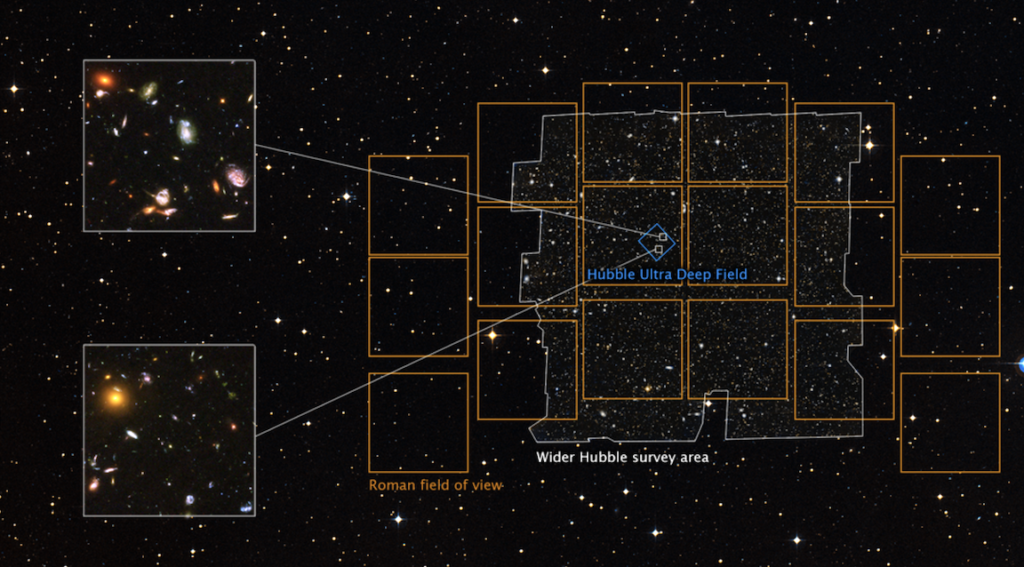
This composite image illustrates the possibility of a Roman Space Telescope “ultra deep field” observation. In a deep field, astronomers collect light from a patch of sky for an extended period of time to reveal the faintest and most distant objects. This view centers on the Hubble Ultra Deep Field (outlined in blue), which represents the deepest portrait of the universe ever achieved by humankind, at visible, ultraviolet and near-infrared wavelengths. Two insets reveal stunning details of the galaxies within the field. Beyond the Hubble Ultra Deep Field, additional observations obtained over the past two decades have filled in the surrounding space. These wider Hubble observations reveal over 265,000 galaxies, but are much shallower than the Hubble Ultra Deep Field in terms of the most distant galaxies observed. These Hubble images are overlaid on an even wider view using ground-based data from the Digitized Sky Survey. An orange outline shows the field of view of NASA’s upcoming Nancy Grace Roman Space Telescope. Roman’s 18 detectors will be able to observe an area of sky at least 100 times larger than the Hubble Ultra Deep Field at one time, with the same crisp sharpness as Hubble.
Credits: NASA, ESA, and A. Koekemoer (STScI); Acknowledgement: Digitized Sky Survey

One of the Hubble Space Telescope’s most iconic images is the Hubble Ultra Deep Field, which unveiled myriad galaxies across the universe, stretching back to within a few hundred million years of the Big Bang. Hubble peered at a single patch of seemingly empty sky for hundreds of hours beginning in September 2003, and astronomers first unveiled this galaxy tapestry in 2004, with more observations in subsequent years.

NASA’s upcoming Nancy Grace Roman Space Telescope will be able to photograph an area of the sky at least 100 times larger than Hubble with the same crisp sharpness. Among the many observations that will be enabled by this wide view of the cosmos, astronomers are considering the possibility and scientific potential of a Roman Space Telescope “ultra-deep field.” Such an observation could reveal new insights into subjects ranging from star formation during the universe’s youth to the way galaxies cluster together in space.

Roman will enable new science in all areas of astrophysics, from the solar system to the edge of the observable universe. Much of Roman’s observing time will be dedicated to surveys over wide swaths of the sky. However, some observing time will also be available for the general astronomical community to request other projects. A Roman ultra deep field could greatly benefit the scientific community, say astronomers.

“As a community science concept, there could be exciting science returns from ultra-deep field observations by Roman. We would like to engage the astronomical community to think about ways in which they could take advantage of Roman’s capabilities,” said Anton Koekemoer of the Space Telescope Science Institute in Baltimore, Maryland. Koekemoer presented the Roman ultra-deep field idea at the 237th meeting of the American Astronomical Society, on behalf of a group of astronomers spanning more than 30 institutions.

As an example, a Roman ultra-deep field could be similar to the Hubble Ultra Deep Field – looking in a single direction for a few hundred hours to build up an extremely detailed image of very faint, distant objects. Yet while Hubble snagged thousands of galaxies this way, Roman would collect millions. As a result, it would enable new science and vastly improve our understanding of the universe.

Structure and history of the universe

Perhaps most exciting is the possibility of studying the very early universe, which corresponds to the most distant galaxies. Those galaxies are also the rarest: for example, only a handful are seen in the Hubble Ultra Deep Field.

Thanks to Roman’s wide field of view and near-infrared data of similar quality to Hubble’s, it could discover many hundreds, or possibly thousands, of these youngest, most distant galaxies, interspersed among the millions of other galaxies. That would let astronomers measure how they group together in space as well as their ages and how their stars have formed.

“Roman would also yield powerful synergies with current and future telescopes on the ground and in space, including NASA’s James Webb Space Telescope and others,” said Koekemoer.

Moving forward in cosmic time, Roman would pick up additional galaxies that existed about 800 million to 1 billion years after the big bang. At that time, galaxies were just beginning to group together into clusters under the influence of dark matter. While researchers have simulated this process of forming large-scale structures, a Roman ultra-deep field would provide real world examples to test those simulations.

Star formation over cosmic time
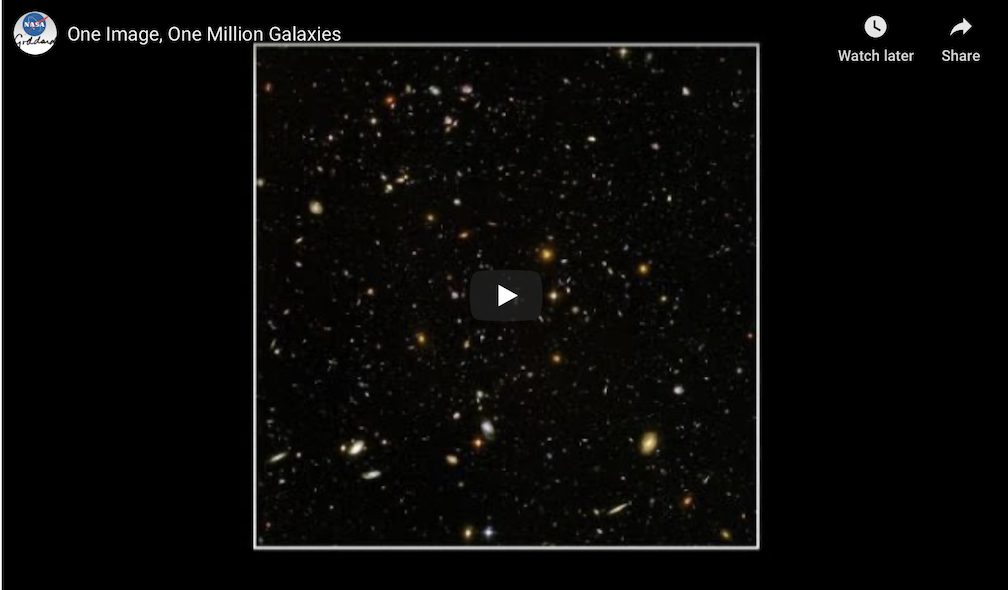
In 2003, Hubble captured its iconic Ultra Deep Field image, which changed our understanding of the universe. With 100 times more coverage, imagine what we could learn if the Nancy Grace Roman Space Telescope did the same.
Credits: NASA’s Goddard Space Flight Center

The early universe also experienced a firestorm of star formation. Stars were being born at rates hundreds of times faster than what we see today. In particular, astronomers are eager to study “cosmic dawn” and “cosmic noon,” which together cover a time 500 million to 3 billion years after the big bang when most star formation was happening, as well as when supermassive black holes were most active.

“Because Roman’s field of view is so large, it will be game changing. We would be able to sample not just one environment in a narrow field of view, but instead a variety of environments captured by Roman’s wide-eyed view. This will give us a better sense of where and when star formation was happening,” explained Sangeeta Malhotra of NASA Goddard Space Flight Center in Greenbelt, Maryland. Malhotra is a co-investigator on the Roman science investigation teams working on cosmic dawn, and has led programs that do deep spectroscopy with Hubble, to learn about distant, young galaxies.

Astronomers are eager to measure star formation rates in this distant epoch, which could influence a variety of factors such as the amount of heavy elements observed. Rates of star formation might depend on whether or not a galaxy lies within a large cluster. Roman will be capable of taking faint spectra that will show distinct “fingerprints” of these elements, and give accurate distances (called redshifts) of galaxies.

“Population experts might ask, what differences are there between people who live in big cities, versus those in suburbia, or rural areas? Similarly, as astronomers we can ask, do the most active star forming galaxies live in very clustered regions, or just at the edges of clusters, or do they live in isolation?” Malhotra said.

Big data and machine learning

One of the greatest challenges of the Roman mission will be learning how to analyze the abundance of scientific information in the public datasets that it will produce. In a sense, Roman will create new opportunities not only in terms of sky coverage, but also in data mining.

A Roman ultra-deep field would contain information on millions of galaxies – far too many to be studied by researchers one at a time. Machine learning – a form of artificial intelligence – will be needed to process the massive database. While this is a challenge, it also offers an opportunity. “You could explore completely new questions that you couldn’t previously address,” stated Koekemoer.

“The discovery potential enabled by the huge datasets from the Roman mission could lead to breakthroughs in our understanding of the universe, beyond what we might currently envision,” Koekemoer added. “That could be Roman’s lasting legacy for the scientific community: not only in answering the science questions we think we can address, but also new questions that we have yet to think of.”

Article from NASA

Filed Under: Government & Regulation, Market Forecasts

Primary Sidebar

Coverage

  • Missions & Constellations
  • Business & Finance
  • Military & Defense
  • Launch
  • Software Automation & Ground Systems
  • Government & Regulation
  • Services & Applications

Most Read Stories

  • SpaceX Loses Contact With Starlink Satellite
  • Rocket Lab Emerging as Potential Bus Provider for 2,800-Satellite Equatys Constellation
  • SpaceX Accelerates Record-Breaking IPO Following Trillion-Dollar xAI Merger
  • Planet Labs Imposes Indefinite Blackout on Iran Satellite Imagery at U.S. Request
  • Amazon in Reported Talks to Acquire Globalstar in $9 Billion Move to Challenge Starlink

Secondary Sidebar

Footer


Satnews is a leading provider of satellite news, events, publications, research and other satellite industry information in both commercial and military enterprises worldwide.

Stories By Category

  • Business & Finance
  • Government & Regulation
  • Launch
  • Military & Defense
  • Missions & Constellations
  • Services & Applications
  • Software Automation & Ground Systems
  • Spectrum & Licensing
  • Startups & NewSpace Business

About Us

  • Leadership & Editorial Team
  • SatNews History
  • Free Satnews Subscription
  • SatNews Events
  • Magazines

Navigation

  • Latest Stories
  • Magazines
  • Events
  • Contact
  • Cookie & Privacy Policy for Satnews

We use cookies to ensure that we give you the best experience on our website. If you continue to use this site we will assume that you are happy with it.
x
Sign up Now (For Free)
Access daily or weekly satellite news updates covering all aspects of the commercial and military satellite industry.
Invalid email address
Notify Me Regarding ( At least one ):
We value your privacy and will not sell or share your email or other information with any other company. You may also unsubscribe at anytime.

Click Here to see our full privacy policy.
Thanks for subscribing!