

• Skip to primary navigation
  • Skip to main content
  • Skip to primary sidebar
  • Skip to secondary sidebar
  • Skip to footer
  • NEWS:
  • SatNews
  • SatMagazine
  • MilSatMagazine
  • SmallSat News
  • |     EVENTS:
  • SmallSat Symposium
  • Satellite Innovation
  • MilSat Symposium
  • SmallSat Europe

SatNews

Satellite Industry Intelligence Since 1983

Subscribe
  • LATEST
  • SatNews Events
  • Magazines
  • Calendar
  • Subscribe
  • Missions & Constellations
    • Exploration & Science Missions
    • In-Orbit Servicing & Orbital Operations
    • LEO Constellations
    • Mission Autonomy & Onboard Systems
    • Mission Deployments & Manifests
    • Navigation & PNT
    • SmallSat
    • Spacecraft & Payload Technology
    View All in Missions & Constellations →
    Aerospace Experts Warn Against Fragmented Architecture for Future Crewed Mars MissionsAerospace Experts Warn Against Fragmented Architecture for Future Crewed Mars Missions
    South Korea Accelerates Uncrewed Lunar Landing Target to 2030 Under New KASA StrategySouth Korea Accelerates Uncrewed Lunar Landing Target to 2030 Under New KASA Strategy
    NASA Details Docking and Software Protocols for Revised Artemis III LEO DemonstrationNASA Details Docking and Software Protocols for Revised Artemis III LEO Demonstration
    Frontier Airlines and Indigo Partners Select Starlink for Multi-Airline Inflight ConnectivityFrontier Airlines and Indigo Partners Select Starlink for Multi-Airline Inflight Connectivity
  • Business
    • Contracts & Commercial Deals
    • Earnings & Financial Reporting
    • Events & Conferences
    • Funding & Venture Capital
    • Market Forecasts
    • Mergers & Acquisitions
    • Personnel Moves & Appointments
    View All in Business & Finance →
    Amazon Secures South African Market Entry Protocol via Herotel Distribution PartnershipAmazon Secures South African Market Entry Protocol via Herotel Distribution Partnership
    SES and Airbus Secure Site for Europe’s Flagship EAGLE-1 Quantum Optical Ground StationSES and Airbus Secure Site for Europe’s Flagship EAGLE-1 Quantum Optical Ground Station
    Viasat Integrates First Satellite Voice Call Capability into BMW iX3 PlatformViasat Integrates First Satellite Voice Call Capability into BMW iX3 Platform
    Terran Mobile Bundling Shifts Satellite Addressable Market RealitiesTerran Mobile Bundling Shifts Satellite Addressable Market Realities
  • Defense
    • Counterspace & ASAT
    • Defense Budgets & Procurement
    • ISR & Reconnaissance
    • MILSATCOM
    • Missile Warning & Defense
    • National Security Programs
    • Space Domain Awareness
    View All in Military & Defense →
    U.S. Space Force Finalizes Acquisition Restructuring Under Nine Mission PortfoliosU.S. Space Force Finalizes Acquisition Restructuring Under Nine Mission Portfolios
    Space Development Agency Awards $1.75 Billion for 36 Additional Missile-Tracking SatellitesSpace Development Agency Awards $1.75 Billion for 36 Additional Missile-Tracking Satellites
    Space ISAC to Convene Classified VOSS VII Summit in Colorado SpringsSpace ISAC to Convene Classified VOSS VII Summit in Colorado Springs
    Air Launch Died the Same Week Responsive Space ArrivedAir Launch Died the Same Week Responsive Space Arrived
  • Gov
    • Export Controls & Compliance
    • International Space Agreements
    • National Space Policy
    • Space Law & Treaties
    • Space Sustainability & Debris Policy
    • Space Traffic Management / Debris Removal
    View All in Government & Regulation →
    European Commission Defers Iliad-Altice Telecom Merger Review to French WatchdogEuropean Commission Defers Iliad-Altice Telecom Merger Review to French Watchdog
    ATVA Opposes Proposed FCC Order Replacing National Broadcast Ownership CapATVA Opposes Proposed FCC Order Replacing National Broadcast Ownership Cap
    FCC Authorizes Radio Operations for Reflect Orbital’s Light-Reflection Test SatelliteFCC Authorizes Radio Operations for Reflect Orbital’s Light-Reflection Test Satellite
    Balancing Orbit: How Regulators Trade Commercial Viability for National SecurityBalancing Orbit: How Regulators Trade Commercial Viability for National Security
  • Launch
    • Launch Providers
    • Launch Schedule & Calendars
    • Launch Sites & Infrastructure
    • Rocket Technology & Vehicles
    View All in Launch →
    AST SpaceMobile Defers Commercial Direct-to-Device Timeline to Early 2027AST SpaceMobile Defers Commercial Direct-to-Device Timeline to Early 2027
    China Achieves Historic First Orbital Booster Recovery via At-Sea Net SystemChina Achieves Historic First Orbital Booster Recovery via At-Sea Net System
    Blue Origin Insulates Lunar Landers from Launch Pad Recovery FalloutBlue Origin Insulates Lunar Landers from Launch Pad Recovery Fallout
    South Korea Formally Ratifies 2035 “K-Starlink” Low Earth Orbit Constellation PlanSouth Korea Formally Ratifies 2035 “K-Starlink” Low Earth Orbit Constellation Plan
  • Software
    • Autonomous Ground Operations
    • Data Processing & AI/ML
    • Digital Twins & Modeling
    • Ground Segment & Teleports
    • Mission Planning & Simulation
    • Space Systems Software Engineering
    • Spectrum & Licensing
    View All in Software Automation & Ground Systems →
    Gilat Satellite Networks Secures $20 Million SkyEdge Ground Segment OrderGilat Satellite Networks Secures $20 Million SkyEdge Ground Segment Order
    Keysight and Sateliot Secure ESA Award for Blockchain-Anchored 5G NTN SecurityKeysight and Sateliot Secure ESA Award for Blockchain-Anchored 5G NTN Security
    Seiren Solidifies Ground Segment Framework for FUSION-1 SmallSat Mission Through SSC and Infostellar PartnershipSeiren Solidifies Ground Segment Framework for FUSION-1 SmallSat Mission Through SSC and Infostellar Partnership
    Powering the Automated Floor: Intralogistics Operators Must Unify AGV Charging InfrastructurePowering the Automated Floor: Intralogistics Operators Must Unify AGV Charging Infrastructure
  • Services & Apps
    • Climate & Environmental Monitoring
    • Disaster Response & Security Mapping
    • Earth Observation & Imaging
    • Maritime & Aviation Satcom
    • Satellite Communications
    View All in Services & Applications →
    Ground Control Deploys RockFLEET for Large-Scale Turkish Fisheries VMS ProgramGround Control Deploys RockFLEET for Large-Scale Turkish Fisheries VMS Program
    Rocket Lab Consolidates Vertical Integration Across Satellite Communications MarketRocket Lab Consolidates Vertical Integration Across Satellite Communications Market
    Astrolight Framework Urges Industrialized Laser Backbone to Protect European Space AutonomyAstrolight Framework Urges Industrialized Laser Backbone to Protect European Space Autonomy
    ESA Backs TUSK IC to Commercialize Made-in-Europe Ka-Band Flat-Panel Antenna SiliconESA Backs TUSK IC to Commercialize Made-in-Europe Ka-Band Flat-Panel Antenna Silicon

NASA—Fueling Around (Satellites)

August 5, 2013


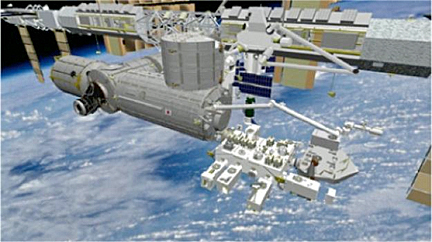
Computer model showing the Japanese Experiment Module on the International Space Station. (Credit: JAXA)

[SatNews] “Just like robotic refueling, there were a lot of folks who said that this simply couldn’t be done…”

It may be called the Robotic Refueling Mission (RRM), but NASA’s RRM was built to demonstrate much more than the clever ways space robots can fill up satellites. With the launch of new hardware to the International Space Station on August 3rd., RRM—recently named a “Top Exploration Technology Application From the International Space Station in 2012″—will be outfitted to practice a new set of satellite-servicing activities.
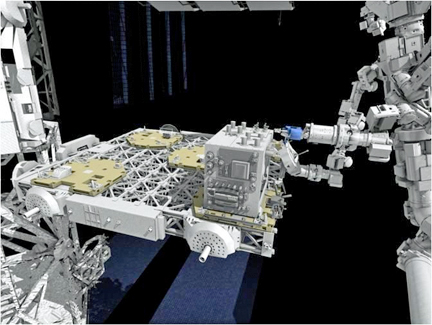

This artistic representation shows ISS’s Dextre robot (right) performing a robotic refueling task on RRM (center), mounted to ELC4. Image courtesy of NASA.
Earlier in 2013, RRM demonstrated remotely controlled robots using today’s technology could refuel satellites not designed to be serviced. RRM tests from January 14th. to 25th. culminated in a first-of-its-kind robotic fluid transfer. Following the success of completing this namesake task, in 2014 RRM will demonstrate how space robots can replenish cryogen (a type of refrigerant) in the instruments of legacy satellites—existing, orbiting spacecraft not originally designed to be serviced.

“Just like robotic refueling, there were a lot of folks who said that this simply couldn’t be done,” says Benjamin Reed, deputy project manager of the Satellite Servicing Capabilities Office (SSCO) at NASA’s Goddard Space Flight Center in Greenbelt, Maryland. “But that’s the whole point of the RRM demonstrations — and the beauty of being able to execute them on such an extraordinary test bed as the space station. RRM is allowing us to show that the robotic satellite-servicing tools, technologies and techniques are mature and ready, because we’ve proven them on orbit.”
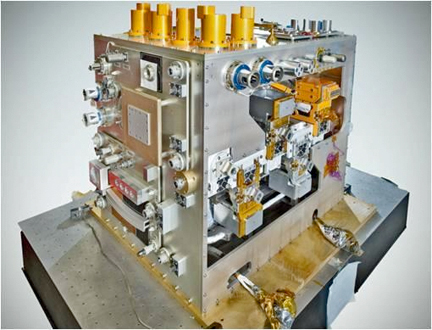

The RRM payload box is peppered with refueling components and activity boards and contains a fluid transfer system. Four unique tools are stowed within RRM until Dextre retrieves them. Photo courtesy of NASA.
New hardware deliveries to the space station will outfit the RRM module for this upcoming set of operations. The Japanese HTV cargo vehicle, currently scheduled to launch on August 3rd., will deliver a new task board and the RRM On-orbit Transfer Cage (ROTC), an original device designed to transfer hardware outside of the space station. Astronauts will mount the ROTC on the sliding table within the Japanese airlock and then install the task board onto the ROTC, giving the Canadian Dextre robot an easy platform from which to retrieve and subsequently install the new hardware.

A second shipment in 2014 will bring a second task board and a new device called the Visual Inspection Poseable Invertebrate Robot (VIPIR). This SSCO-built borescope inspection tool provides a set of eyes for internal satellite repair jobs. Both also will be transferred and installed on RRM via the Japanese airlock, ROTC and Dextre.

With the help of the twin-armed Dextre robot, the newly installed RRM task boards, and the RRM tools, the RRM team will then work its way through intermediate steps leading up to cryogen replenishment. After retrofitting valves with new hardware, peering into dark places with the aid of VIPIR and creating a pressure-tight seal, the RRM and Dextre duo will stop short of actual cryogen transfer for this round of tasks.

RRM Phase 2 operations are scheduled to begin in 2014. Initial activities to demonstrate this in-orbit capability—cutting wires and removing caps—were completed in 2012 with the aid of the original RRM tools and activity boards.
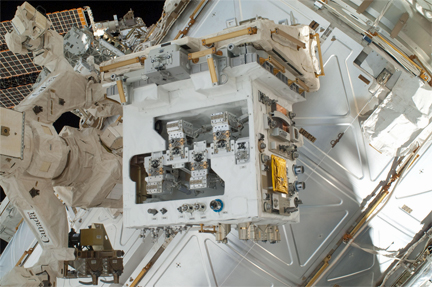

With the International Space Station’s accordion solar array in the background, the Dextre “OTCM” (at end of arm) uses its built-in cameras and lights to scan the Robotic Refueling Mission module during the Vision Task. This data will help develop machine vision algorithms against the harsh lighting on orbit, aiding future autonomous robotic operations beyond RRM. Image courtesy of NASA.

“It’s all about expanding options for fleet operators, in both the government and the commercial sectors,” Reed said. “Instead of retiring an aging observatory or spacecraft — and perhaps launching a new, costly, one — [operators] could choose to extend their lives by calling on a future cryogen-toting space tow truck. The RRM demonstrations are an important step to eventually enabling this capability.”

“Since its launch to the ISS in 2011 on the last shuttle mission, RRM has been steadily practicing robotic satellite-servicing activities on orbit,” says Jill McGuire, RRM project manager at SSCO. “A joint effort with the Canadian Space Agency, RRM uses the space station as a test bed for technology research and development.”

On July 17, RRM was named a “Top Exploration Technology Application from the International Space Station in 2012” at the second international ISS Research and Development Conference in Denver. McGuire accepted on behalf of the team. NASA developed RRM to demonstrate how remotely-operated robot mechanics could extend the lives of the hundreds of satellites residing in geosynchronous-Earth orbit (GEO). Costly assets traveling about 22,000 miles above Earth, GEO spacecraft deliver such essential services as weather reports, cell phone communications, television broadcasts, government communications and air traffic management. Servicing capabilities could greatly expand the options for government and commercial fleet operators in the future. They could potentially deliver satellite owners significant savings in spacecraft replacement and launch costs.

NASA continues to test capabilities for a new robotic servicing frontier. In conjunction with RRM, the SSCO team has been studying a conceptual servicing mission while building the necessary technologies, including an autonomous rendezvous and capture system, a propellant transfer system and specialized algorithms to orchestrate and synchronize satellite-servicing operations.

(Source: NASA. “Japanese vehicle delivers new hardware for NASA’s robotic refueling mission.” ScienceDaily, 2 Aug. 2013. Web. 4 Aug. 2013.)

Filed Under: In-Orbit Servicing & Orbital Operations

Primary Sidebar

Coverage

  • Missions & Constellations
  • Business & Finance
  • Military & Defense
  • Launch
  • Software Automation & Ground Systems
  • Government & Regulation
  • Services & Applications

Most Read Stories

  • Arianespace fights back – possibly!
  • AST SpaceMobile Finalizes Assembly of Next-Generation BlueBirds for August SpaceX Launch
  • SpaceX Controlled-Deorbit Report Discloses Decommissioning of 260 Starlink Satellites Over Six Months
  • BNP Paribas Outlines Steep Regulatory Obstacles in SpaceX Mobile Integration Strategy
  • SpaceX Files FCC Application for 100,000 Third-Generation Starlink Satellites

Secondary Sidebar

Footer


Satnews is a leading provider of satellite news, events, publications, research and other satellite industry information in both commercial and military enterprises worldwide.

Stories By Category

  • Business & Finance
  • Government & Regulation
  • Launch
  • Military & Defense
  • Missions & Constellations
  • Services & Applications
  • Software Automation & Ground Systems
  • Spectrum & Licensing
  • Startups & NewSpace Business

About Us

  • Leadership & Editorial Team
  • SatNews History
  • Free Satnews Subscription
  • SatNews Events
  • Magazines

Navigation

  • Latest Stories
  • Magazines
  • Events
  • Contact
  • Cookie & Privacy Policy for Satnews

We use cookies to ensure that we give you the best experience on our website. If you continue to use this site we will assume that you are happy with it.
x
Sign up Now (For Free)
Access daily or weekly satellite news updates covering all aspects of the commercial and military satellite industry.
Invalid email address
Notify Me Regarding ( At least one ):
We value your privacy and will not sell or share your email or other information with any other company. You may also unsubscribe at anytime.

Click Here to see our full privacy policy.
Thanks for subscribing!
