

• Skip to primary navigation
  • Skip to main content
  • Skip to primary sidebar
  • Skip to secondary sidebar
  • Skip to footer
  • NEWS:
  • SatNews
  • SatMagazine
  • MilSatMagazine
  • SmallSat News
  • |     EVENTS:
  • SmallSat Symposium
  • Satellite Innovation
  • MilSat Symposium
  • SmallSat Europe

SatNews

Satellite Industry Intelligence Since 1983

Subscribe
  • LATEST
  • SatNews Events
  • Magazines
  • Calendar
  • Subscribe
  • Missions & Constellations
    • Exploration & Science Missions
    • In-Orbit Servicing & Orbital Operations
    • LEO Constellations
    • Mission Autonomy & Onboard Systems
    • Mission Deployments & Manifests
    • Navigation & PNT
    • SmallSat
    • Spacecraft & Payload Technology
    View All in Missions & Constellations →
    The Astronaut Wears Prada. Axiom Space and the Inner Layer of Next-Generation Lunar SpacesuitThe Astronaut Wears Prada. Axiom Space and the Inner Layer of Next-Generation Lunar Spacesuit
    Analyst Projects Massive Subscription Growth for Starlink Ahead of Imminent SpaceX IPOAnalyst Projects Massive Subscription Growth for Starlink Ahead of Imminent SpaceX IPO
    Emergency Alert on the ISS: NASA Orders Safe Haven Amid Russian Module Leak RepairsEmergency Alert on the ISS: NASA Orders Safe Haven Amid Russian Module Leak Repairs
    KSAT and iQPS Expand Strategic Alliance to Accelerate High-Frequency SAR ConstellationKSAT and iQPS Expand Strategic Alliance to Accelerate High-Frequency SAR Constellation
  • Business
    • Contracts & Commercial Deals
    • Earnings & Financial Reporting
    • Events & Conferences
    • Funding & Venture Capital
    • Market Forecasts
    • Mergers & Acquisitions
    • Personnel Moves & Appointments
    View All in Business & Finance →
    Brian Hughes Appointed as New Director of NASA’s Kennedy Space Center to Oversee Surging Launch DemandBrian Hughes Appointed as New Director of NASA’s Kennedy Space Center to Oversee Surging Launch Demand
    Beyond Mega-Constellations: Iridium and Globalstar Emerge as Prime Defense and IoT Investment PlaysBeyond Mega-Constellations: Iridium and Globalstar Emerge as Prime Defense and IoT Investment Plays
    SpaceX IPO: Will all that glitters turn to…….?SpaceX IPO: Will all that glitters turn to…….?
    Pilot Photonics Secures €1M ESA Contract to Advance Space PhotonicsPilot Photonics Secures €1M ESA Contract to Advance Space Photonics
  • Defense
    • Counterspace & ASAT
    • Defense Budgets & Procurement
    • ISR & Reconnaissance
    • MILSATCOM
    • Missile Warning & Defense
    • National Security Programs
    • Space Domain Awareness
    View All in Military & Defense →
    American military space closed around one company in seven daysAmerican military space closed around one company in seven days
    MDA Space Selected by BAE Systems for U.S. Space Force Missile Warning ConstellationMDA Space Selected by BAE Systems for U.S. Space Force Missile Warning Constellation
    ParaZero Secures First DefendAir Order from U.S. Tier-1 Defense CorporationParaZero Secures First DefendAir Order from U.S. Tier-1 Defense Corporation
    Northrop Grumman Partners with Apex for Space-Based Interceptors Targeting 2027 DeliveryNorthrop Grumman Partners with Apex for Space-Based Interceptors Targeting 2027 Delivery
  • Gov
    • Export Controls & Compliance
    • International Space Agreements
    • National Space Policy
    • Space Law & Treaties
    • Space Sustainability & Debris Policy
    • Space Traffic Management / Debris Removal
    View All in Government & Regulation →
    Major opportunities for 2 GHz over EuropeMajor opportunities for 2 GHz over Europe
    “Dual-use” is the funding word. It’s also the label operators want off.“Dual-use” is the funding word. It’s also the label operators want off.
    Sovereignty got an answer on Day 3. Two answers, actually, and a commercial veto.Sovereignty got an answer on Day 3. Two answers, actually, and a commercial veto.
    Dependency killed the old debate. Sovereignty is the new one, and Europe hasn’t agreed what it means.Dependency killed the old debate. Sovereignty is the new one, and Europe hasn’t agreed what it means.
  • Launch
    • Launch Providers
    • Launch Schedule & Calendars
    • Launch Sites & Infrastructure
    • Rocket Technology & Vehicles
    View All in Launch →
    Twelve Scientific Payloads Experience Microgravity Aboard SubOrbital Express-5Twelve Scientific Payloads Experience Microgravity Aboard SubOrbital Express-5
    Amazon Leo Constellation Surpasses 330 Satellites Following Latest Atlas V LaunchAmazon Leo Constellation Surpasses 330 Satellites Following Latest Atlas V Launch
    If You Thought Space Was Hard Try to Get Your Satellite On a RocketIf You Thought Space Was Hard Try to Get Your Satellite On a Rocket
    Blue Origin Suffers Major Setback as New Glenn Rocket Explodes During Static Fire TestBlue Origin Suffers Major Setback as New Glenn Rocket Explodes During Static Fire Test
  • Software
    • Autonomous Ground Operations
    • Data Processing & AI/ML
    • Digital Twins & Modeling
    • Ground Segment & Teleports
    • Mission Planning & Simulation
    • Space Systems Software Engineering
    • Spectrum & Licensing
    View All in Software Automation & Ground Systems →
    KSAT and Axelspace Expand Strategic Partnership to Accelerate Earth ObservationKSAT and Axelspace Expand Strategic Partnership to Accelerate Earth Observation
    Europe has ships. SmallSat Europe said it doesn’t have ports.Europe has ships. SmallSat Europe said it doesn’t have ports.
    The orbital data center thesis just became an economics question.The orbital data center thesis just became an economics question.
    AI just reached production in European space. The trust problem is what comes next.AI just reached production in European space. The trust problem is what comes next.
  • Services & Apps
    • Climate & Environmental Monitoring
    • Disaster Response & Security Mapping
    • Earth Observation & Imaging
    • Maritime & Aviation Satcom
    • Satellite Communications
    View All in Services & Applications →
    Viasat Secures Lockheed Martin Contract for NOAA’s Next-Generation AircraftViasat Secures Lockheed Martin Contract for NOAA’s Next-Generation Aircraft
    SES Partners with Viva to Launch Multi-Orbit In-Flight ConnectivitySES Partners with Viva to Launch Multi-Orbit In-Flight Connectivity
    Resolve Optics Delivers Radiation-Resistant Lenses for LEO SatellitesResolve Optics Delivers Radiation-Resistant Lenses for LEO Satellites
    SITAEL Unveils €200 Million Growth Strategy and ESA Mission Contract at SmallSat EuropeSITAEL Unveils €200 Million Growth Strategy and ESA Mission Contract at SmallSat Europe

SpaceX…It’s A First…A Dragon’s Berth Day At The ISS… One Hour Early

March 3, 2013

[SatNews] Private enterprise has accomplished a major task in space.

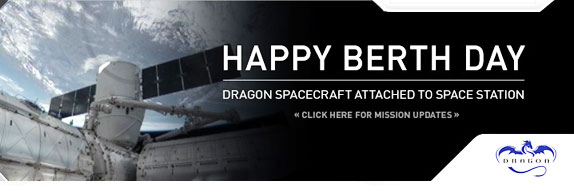
SpaceX’s Dragon spacecraft was berthed to the International Space Station at approximately 8:56 a.m. EST Sunday, installed onto the Earth-facing port of the Harmony module. Dragon arrived to station with over 2,300 pounds of cargo and packaging to ensure safe travel, and during the next 22 days, astronauts will unload and then load cargo, including materials to support critical science experiments.


The SpaceX Dragon capsule was berthed to the Harmony module of the International Space Station at 8:56 a.m. EST. The hatch between the newly arrived spacecraft and the Harmony module of the space station is scheduled to be opened tomorrow. The capsule is scheduled to spend 22 days attached to the station.

Dragon will return to Earth with over 3,000 pounds of cargo, and has a targeted splashdown in the Pacific Ocean off the coast of Baja, California on March 25. Dragon is the only spacecraft in the world today capable of returning significant amounts of cargo to Earth.

  “SpaceX is proud to execute this important work for NASA, and we’re thrilled to bring this capability back to the United States,” said Gwynne Shotwell, President of SpaceX. “Today’s launch continues SpaceX’s long-term partnership with NASA to provide reliable, safe transport of cargo to and from the station, enabling beneficial research and advancements in technology and research.”

A second contracted flight for the SpaceX Dragon spacecraft to the International Space Station will be twice as nice for researchers working with investigations on the orbiting laboratory. While other cargo ships can bring research payloads to the station, only the Dragon and the Russian Soyuz can safely get the cargo home. Scientists in the United States, Canada, France and Japan—and several high school students—are awaiting the return of their research studying a wide range of subjects, from plants to liquid crystals.

Information from NASA regarding the project…

The Dragon capsule is scheduled to launch March 1 on a Falcon 9 rocket, carrying about 1,268 pounds (575 kilograms) of supplies. On March 2, Expedition 34 commander Kevin Ford and Flight Engineer Tom Marshburn of NASA will grab the capsule with the station’s robotic arm and attach it to the Harmony module, where it will stay for about three weeks. Dragon is scheduled to return to Earth on March 25, bringing home nearly double the amount of supplies it brought up — about 2,668 pounds (1,210 kilograms). Returning investigation samples will demonstrate how life in microgravity affects the growth of plant seedlings, changes to the human body, the behavior of semiconductors and detergents, and more.
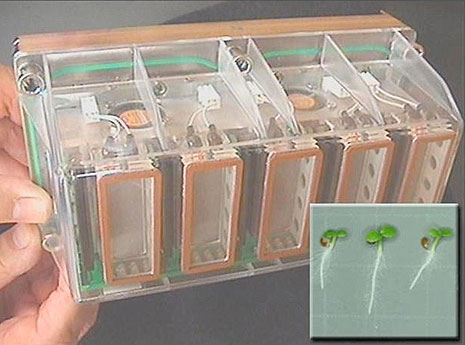

The Experiment Container with Plant Seedling Seed Cassettes (seedlings, inset lower right) is an example of the samples returning aboard the SpaceX Dragon vehicle for ground analysis. (NASA)

Several studies involve a small flowering plant called thale cress, or Arabidopsis thaliana, which is essentially the lab mouse of plant research. The Plant Signaling investigation and Biological Research in Canisters (BRIC) 17-1 both study how the plants’ gene expressions change in microgravity. Scientists think plant cells living in space do not behave the same way as cells in plants on Earth, and the experiments will examine these changes on a molecular level.

In BRIC 17-1, cell cultures derived from thale cress plants are grown in Petri dishes and later examined to determine which genes are involved in certain cellular changes. A related experiment, BRIC 17-2, exposes thale cress seedlings to low oxygen levels to examine its effects on the health of their roots. The BRIC investigations will be delivered to station aboard Dragon and will come home after its three-week stay. These experiments will help biologists understand how plants respond to microgravity, which will improve efforts aimed at growing food in space — a crucial component of long-duration missions to Mars or elsewhere in the solar system. It can also inform crop production here on Earth.

Another study making a round trip with Dragon will look at how metal mixtures solidify. Coarsening in Solid Liquid Mixtures-3 (CSLM-3) examines the growth and solidification of lead-based liquids that contain small amounts of tin. When the liquid solidifies, the tin forms small branch-like structures called dendrites. By using tiny amounts of tin, scientists can observe single dendrites at a time, which would be impossible on the ground because of gravity’s effects. By understanding how temperatures and time control the growth of these dendrites, materials scientists may find new ways to produce materials from molten metals.
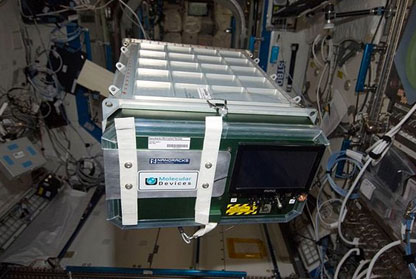

The NanoRacks Plate Reader, shown here, will enable in orbit analysis of research samples for certain studies aboard the International Space Station. (NASA)

Microgravity research can also benefit scientists trying to improve the shelf life of consumer products like toothpaste and laundry detergent. Dragon is delivering the Advanced Colloids Experiment-M-1 (ACE-M-1) investigation on behalf of Procter & Gamble, which owns several brands of personal care products.    ACE-M-1 testing will take advantage of the microgravity environment of station to study how microscopic particles spread out and clump together in gels and creams. Particle additives can make a product last longer by maintaining its consistency, but they sink and clump together after a certain amount of time, which can spoil a product. It’s difficult to study these dynamics on Earth because gravity gets in the way, making the space station an ideal research platform for these important industrial processes.

Along with scientists from NASA centers and private industry, plenty of students are excited for the deployment of their own experiments, facilitated by the NanoRacks system. Students from several California schools developed investigations to study bacteria, iron corrosion, battery performance and carbon dioxide levels aboard station, all of which will be delivered by Dragon.

Finally, the Wet Lab Kit will provide crew members with frequently-used tools and supplies needed to perform in-orbit experiment sample manipulation and analysis. Wetlab will increase experiments’ science return while decreasing the time between investigations.

Dragon as a mode of return transport also increases the station’s science return, an important capability to retrieve samples for analysis on the ground. Samples taken from the crew support human health studies in microgravity, such as the Nutrition investigation. Astronauts already provide blood and urine samples before and after flight so scientists can examine changes to their metabolism, but Dragon’s cold stowage capability will allow scientists to examine samples returned in the middle of the crew’s mission.

Additionally, the returning Dragon capsule will bring back several “space fish,” Japanese Medaka fish (Oryzias latipes) that lived on the station since October 2012. Researchers in Japan will study changes in the bone density of the fish in the Medaka Osteoclast investigation Dragon’s round-trip carrying capacity also will help scientists build upon their previous work and explore new questions. After this month’s delivery, the cargo ship could have even more to bring home on its next trip — the third time will be a charm.

Rebecca Boyle’s article International Space Station Program Science Office can be found here

Filed Under: In-Orbit Servicing & Orbital Operations, Launch Providers

Primary Sidebar

Coverage

  • Missions & Constellations
  • Business & Finance
  • Military & Defense
  • Launch
  • Software Automation & Ground Systems
  • Government & Regulation
  • Services & Applications

Most Read Stories

  • SmallSat Europe Speaker Focus: Frank M. Salzgeber, Nadir Space Venture
  • SpaceX Debuts Starship V3: Redefining Heavy-Lift Launch Capability
  • SpaceX Is Worth $1.75 Trillion. Only 7% of That Is Real.
  • FCC Approves Landmark Spectrum Sharing and Direct-to-Device Frameworks
  • SpaceX: 10,000 Launches Annually

Secondary Sidebar

Footer


Satnews is a leading provider of satellite news, events, publications, research and other satellite industry information in both commercial and military enterprises worldwide.

Stories By Category

  • Business & Finance
  • Government & Regulation
  • Launch
  • Military & Defense
  • Missions & Constellations
  • Services & Applications
  • Software Automation & Ground Systems
  • Spectrum & Licensing
  • Startups & NewSpace Business

About Us

  • Leadership & Editorial Team
  • SatNews History
  • Free Satnews Subscription
  • SatNews Events
  • Magazines

Navigation

  • Latest Stories
  • Magazines
  • Events
  • Contact
  • Cookie & Privacy Policy for Satnews

We use cookies to ensure that we give you the best experience on our website. If you continue to use this site we will assume that you are happy with it.
x
Sign up Now (For Free)
Access daily or weekly satellite news updates covering all aspects of the commercial and military satellite industry.
Invalid email address
Notify Me Regarding ( At least one ):
We value your privacy and will not sell or share your email or other information with any other company. You may also unsubscribe at anytime.

Click Here to see our full privacy policy.
Thanks for subscribing!