

A phenomenon was recorded by imagers aboard NASA‘s Deep Impact spacecraft from Sept. 9 to 17 during pre-planned scientific observations of the comet. These observations, when coupled with expected images during the closest encounter with Hartley 2 on Nov. 4, will become the most detailed look yet at a comet’s activity during its pass through the inner-solar system.
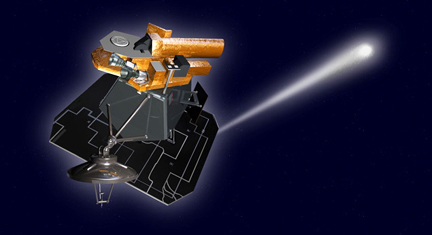
NASA’s Deep Impact/EPOXI spacecraft flew past Earth on June 27, 2010, to get a boost from Earth’s gravity. It is now on its way to comet Hartley 2, depicted in this artist’s concept, with a planned flyby this fall. Image credit: NASA/JPL-Caltech
The new phenomenon is unlike typical cometary outbursts, which have sudden onsets and are usually accompanied by considerable dust. It also seems unrelated to the cyanide jets that are sometimes seen in comets. The EPOXI science team believes that astronomers and interested observers viewing the comet from Earth should be aware of this type of activity when planning observations and interpreting their data. “If observers monitoring Hartley 2 do not take into account this new phenomenon, they could easily get the wrong picture of how the comet is changing as it approaches and recedes from the sun,” said A’Hearn.
Cyanide is a carbon-based molecule. It is believed that billions of years ago, a bombardment of comets carried cyanide and other building blocks of life to Earth. The name EPOXI itself is a combination of the names for the two extended mission components: the extrasolar planet observations, called Extrasolar Planet Observations and Characterization (EPOCh), and the flyby of comet Hartley 2, called the Deep Impact Extended Investigation (DIXI). The spacecraft will continue to be referred to as “Deep Impact.”
