

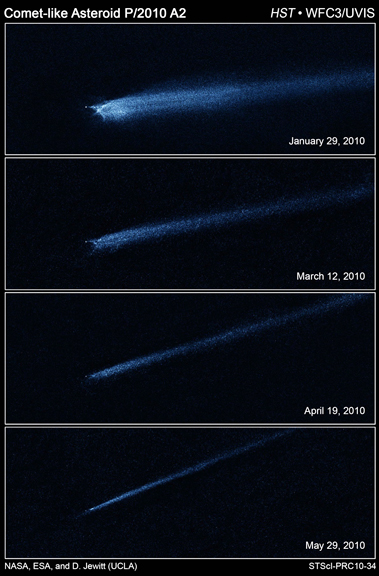
These four Hubble Space Telescope images, taken over a five-month period, show the odd-shaped debris that likely came from a collision between two asteroids. Credit: NASA, ESA, and D. Jewitt (UCLA)
Catching colliding asteroids is difficult because large impacts are rare while small ones, such as the one that produced P/2010 A2, are exceedingly faint. The two asteroids that make up P/2010 A2 were unknown before the collision because they were too faint to be noticed. The collision itself was unobservable because of the asteroids’ position in relation to the sun. About 10 or 11 months later, in January 2010, the Lincoln Near-Earth Research (LINEAR) Program Sky Survey spotted the comet-like tail produced by the collision. But only Hubble discerned the X pattern, offering unequivocal evidence that something stranger than a comet outgassing had occurred. Although the Hubble images give compelling evidence for an asteroid collision, Jewitt says he still does not have enough information to rule out other explanations for the peculiar object. In one such scenario, a small asteroid’s rotation increases from solar radiation and loses mass, forming the comet-like tail.
The Hubble images, taken from January to May 2010 with the telescope’s Wide Field Camera 3, reveal a point-like object about 400 feet wide, with a long, flowing dust tail behind a never-before-seen X pattern. Particle sizes in the tail are estimated to vary from about 1/25th of an inch to an inch in diameter. The 400-foot-wide object in the Hubble image is the remnant of a slightly larger precursor body. Astronomers think a smaller rock, perhaps 10 to 15 feet wide, slammed into the larger one. The pair probably collided at high speed, about 11,000 mph, which smashed and vaporized the small asteroid and stripped material from the larger one. Jewitt estimates that the violent encounter happened in February or March 2009 and was as powerful as the detonation of a small atomic bomb. Sunlight radiation then swept the debris behind the remnant asteroid, forming a comet-like tail. The tail contains enough dust to make a ball 65 feet wide, most of it blown out of the bigger body by the impact-caused explosion. The science journal Nature will publish the findings in the Oct. 14 issue.
Astronomers do not have a good explanation for the X shape. The crisscrossed filaments at the head of the tail suggest that the colliding asteroids were not perfectly symmetrical. Material ejected from the impact, therefore, did not make a symmetrical pattern, a bit like the ragged splash made by throwing a rock into a lake. Larger particles in the X disperse very slowly and give this structure its longevity. Astronomers plan to use Hubble again next year to view the object. Jewitt and his colleagues hope to see how far the dust has been swept back by the sun’s radiation and how the mysterious X-shaped structure has evolved.
