

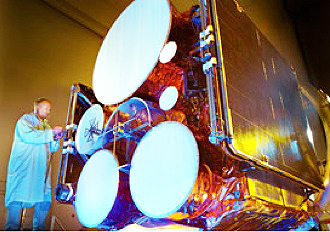
 The U.S. Air Force’s Defense Satellite Communications System (DSCS) B8 satellite, built by Lockheed Martin [NYSE: LMT], has now surpassed its 10-year design life of on-orbit service in providing secure and reliable communications capabilities for the warfighter. Launched from Cape Canaveral on Jan. 20, 2000, the B8 satellite is one of 14 DSCS III spacecraft designed and built by Lockheed Martin Space Systems for the MILSATCOM Systems Wing at the Air Force’s Space and Missile Systems Center, Los Angeles Air Force Base, California.
The satellite is also the first of four DSCS III satellites to feature Service Life Enhancement Program (SLEP) upgrades that enabled a 200-percent increase in communication capacity over original DSCS III spacecraft with its 50-watt Traveling Wave Tube Amplifiers. The system provides uninterrupted secure voice and high-data rate communications to Department of Defense users; essential tools in monitoring events and deploying and sustaining forces anywhere in the world. In 2009, the overall DSCS III constellation surpassed 200 years of on-orbit operations, the longest total operational experience of any U.S. military communications satellite constellation.
Lockheed Martin is also progressing on the Department of Defense’s highly secure communications satellite system, the Advanced Extremely High Frequency (AEHF) program. As the successor to Milstar, AEHF will increase data rates by a factor of five, permitting transmission of more tactical military communications, such as real-time video, battlefield maps and targeting data. The first AEHF spacecraft has completed final testing and is planned for delivery to the Air Force in second quarter 2010.
