

• Skip to primary navigation
  • Skip to main content
  • Skip to primary sidebar
  • Skip to secondary sidebar
  • Skip to footer
  • NEWS:
  • SatNews
  • SatMagazine
  • MilSatMagazine
  • SmallSat News
  • |     EVENTS:
  • SmallSat Symposium
  • Satellite Innovation
  • MilSat Symposium
  • SmallSat Europe

SatNews

Satellite Industry Intelligence Since 1983

Subscribe
  • LATEST
  • SatNews Events
  • Magazines
  • Calendar
  • Subscribe
  • Missions & Constellations
    • Exploration & Science Missions
    • In-Orbit Servicing & Orbital Operations
    • LEO Constellations
    • Mission Autonomy & Onboard Systems
    • Mission Deployments & Manifests
    • Navigation & PNT
    • SmallSat
    • Spacecraft & Payload Technology
    View All in Missions & Constellations →
    FCC Moves to Mirror Foreign Satellite Rules Ahead of December VoteFCC Moves to Mirror Foreign Satellite Rules Ahead of December Vote
    Cerberus Capital Management to Acquire Airbus U.S. Space & Defense Satellite Manufacturing UnitCerberus Capital Management to Acquire Airbus U.S. Space & Defense Satellite Manufacturing Unit
    NATO NCIA Plans EUR 2.7 Billion in Commercial Contracts Through 2028 as Space Share RisesNATO NCIA Plans EUR 2.7 Billion in Commercial Contracts Through 2028 as Space Share Rises
    Radiation-Resistant Lens Designs Adapt to Accelerate Space Payload ProductionRadiation-Resistant Lens Designs Adapt to Accelerate Space Payload Production
  • Business
    • Contracts & Commercial Deals
    • Earnings & Financial Reporting
    • Events & Conferences
    • Funding & Venture Capital
    • Market Forecasts
    • Mergers & Acquisitions
    • Personnel Moves & Appointments
    View All in Business & Finance →
    Seibersdorf Laboratories and Tumbleweed Partner on Microgravity R&D Service for Pharma and BiotechSeibersdorf Laboratories and Tumbleweed Partner on Microgravity R&D Service for Pharma and Biotech
    Build, Buy or Merge: Satellite Companies Move to Own Their LaunchBuild, Buy or Merge: Satellite Companies Move to Own Their Launch
    Early Signals, 2016: SpaceX’s First Backer Opened the First SmallSat SymposiumEarly Signals, 2016: SpaceX’s First Backer Opened the First SmallSat Symposium
    EnSilica Reaches Initial Agreement for $80 Million Resilient GNSS ASIC ProgramEnSilica Reaches Initial Agreement for $80 Million Resilient GNSS ASIC Program
  • Defense
    • Counterspace & ASAT
    • Defense Budgets & Procurement
    • ISR & Reconnaissance
    • MILSATCOM
    • Missile Warning & Defense
    • National Security Programs
    • Space Domain Awareness
    View All in Military & Defense →
    ARES Shield AI Completes First In-Orbit Object Detection Test Aboard D-Orbit SpacecraftARES Shield AI Completes First In-Orbit Object Detection Test Aboard D-Orbit Spacecraft
    A Second LEO Network Has Paying Customers and a Launch ProblemA Second LEO Network Has Paying Customers and a Launch Problem
    GAO Finds Pentagon Lacks Coordinated View of Military Space Supply Chain RisksGAO Finds Pentagon Lacks Coordinated View of Military Space Supply Chain Risks
    Orbital Proximity Incidents Mask Broader Satellite Jamming ThreatOrbital Proximity Incidents Mask Broader Satellite Jamming Threat
  • Gov
    • Export Controls & Compliance
    • International Space Agreements
    • National Space Policy
    • Space Law & Treaties
    • Space Sustainability & Debris Policy
    • Space Traffic Management / Debris Removal
    View All in Government & Regulation →
    United States Finalizes 20 Agenda Item Positions Ahead of WRC-27 Spectrum NegotiationsUnited States Finalizes 20 Agenda Item Positions Ahead of WRC-27 Spectrum Negotiations
    FCC Upper C-Band Auction 115 Creates Indirect Spectrum and Market Shifts for SmallSat and LEO OperatorsFCC Upper C-Band Auction 115 Creates Indirect Spectrum and Market Shifts for SmallSat and LEO Operators
    FCC Sets April 27, 2027 Start Date for Upper C-Band Auction, Pressuring BroadcastersFCC Sets April 27, 2027 Start Date for Upper C-Band Auction, Pressuring Broadcasters
    Senate Appropriators Move to Bar Sole-Source Awards Over $100 Million for Space Data Network and SB-AMTISenate Appropriators Move to Bar Sole-Source Awards Over $100 Million for Space Data Network and SB-AMTI
  • Launch
    • Launch Providers
    • Launch Schedule & Calendars
    • Launch Sites & Infrastructure
    • Rocket Technology & Vehicles
    View All in Launch →
    NATO Stands Up Starlift Launch Brokerage to Connect Alliance Demand With Allied SpaceportsNATO Stands Up Starlift Launch Brokerage to Connect Alliance Demand With Allied Spaceports
    ULA Clears Blue Origin BE-4 Engines, Focuses Vulcan Failure Probe on Core Stage Fuel SupplyULA Clears Blue Origin BE-4 Engines, Focuses Vulcan Failure Probe on Core Stage Fuel Supply
    Google Selects Blue Origin’s New Glenn Rocket for 2029 AI Satellite LaunchGoogle Selects Blue Origin’s New Glenn Rocket for 2029 AI Satellite Launch
    NASA’s Voyager 1 Reaches One Light-Day From Earth at 16.1 Billion MilesNASA’s Voyager 1 Reaches One Light-Day From Earth at 16.1 Billion Miles
  • Software
    • Autonomous Ground Operations
    • Data Processing & AI/ML
    • Digital Twins & Modeling
    • Ground Segment & Teleports
    • Mission Planning & Simulation
    • Space Systems Software Engineering
    • Spectrum & Licensing
    View All in Software Automation & Ground Systems →
    Lite Coms Secures Over $100 Million in Q3 2026 Defense SATCOM OrdersLite Coms Secures Over $100 Million in Q3 2026 Defense SATCOM Orders
    RBC Signals Secures $10 Million Strategic Growth Investment Led by Washington Harbour PartnersRBC Signals Secures $10 Million Strategic Growth Investment Led by Washington Harbour Partners
    Ramon.Space Raises $124 Million Series B to Scale Orbital Computing InfrastructureRamon.Space Raises $124 Million Series B to Scale Orbital Computing Infrastructure
    Gilat Cuts 2026 Growth Forecast to 3% Amid Launch and IFC DelaysGilat Cuts 2026 Growth Forecast to 3% Amid Launch and IFC Delays
  • Services & Apps
    • Climate & Environmental Monitoring
    • Disaster Response & Security Mapping
    • Earth Observation & Imaging
    • Maritime & Aviation Satcom
    • Satellite Communications
    View All in Services & Applications →
    Smart and Elveo Mobile Complete Direct-to-Device Satellite Trials on Philippine Sea RouteSmart and Elveo Mobile Complete Direct-to-Device Satellite Trials on Philippine Sea Route
    Thales Alenia Space Signs €240 Million Contract With OHB for Sentinel-3NG Topography AltimetersThales Alenia Space Signs €240 Million Contract With OHB for Sentinel-3NG Topography Altimeters
    Thales Alenia Space Awarded DGA Contract for French IRIS Military Optical ConstellationThales Alenia Space Awarded DGA Contract for French IRIS Military Optical Constellation
    Ubotica Demonstrates Autonomous Onboard Satellite Scheduling for Maritime SurveillanceUbotica Demonstrates Autonomous Onboard Satellite Scheduling for Maritime Surveillance

This Ain’t Your Everyday Cookie! Microbes In Space…

May 7, 2009

An article by Michael Schirber for Astrobiology Magazine reveals a new research project is in the works with plans to monitor samples of organic compounds and living organisms as they orbit the Earth in a small satellite.

The hope is this will give astrobiology researchers vital data about chemical evolution in the early cosmos and about the survival of life that may be transported between the planets. Above the protection of our planet’s atmosphere and magnetic field, a myriad of particles and high-energy rays await the intrepid space traveler. This onslaught includes heavy ions, protons, electrons, gamma rays, X-rays and UV light. Life in this region of space also must cope with the effects of a lower-gravity environment.
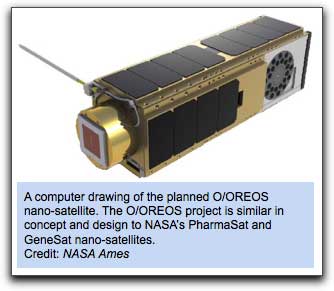
O/OREOS nano satellite (NASA) “In the lab, researchers can duplicate certain aspects of this, but the combined radiation environment in space is very complex,” says Tony Ricco from NASA‘s Ames Research Center. The Organism/ORganics Exposure to Orbital Stresses (O/OREOS) nano-satellite will test how life and the components of life respond to this complexity. Ricco is a member of an engineering team in the NASA/Ames Small Satellite Division that is building the satellite. O/OREOS will carry selected organisms and organic compounds up into space and directly monitor the changes induced by the radiation and microgravity of the final frontier. Due to the nanos simple, inexpensive design, O/OREOS may be just a taste of what’s to come. Over the course of the six-month mission, onboard instruments will check whether chemical changes are uniform in time or perhaps correlated with other phenomena such as solar activity.
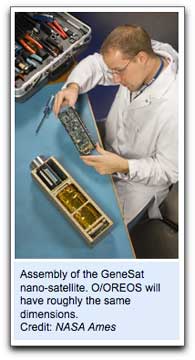
GeneSat nanosat assembly (NASA) O/OREOS is similar in design to other nano-satellites that have flown, including GeneSat, which tracked the reaction of bacteria to microgravity, and PharmaSat, which will track how yeast behaves in space. The cargo on those experiments weren’t exposed to the full array of space conditions, however, like in the O/OREOS experiment. The 5-kilogram O/OREOS has a modular design made up of three 10-centimeter cubes. One of these cubes acts as the “brains” (radio and telemetry), while two other cubes carry the scientific payload. The first cube will carry experiments to study how two types of microbes cope with the space environment. One microbe is a common, fast-growing bacteria, Bacillus subtilis, which holds the record for surviving in space for the longest duration (6 years on a NASA satellite). The other is a slow-growing microbe, Halorubrum chaoviatoris, which thrives in the sort of briny water that may exist below the surface of Mars or on Jupiter’s moon Europa. Both of these “bugs” have been studied before in space, so the team has a rough idea of what to expect, says project scientist Pascale Ehrenfreund, who currently works from the Space Policy Institute at George Washington University. The bacteria will be launched as dried spores and revived at different times during the mission with a nutrient-filled fluid.

O/OREOS will be in a low-Earth orbit (at an altitude of 650 kilometers) where its samples will experience 1/10,000th the gravity on Earth. This could affect how microbes get food and how their waste is carried away, says Wayne Nicholson, a science team member from the Kennedy Space Center and the University of Florida. The radiation dose will be around 30 rads per day (which is roughly 30,000 times more than on a single intercontinental airplane flight). The growth rate and metabolism of the bacteria will be tracked by measuring the color of a metabolic indicator dye and via total light absorption. To test if the bacteria are capable of adapting to life in space, mutant varieties of the two species will also be flown on O/OREOS, according to science team member Rocco Mancinelli of NASA Ames.

Launch of the nano-satellite is planned for February 2010 from Kodiak Island, Alaska. O/OREOS is small and light, so it will be able to piggyback on another spacecraft’s launch vehicle. This makes it a bargain, at a cost of just $2 million. Plus, there may well be a lot more of these nano-satellites on the way. In 2008, NASA’s Astrobiology Science and Technology Instrument Development program established a small payloads initiative, which seeks quick-turnaround science experiments that can fit on nano-satellites or as external attachments to larger space vehicles. The program selected O/OREOS as the first demonstration flight. NASA also wants to develop similar satellites through its Stand-Alone Mission of Opportunity Notice.

Filed Under: Exploration & Science Missions

Primary Sidebar

Coverage

  • Missions & Constellations
  • Business & Finance
  • Military & Defense
  • Launch
  • Software Automation & Ground Systems
  • Government & Regulation
  • Services & Applications

Most Read Stories

  • Amazon Navigates Launch Delays with Under 400 Satellites in Orbit Ahead of Nov. 13 Vulcan Return
  • NASA Outlines Artemis IV Starship Refueling Architecture as Launch Estimates Vary
  • Northwood Space Secures $375M Series C at $2B Valuation to Expand Shared Ground Station Network
  • SpaceX Explores Boost Mobile Acquisition in Push to Build Hybrid Terrestrial-Satellite Network
  • SpaceX Selects Qualcomm to Supply Terrestrial Base Stations for Starlink Mobile Network

Secondary Sidebar

Footer


Satnews is a leading provider of satellite news, events, publications, research and other satellite industry information in both commercial and military enterprises worldwide.

Stories By Category

  • Business & Finance
  • Government & Regulation
  • Launch
  • Military & Defense
  • Missions & Constellations
  • Services & Applications
  • Software Automation & Ground Systems
  • Spectrum & Licensing
  • Startups & NewSpace Business

About Us

  • Leadership & Editorial Team
  • SatNews History
  • Free Satnews Subscription
  • SatNews Events
  • Magazines

Navigation

  • Latest Stories
  • Magazines
  • Events
  • Contact
  • Cookie & Privacy Policy for Satnews

We use cookies to ensure that we give you the best experience on our website. If you continue to use this site we will assume that you are happy with it.
x
Sign up Now (For Free)
Access daily or weekly satellite news updates covering all aspects of the commercial and military satellite industry.
Invalid email address
Notify Me Regarding ( At least one ):
We value your privacy and will not sell or share your email or other information with any other company. You may also unsubscribe at anytime.

Click Here to see our full privacy policy.
Thanks for subscribing!