

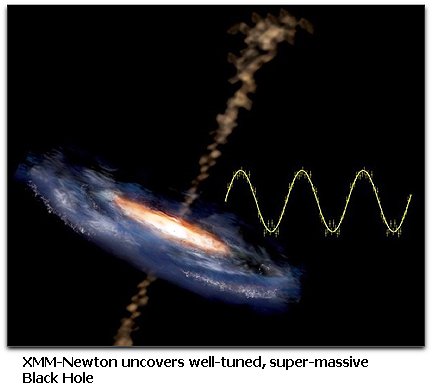
In theory, as matter is sucked in to a black hole, it is heated up, and emits X-rays. The X-ray emission can then be modulated at a certain frequency, as infalling matter wobbles around the black hole — this frequency is detected as a periodic signal. From the frequency of the signal, it is possible to estimate the size of the black hole itself. These periodic signals are widely observed in black holes of a lower mass, of the order of tens of solar masses, in our Galaxy. Scientists have suspected that the underlying physical processes behind black hole accretion mechanisms are the same, regardless of the size of the black hole. This means such periodic signals should also be emitted by super-massive black holes lodged at the galactic centers, also called active galactic nuclei. Until now, no super-massive black hole was known to display such a periodic signal. XMM-Newton’s sensitive instruments have now shown that the black hole at the centre of RE J1034+396 displays a periodic signal (called a quasi-periodic oscillation), once per hour. The finding confirms that the fundamental physical processes behind black hole accretion mechanisms are the same, giving them a new, powerful tool to study AGN.
