


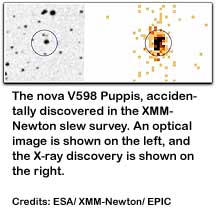
 XMM-Newton has discovered an exploding star in the Milky Way. Usually that would be important in itself, but this time there is a special twist. Calculations show that the explosion must have been clearly visible to the unaided eye, but was missed by the legions of star watchers around the planet. On October 9, 2007, ESA’s orbiting X-ray observatory XMM-Newton was turning from one target to another. As it did so, it passed across a bright source of X-rays that no one was expecting. The source was not listed in any previous X-ray catalogue, yet XMM-Newton was receiving some 50 X-rays every second from this mysterious object. The only celestial object the XMM-Newton team could find at this location was a faint star, known only by its catalogue number USNO-A2.0 0450-03360039. Acting quickly, Andy Read of the University of Leicester and Richard Saxton of ESA’s European Space Astronomy Centre (ESAC), Spain, arranged for an astronomical telegram to be circulated across the Internet, informing other astronomers of the newly-discovered X-ray source. Astronomers using the 6.5-m Magellan-Clay telescope at Las Campanas Observatory in Chile, found that USNO-A2.0 0450-03360039 had dramatically brightened by more than 600 times. Analysing the light from the source meant that they could classify the object as a nova. For additional details, head over to this ESA website…
