
 Thales Alenia Space is ready to deliver the high-resolution (HR) optical imaging instrument for integration in the first Pleiades earth observation satellite. The Pleiades project is part of ORFEO, a joint Franco-Italian initiative by the countries’ national space agencies CNES and ASI, marking a major technological advance in optical earth observation systems. The dual-technology program addresses military and civil needs for European users, including mapping, volcano monitoring, geophysical and hydrology studies, urban planning, and so on. As prime contractor for the Pleiades system—in particular the ground segment—CNES selected Astrium as satellite prime contractor and Thales Alenia Space for the imaging instruments.
The Pleiades optical high-resolution imaging instruments offers enhanced resolution of 70 cm over a wide swath (20 km) in the visible and near infrared bands. This very high resolution instrument also introduces significant innovations such as the highly-integrated detection sub-assemblies (SEDHI), while also reducing volume three-fold compared to previous generations. The instrument provides very high dimensional stability thanks to a concept combining a carbon/carbon structure (material insensitive to moisture and with a very low coefficient of thermal expansion) and Zerodur mirrors. To optimize in-flight performance, the instrument has an innovative thermal refocusing system, eliminating the need for a complex mechanism. The absence of this mechanism plus the satellite’s own enhanced performance (satellite pointing/tilting capabilities, downlink transmission rate of 450 Mbit/s) means a significant increase in mission performances.
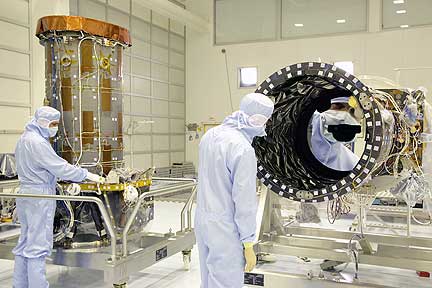
The first flight-model instrument is now ready for delivery, after successfully passing its environmental tests. The performances of optical and radiometric tests, as measured in a Class 100 clean room in Cannes—the level required for this class of instrument—are excellent. The instrument will be integrated on the first satellite flight model, which will then undergo checks at Astrium’s facility in Toulouse. The two Pleiades observation satellites have a design life of five years and offer a high degree of in-orbit agility thanks to their maneuvering capability. They will be able to acquire a series of images both along the swath or across the swath to create a veritable mosaic of ground scenes. They are scheduled for launch in 2010 and 2011, respectively.