

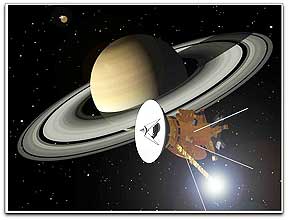
 SPACECRAFT — June 30th marked the end of the four-year primary mission for the joint NASA/ESA/ASI Cassini spacecraft mission and the start of the extended mission. Approval for the two-year extension, called the Cassini Equinox Mission, was announced by NASA in April 2008. The mission extension builds upon the success of the primary mission. Some key scientific objectives of this extended mission are:
- to study in more detail the Saturnian moons, in particular Titan and Enceladus
- to monitor seasonal effects on Titan and Saturn
- to explore new regions of the Saturnian magnetosphere
- to observe the unique ring geometry of the Saturn equinox in August 2009 – when sunlight will pass directly through the plane of the rings
Observations of Titan have been obtained by the orbiter remote sensing instruments during several flybys of the primary mission. The Huygens landing site, which has already been observed a few times, will be further observed during the extended mission, in particular with the RADAR and VIMS instruments. Observations with these instruments, which at closest approach to Titan have a resolution of 300-500 m, will be used to look for temporal variability in this region which has been extensively studied with Huygens. Data from the Cassini primary and extended missions will provide valuable data for possible future missions to Saturn, Titan, or Enceladus.
