

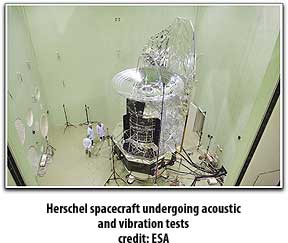
 The Herschel spacecraft is now undergoing a series of mechanical tests at ESA’s European Space Research and Technology Center (ESTEC). The tests are carried out to make certain the spacecraft can withstand the acoustic and vibration loads that it will encounter during launch. The vibration tests were started on Friday, June 20th, and will be completed next week. The spacecraft was shaken along its longitudinal axis (the X-axis) at frequencies starting from 4 Hertz, increasing to 100 Hertz over a period of about 80 seconds. Such vibration tests will also be performed along the two lateral axes (the Y and the Z axis), four times each, with differing loads each time. The spacecraft’s electronic components are checked for normal functionality before and after each run. Earlier, on June 5th and 6th, Herschel successfully passed the acoustic test. During the test, the spacecraft was subjected to acoustic noise, generated to simulate the noise levels that it will encounter during launch. The test was carried out at ESTEC‘s Large European Acoustic Facility (LEAF). The Herschel infrared observatory’s telescope will carry the largest mirror ever flown in space. With this telescope and its three science instruments, it will observe and study relatively cool objects everywhere in the Universe, in unprecedented detail. Herschel will study the birth and evolution of a wide range of celestial bodies — from stars in our own backyard to distant galaxies.
Herschel Is Hammered
The Herschel spacecraft is now undergoing a series of mechanical tests at ESA’s European Space Research and Technology Center (ESTEC). The tests are carried out to make certain the spacecraft can withstand the acoustic and vibration loads that it will encounter during launch. The vibration tests were started on Friday, June 20th, and will be completed next week. The spacecraft was shaken along its longitudinal axis (the X-axis) at frequencies starting from 4 Hertz, increasing to 100 Hertz over a period of about 80 seconds. Such vibration tests will also be performed along the two lateral axes (the Y and the Z axis), four times each, with differing loads each time. The spacecraft’s electronic components are checked for normal functionality before and after each run. Earlier, on June 5th and 6th, Herschel successfully passed the acoustic test. During the test, the spacecraft was subjected to acoustic noise, generated to simulate the noise levels that it will encounter during launch. The test was carried out at ESTEC‘s Large European Acoustic Facility (LEAF). The Herschel infrared observatory’s telescope will carry the largest mirror ever flown in space. With this telescope and its three science instruments, it will observe and study relatively cool objects everywhere in the Universe, in unprecedented detail. Herschel will study the birth and evolution of a wide range of celestial bodies — from stars in our own backyard to distant galaxies.
