

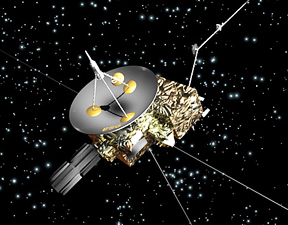
 It’s been a long run, and the Ulysses performed beyond expectations. After more than 17 years of pioneering solar science, a joint NASA and European Space Agency mission to study the sun will end on or about July 1. The Ulysses spacecraft has endured for almost four times its expected lifespan. However, the spacecraft will cease operations because of a decline in power produced by its onboard generators. Ulysses has changed the way scientists view the sun and its effect on the surrounding space. Mission results and the science legacy it leaves behind were reviewed today at ESA Headquarters in Paris.
Ulysses was the first mission to survey the environment in space above and below the poles of the sun in the four dimensions of space and time. It showed the sun’s magnetic field is carried into the solar system in a more complicated manner than previously believed. Particles expelled by the sun from low latitudes can climb to high latitudes and vice versa, sometimes unexpectedly finding their way out to the planets. Ulysses also studied dust flowing into our solar system from deep space, and showed it was 30 times more abundant than astronomers suspected. In addition, the spacecraft detected helium atoms from deep space and confirmed the universe does not contain enough matter to eventually halt its expansion.
Ulysses ends its career after revealing that the magnetic field emanating from the sun’s poles is much weaker than previously observed. This could mean the upcoming solar maximum period will be less intense than in recent history. Ulysses collected and transmitted science data to Earth during a 5.4-billion mile journey. As the power supply weakened during the years, engineers devised methods to conserve energy. The power has dwindled to the point where thruster fuel soon will freeze in the spacecraft’s pipelines. This wasn’t an easy task, as the spacecraft and its suite of 10 instruments had to be highly sensitive, yet robust enough to withstand some of the most extreme conditions in the solar system. This includes intense radiation while passing by the giant planet Jupiter‘s north pole. The encounter occurred while injecting the mission into its orbit over the sun’s poles.
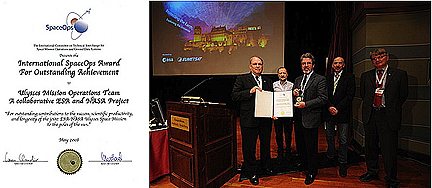
Ulysses was launched aboard space shuttle Discovery, October 6, 1990. From Earth orbit, it was propelled toward Jupiter by solid-fuel rocket motors. Ulysses passed Jupiter on February 8, 1992. The giant planet’s gravity then bent the spacecraft’s flight path downward and away from the ecliptic plane to place the spacecraft in a final orbit around the sun that would take it past our star’s north and south poles. The spacecraft was provided by ESA. NASA provided the launch vehicle and upper stage boosters. The U.S. Department of Energy supplied a radioisotope thermoelectric generator to provide power to the spacecraft. Science instruments were provided by both U.S. and European investigators. The spacecraft is operated from JPL by a joint NASA/ESA team.
