


In response to his prediction, NASA performed stratospheric dust collections, using an ER-2 high-altitude aircraft flown from NASA’s Dryden Flight Research Center at Edwards Air Force Base, California. The aircraft collected IDPs from this particular comet stream in April 2003. The new mineral was found in one of the particles. To determine the mineral’s origin and examine other dust materials, a powerful new transmission electron microscope was installed in 2005 at Johnson. “Because of their exceedingly tiny size, we had to use state-of-the-art nano-analysis techniques in the microscope to measure the chemical composition and crystal structure of Keiko’s new mineral,” said Lindsay Keller, Johnson space scientist and a co-discoverer of the new mineral. “This is a highly unusual material that has not been predicted either to be a cometary component or to have formed by condensation in the solar nebula.”

Since 1982, NASA routinely has collected cosmic and interplanetary dust with high-altitude research aircraft. However, the sources of most dust particles have been difficult to pin down because of their complex histories in space. The Earth accretes about 40,000 tons of dust particles from space each year, originating mostly from disintegrating comets and asteroid collisions. This dust is a subject of intense interest because it is made of the original building blocks of the solar system, planets, and our bodies. The mineral was surrounded by multiple layers of other minerals that also have been reported only in extraterrestrial rocks. There have been 4,324 minerals identified by the International Mineralogical Association, or IMA. This find adds one more mineral to that list.
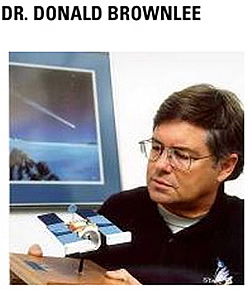 The IMA-approved new mineral, Brownleeite, is named after Donald E. Brownlee, professor of astronomy at the University of Washington, Seattle. Brownlee founded the field of IDP research. The understanding of the early solar system established from IDP studies would not exist without his efforts. Brownlee also is the principal investigator of NASA’s Stardust mission.
