

On Oct. 1, 2026, Indian spacetech startup TakeMe2Space will launch its MOI-1A orbital computing satellite aboard a SpaceX Falcon 9 rocket.
The mission marks the operator’s transition to commercial flight operations following a previous launch failure during a test flight with the Indian Space Research Organisation (ISRO).
Spacecraft Architecture and Edge Computing Hardware Specifications
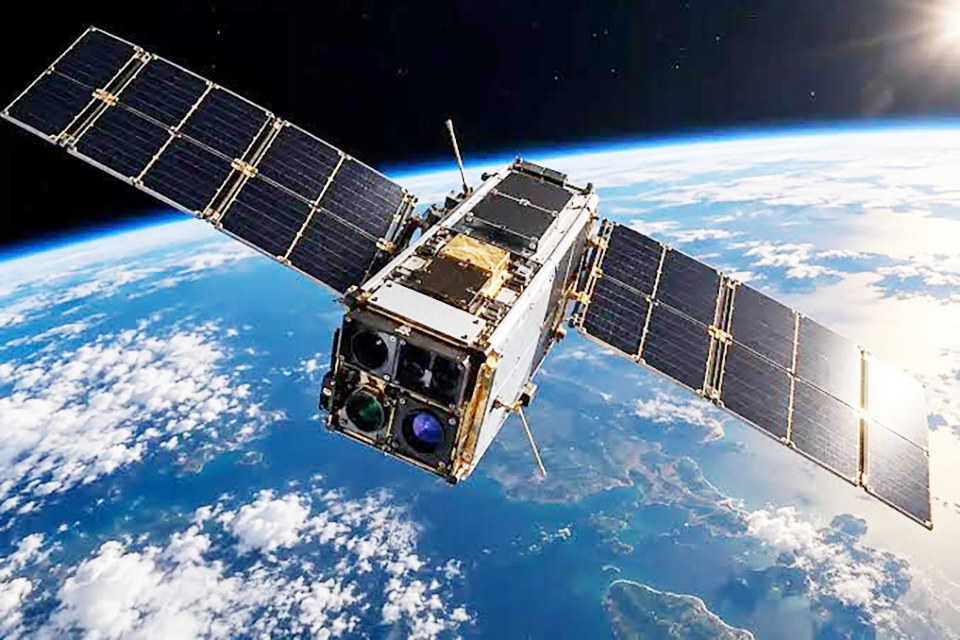
The MOI-1A satellite is designed as an orbital data center engineered to execute space edge computing and artificial intelligence tasks directly in low Earth orbit.
The satellite bus houses commercial off-the-shelf processing hardware powered by Nvidia compute chips. The onboard GPU architecture enables the spacecraft to run machine learning algorithms, process raw sensor imagery, and perform semantic data reduction prior to ground downlinking.
By analyzing data in orbit rather than transmitting raw files to terrestrial teleports, MOI-1A reduces downlink bandwidth constraints, allowing payload operators to receive processed analytics vectors in near real time.
Commercial Customer Manifest and Market Application
The MOI-1A payload hosts compute allocations for 23 commercial, academic, and government customers across multiple industrial sectors.
Participating organizations utilize the spacecraft’s onboard processing power to run specialized algorithms for digital mapping, crop yield prediction in agriculture, land-use classification, and infrastructure risk assessment for the insurance industry. Hosting third-party software container environments allows customers to upload custom AI models directly to the satellite while in orbit.
Launch Schedule and Flight Horizon
Following encapsulation within the Falcon 9 payload fairing, the MOI-1A satellite will deploy into low Earth orbit during the Oct. 1, 2026 rideshare launch window. TakeMe2Space engineering teams will initiate bus commissioning and activate the Nvidia compute modules shortly after orbital insertion to begin customer data processing runs.
