

Marking a major operational milestone in In-Space Servicing, Assembly, and Manufacturing (ISAM), SpaceLogistics—a wholly owned subsidiary of Northrop Grumman—successfully launched its Mission Robotic Vehicle (MRV-1) on Tuesday, July 21, 2026.
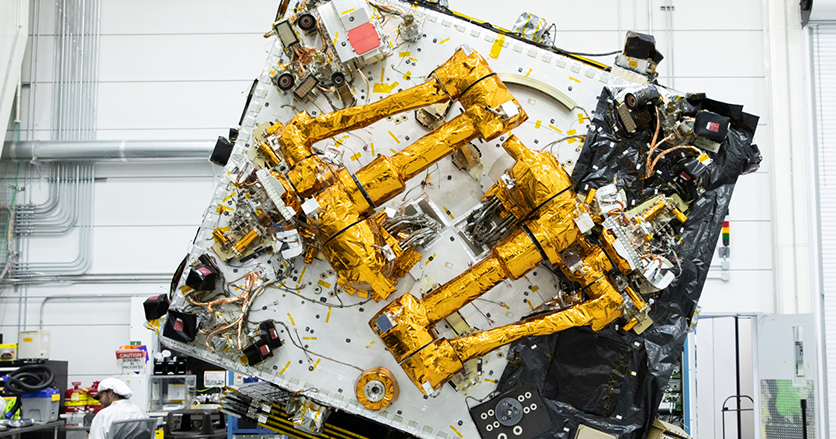
Lifted aboard a SpaceX Falcon 9 rocket, the robotic spacecraft carried three piggyback Mission Extension Pods (MEPs) destined for deployment in geostationary Earth orbit (GEO).
Program Heritage and Public-Private Development
MRV-1 represents the second generation of commercial satellite-servicing platforms developed by SpaceLogistics. Unlike the first-generation Mission Extension Vehicles (MEV-1 and MEV-2), which remained permanently docked to host spacecraft to provide propulsion control, MRV-1 operates as a multi-client robotic servicer.
The mission builds on a public-private partnership combining SpaceLogistics’ satellite bus with specialized robotic payloads developed by the Defense Advanced Research Projects Agency (DARPA) and the U.S. Naval Research Laboratory (NRL) under the Robotic Servicing of Geosynchronous Satellites (RSGS) program. This milestone follows long-term customer commitments, including contractual agreements with Optus and life-extension procurement by Intelsat, as detailed in SatNews’ technical analysis of the MRV architecture.
Robotic Payload and Extension Pod Specifications
The integrated spacecraft stack incorporates dual-function robotics and propulsion-augmentation hardware:
- Robotic Manipulators: Features two DARPA-funded dexterous robotic arms equipped with multi-tool enclosures capable of executing sub-centimeter mechanical tasks, payload installations, and structural repairs in zero gravity.
- Autonomous Tracking: Integrates machine-vision systems, lidar arrays, and infrared sensors to execute rendezvous and proximity operations (RPO) with non-cooperative GEO targets.
- Mission Extension Pods (MEPs): Compact, customer-controlled propulsion augmentation devices designed to attach to client satellites, providing up to six years of station-keeping life extension.
Orbit Transfer and Demonstration Phase
Following initial orbit insertion, MRV-1 will utilize electric propulsion over a 10-month transit period to raise its altitude to the GEO belt, approximately 36,000 kilometers above Earth. Upon arrival, the spacecraft will perform on-orbit calibration of its robotic arms before commencing the installation of the three MEPs onto commercial and defense host satellites, including assets operated by Optus and Intelsat.
