

By Nick David, Editorial Lead, SatNews
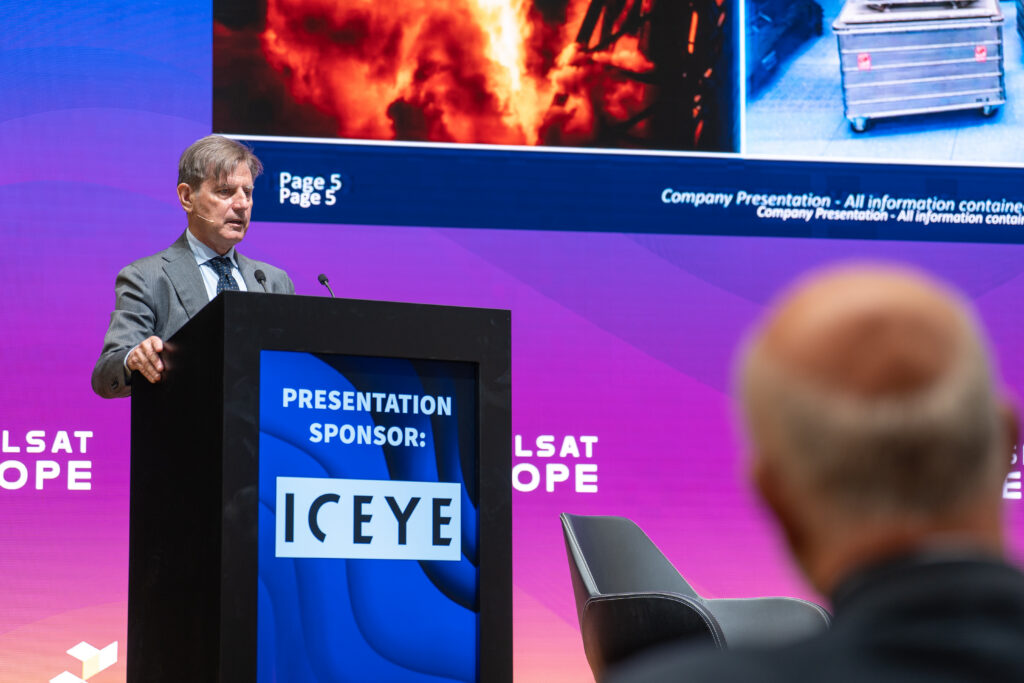
The Day 1 diagnosis was that European space spending had finally hit the scale that demanded a more coordinated industrial base underneath it. Day 2 was the day the European industry started attaching numbers to its answer in public, and the numbers were specific.
The morning keynote on the Business Stage came from Roberto Aceti, CEO of OHB Italia. Aceti opened with the legacy frame. OHB, he said, is the third-largest space company in Europe, with about €1.3 billion in space revenues and 3,500 employees, committed to the institutional market. Then he attached the number that landed.
“At the moment we have achieved a production rate of this satellite of two satellites a month. We can further improve. This is not really the limit, but this is a production rate that is comfortable for us.” Roberto Aceti, CEO, OHB Italia
The product Aceti was describing is OHB Italia’s contribution to IRIDE, the Italian government’s twenty-four-satellite Earth observation programme financed under PNRR with EU recovery funds. The satellites are twenty-five kilograms, dual optical and AIS payloads, sub-two-metre resolution, designed for a three-year operational life. Sixteen are already on orbit. The remaining eight ship to SpaceX in two weeks for an October launch.
Two 25-kilogram microsatellites a month for IRIDE is not a Starlink number, and it is not OHB Italia’s normal five-year institutional-tier work either. It is the rate the company has hit by deliberately designing IRIDE below the 50-kg SpaceX rideshare threshold and importing serial-production discipline into a legacy prime. Aceti was explicit on the lesson he wanted the room to take home. “If you want to be engaged in these things, you have to be super vertical.” Vertical integration, requirement-challenge discipline against the customer, and a flat decision structure that names individuals rather than functions on every non-conformance. “There is not a function. There is a guy,” Aceti said of how non-conformance reports get resolved at IRIDE pace. Those are the operating moves that compressed OHB Italia’s typical five-year project timeline to three.
OHB Italia IRIDE Production · By the Numbers
24
satellites in three years
25 kg
per satellite
Sub-2m
optical resolution
16
satellites already on orbit
2/month
production rate, comfortable
DLR funds the day after tomorrow
The day’s second institutional voice was Andres Bolte, Project Manager for Small Satellite Technologies at the German Space Agency at DLR.
“We are funding activities for small satellites, always looking at the day after tomorrow. So not looking back, not looking at the day, but actually preparing us for what is coming in the next steps.”
DLR is reaching one step further forward into pre-qualification of suppliers, processes, and components for product families that have not yet been ordered. The contracting innovation Bolte spent the second half of the brief explaining is procurement consolidation. A single integrator contract can now bundle multiple test sources and multiple production sources at the supplier tier. That lets Tier 2 and Tier 3 suppliers aggregate orders fast enough to justify the capex on new production lines.
The funding-to-revenue gap
The Public Purses & Policy Goals panel was moderated by Reid Whitten, managing partner of Sheppard’s London office and head of its space practice. The institutional voices were Anders Bohlin, Lead Economist for Digital Infrastructure at the European Investment Bank, and Dr. Gianluigi Baldesi, Head of ESA’s Ventures and Financing Office.
Baldesi made the most useful structural point. ESA can fund development. It cannot manufacture demand for a market segment in which it is not itself the customer. The room agreed publicly that the gap Europe has to close is no longer a development-funding gap. It is a revenue gap. Without a clear paying customer beyond the pilot, the supply base cannot scale. Without supply-base scale, the institutional buyer’s serial-production orders stay hard to fill. The loop runs the wrong direction. Closing it is the next two years of work.
The supplier-tier consolidation question
The afternoon Shoring Up the Base panel, opened by Marco Esposito of Cosine Remote Sensing, made the political-economy case underneath the funding gap. Jeroen Rotteveel of ISISPACE Group gave the most direct version of it.
“There is this new European initiative to standardize the mid-sized satellite, so they have 500 to 1000 kilogram spacecraft and there are more than 45 players in Europe established in that range. And there’s at least 25 new entrants trying to get there. And I doubt that there’s space for more than one per European country, let alone three.” Jeroen Rotteveel, CEO, ISISPACE Group
Richard French of Rocket Lab Space Systems, fresh off Rocket Lab’s acquisition of Munich-based Mynaric to form Rocket Lab Germany, layered the venture vocabulary on top.
“Constellation class manufacturing isn’t easy. You need to get through the technical valley of death. And then the production valley of death. And then hope that on the other side of that, you also can get through the market-product-fit valley of death where you actually have scale on the demand side.”
Three sequential valleys. Not every European mid-sat player will clear all three, and the procurement officer who picks the strongest contenders early accelerates the consolidation toward a healthier supplier base.
Dr. Markus Geiss, co-founder and Chief Commercial Officer of Dcubed, surfaced the next bottleneck behind the consolidation question. “Coming from the sort of deployable side of things and adding to what was said, I think our biggest bottleneck right now is power. Affordable and available space power.” Power, not bus volume, is the constraint that the next round of European component suppliers has to clear.
The flexible factory
The Flexible Factory panel was moderated by Dr. Marco Villa, CEO of Canopy Aerospace & Defense, with Simon van den Dries of EnduroSat, Pierre Wilhelm of Aerospacelab, Pieter van Duijn of Loft Orbital, and Jack Bowden of Open Cosmos. (Luis Gomes of AAC Clyde Space was scheduled but could not make it in.) Between the four companies on stage, $400 million of private capital has been raised in the last eighteen months. The infrastructure numbers are equally specific. EnduroSat’s new 18,000-square-metre Sofia facility targets two ESPA-class satellites per day. Aerospacelab’s Charleroi megafactory clears 6,000 square metres designed around satellite throughput. Loft Orbital is running parallel work cells to absorb mission variance without ripple-effect disruptions. Bowden put Open Cosmos’s UK transformation in the most concrete terms of the day.
“In the UK now, we’ve actually transitioned fully into a moving article production line. Satellite starts in one place with subsystem build and acceptance, and at the end, the satellite comes out. Every morning I go to the office, there is a finished satellite.” Jack Bowden, Future Mission Manager, Open Cosmos
That is what serial production looks like at the smallsat tier when the design discipline, the procedure discipline, and the factory layout discipline land together. A satellite a morning is not a Starlink number, but it is the moving-article line moving.
Van den Dries, from the EnduroSat seat, surfaced the supply-chain side of the same story. EnduroSat keeps its entire supply chain within an hour’s drive of Sofia, pulling from Bulgaria’s medical-device and automotive supplier base for components older European supply chains did not staff for space-grade work. His top regulatory pain point was intra-EU export paperwork. “If I want to ship something from Sofia to Toulouse, the amount of paperwork is just crazy,” he said. The physical-space wall is now the harder one: the new 18,000-square-metre Sofia facility, he noted, is already getting called “the old building” against what the company will need next.
Radiation hardening as a business decision
Merek Chertkow, CEO of The Radiation Team, closed the engineering loop with a tech brief on Modernizing Radiation Hardening Approaches. The argument was that radiation hardening is not a parts problem. It is a business-model problem.
“On Monday, go ask your team: what is the mission assurance financial budget and schedule? And what does it buy us? If your team can’t answer this question, you have a business problem you haven’t priced in yet. The earlier you can answer this problem, the better you’re able to make the decisions that are optimised for you, whatever mission success means for you.” Merek Chertkow, CEO, The Radiation Team
That engineering posture, priced in business terms and executed at production volume, is what the European supply base is starting to internalise across every component category.
The verdict from Day 2
Day 2 was not a victory lap. It was a credible mid-cycle update. The diagnosis is shared. Institutional funding is flowing into the structural gaps. Production rates are being claimed publicly and are starting to land in the same range as the demand-side numbers. The bottleneck is now execution discipline and procurement velocity at the supplier tier underneath the primes.
OHB Italia at two a month, comfortably. Open Cosmos at a satellite a morning. The Flexible Factory four at ESPA-class daily and constellation-class weekly throughput targets. The number that decides whether the European industrial story carries through is the one that comes from the supplier tier underneath all of them. That number is not yet public. The next budget cycle is when it has to become so.
Key Takeaway
European space supply is consolidating publicly. OHB Italia ships two satellites a month, comfortably. Open Cosmos ships one a morning. The bottleneck has shifted from technology to production-discipline at the supplier tier, power, components, certification, and to procurement velocity from the institutional buyers underneath them.
About the Author
A storyteller at heart, Nick David covers space policy, satellite markets, defense, and the technologies reshaping how humanity operates beyond Earth. With a background in creative direction, brand strategy, and editorial storytelling, he brings a modern lens to complex subjects and a relentless curiosity about what comes next.
