

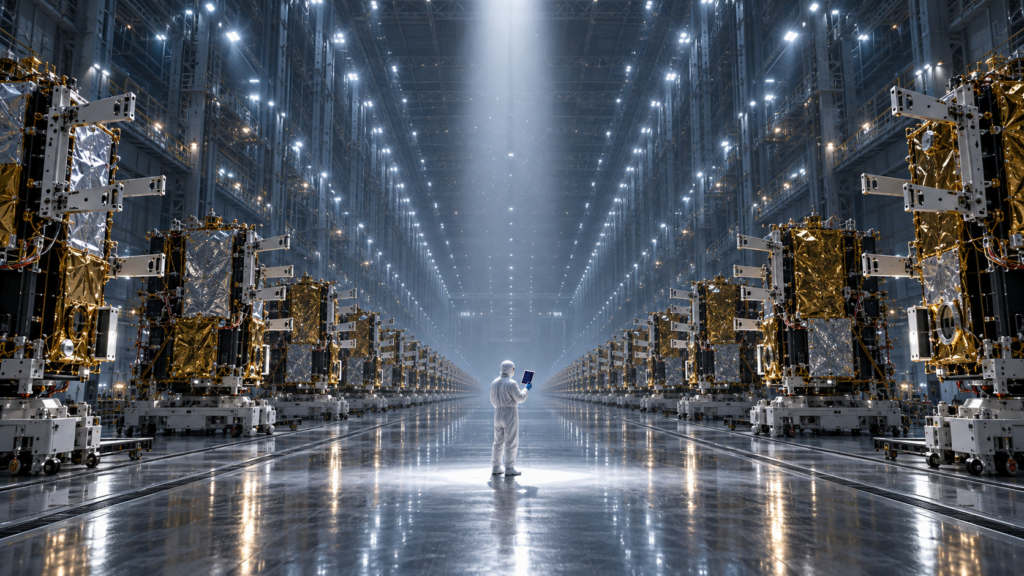
Executives at two of the largest satellite manufacturers put numbers on their factory throughput at Novaspace’s World Space Business Week in Paris (Sept. 14–17). Taken one at a time, each figure passed without much comment. Set against each other, and against what the component tier said the same week, they describe a capital commitment to volume satellite manufacturing capacity that has been made but not yet proved. SatNews reported the same constraint from the merchant RF side in June, in “Three LEO Operators Bet 2026 on a Supply Chain Built for 2027.”
The numbers first.
Giampiero Di Paolo, deputy chief executive of Thales Alenia Space and chief executive of its Italian arm, Thales Alenia Space Italia, told the conference’s Earth observation panel on the final day that the target for the company’s Rome Space Smart Factory is “100 satellites per year integrated in the smart factory, every class of satellite ranging from 300 kilos up to 6, 7 tons.” The facility opened in October 2025 at the Tecnopolo Tiburtino, on more than €100 million of investment drawn from Italian Space Agency PNRR funds alongside Thales and Leonardo. Thales Alenia Space’s published figure is more than 100 satellites a year, or roughly two a week, although its announcement at the opening described satellites of up to 300 kilograms, a far narrower range than the one Di Paolo gave in Paris.
His own chief executive gave a higher target. Hervé Derrey, chief executive of Thales Alenia Space, told the opening-day prime manufacturers’ panel at the Summit for Satellite Financing that the factory’s objective is “to go up to one satellite per day.” That is more than three times the company’s published rate.
Mike Greenley, chief executive of MDA Space, told the same panel that the company’s new Montreal line can produce “up to two satellites a day.” MDA’s published capacity for the 185,000-square-foot facility, inaugurated in May 2026, is up to 400 satellites a year, well below what two a day would produce over a full year. Asked whether the plant would be fully operational by the end of 2026, Greenley said “Yeah, for sure,” and described Pathfinder units now moving through it: “we’re taking them through all the steps of that assembly line and the process, setting everything to work and confirming all of our touch times.” Full production follows. “We’ll be building a couple of hundreds of satellites next year.” MDA’s backlog stood at C$4.003 billion at the end of June.
The Primes’ Numbers
100
Satellites a year: Rome factory target, per Di Paolo
1
Satellite a day: Rome objective, per Derrey
2
Satellites a day: MDA Montreal line, per Greenley
400
Satellites a year: MDA’s published Montreal capacity
None of these figures describes demand. The sharpest account of that came from a supplier to the primes rather than a prime. Jean-Marie Bétermier, chief executive of Safran Data Systems and executive vice president for space at Safran Electronics & Defense, was asked what industrial scale-up the market now needs. “In our factories now, we have some private customers investing a lot, expanding their constellations,” he said. Those customers now ask for hundreds of units a year, where a couple of years ago orders ran to five to ten.
Three different kinds of claim
Thales Alenia Space’s figures, 100 a year from its deputy chief executive and one a day from its chief executive, are targets for a facility that exists and is running, and the two executives did not give the same one. MDA’s two a day is rated capacity in commissioning, with a stated date and demonstrated output still to come. Bétermier’s “hundreds” describes orders arriving rather than units leaving a building.
Bétermier also gave the one figure at the conference that measures achieved growth, and it is smaller than the capacity claims imply. Safran’s space business has seen “important growth more than 13% each year since the last five years,” he said, “and when we see the future we clearly believe the growth will be higher than that.” Thirteen percent a year for five years compounds to about 1.8 times the starting size: steady scaling so far, short of the step change the factory figures suggest, though he expects it to accelerate.
What the suppliers said
The best-evidenced scaling at the conference came from component and subsystem makers, and their figures describe units already shipped and lines already full.
Ane Aanesland, co-founder and chief executive of the French propulsion company ThrustMe, gave a delivery history. “We have doubled production every year for the last three years and it becomes, of course, harder and harder because doubling from 10 to 20 is easy.”
The numbers followed. “But now, last year we produced and delivered 200 units. This year we are producing 400 units.” She put cumulative deliveries above 500 units.
The same component makers described lines with no slack in them. Brad King, chief executive of Orbion Space Technology, which York Space Systems acquired in March, said his company runs “at about 90 percent our current capacity,” with plans to “double our facilities and headcount.” Dcubed chief commercial officer Markus Geiss put his company at “100 plus percent capacity,” and said Dcubed is adding a production line in Munich, with another to follow in Denver next year. He also named the component still holding things up: triple-junction solar cells, where the choice is to “pay a fortune for it or wait 18 plus months for shipment.”
Pay a fortune for it or wait 18 plus months for shipment.
Trey Pappas, chief revenue officer of CesiumAstro, put his own line at “100 percent capacity right now” and said the nearly 270,000-square-foot facility the company is building in Texas “comes online next year.” He also supplied the sentence that explains why the constraint persists. “If an FPGA is going to go to a car company where they’re doing 10 million a year. I’m not doing 10 million a year. And so my problem seems a little less interesting to providers at the moment.”
The supplier view on standardization
On the first day, at a supply-chain session, Beyond Gravity chief executive Barbara Frei-Spreiter was asked whether standardization and modularity drive resilience. She endorsed the direction without accepting that the industry has arrived at it.
“Absolutely, I think it makes the development processes of our customers much faster,” she said, “but I think there has to be a kind of change in the whole industry to really accept it.” The change she is waiting for is on the demand side. For now, she said, Beyond Gravity is more often the one proposing a standard solution than the customer asking for one. “We have now few players in new space, they come to us and say, hey, can I not just take a standard fairing and I adjust the rest of my launcher to it? That’s more the exception. That’s not yet the rule.”
She was equally clear about where she thinks it goes: “if you really want to scale… standardization is a must… And I think that’s the area or that’s the direction we have to move on.”
On the same panel, Lisa Napolitano, vice president and general manager of space at Honeywell Aerospace, made a related point about her own suppliers. Honeywell Aerospace has been a separate Nasdaq-listed company since its spin-off completed on June 29. The biggest vulnerabilities she has found sit deep in the supply chain, with component makers who “have a challenge, really scaling, because we’re still a bit low volume, even with the scale, based on what else is in their factories, our growth tends to still not be what they need.”
The launch objection
Not everyone who builds satellites agreed that parts are the binding constraint. Jonathan Dyer, co-founder and chief executive of Muon Space, told a smallsat manufacturing panel on Sept. 16 that his company had spent five years making its supply chain resilient to scale. “I’m going to say something provocative, which is none of it matters right now,” he said. “The ability to launch satellites is what will constrain our ability to scale over the next several years.” A day earlier, asked whether Aerospacelab faced bottlenecks beyond its own factory, founder and chief executive Benoît Deper named “raw material supply, launches, and things that are broadly speaking outside of the scope of what we can fix.”
The two accounts don’t compete. A satellite waiting on solar cells and a satellite waiting on a rideshare slot miss the same date, and both constraints sit outside the factory walls.
What this means for buyers of satellite manufacturing capacity
Two things follow for anyone planning a constellation against these figures.
First, most of the advertised capacity has not yet produced a satellite at rate. Thales Alenia Space’s Rome factory has been open for less than a year, and MDA’s line is in commissioning with a year-end target. A program schedule built on advertised throughput is a bet on commissioning going to plan.
Second, the constraints sit outside the primes’ own factories. The primes described capacity; the component makers described full lines and lead times past a year for solar cells, and Pappas described chipmakers for whom space orders are too small to matter. York’s purchase of Orbion in March shows one prime’s response, which was to buy the supplier. Clean-room floor space in Rome and Montreal does not shorten an 18-month wait for solar cells.
Key Takeaway
The capacity is funded and the facilities exist. What has not been demonstrated is sustained output at the advertised rate, and the component tier the industry draws on is already running full.
Update, Oct. 1, 2026: After publication, Thales Alenia Space provided the following statement, agreed by chief executive Hervé Derrey and deputy chief executive Giampiero Di Paolo: “When the ‘Space Smart Factory’ concept emerged in late 2023, Thales Alenia Space’s aim was to be able to deliver two satellites a week. Today, given the growing demand for constellations, our company will have the capacity, on demand, to extend its capacity up to one satellite a day during production ramp-ups.”
