

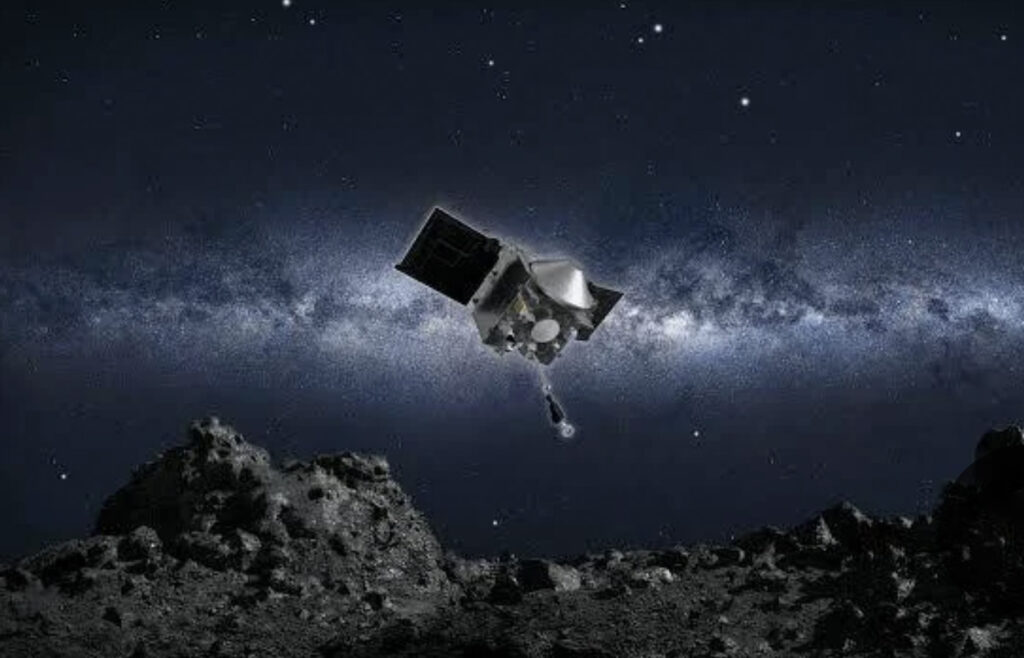
HOUSTON — In a landmark finding for astrobiology and planetary science, researchers analyzing samples returned from asteroid Bennu by NASA’s OSIRIS-REx mission have identified a trifecta of primordial materials: bio-essential sugars, an unprecedented polymer-like “gum,” and a trove of ancient stardust.
The findings, detailed in three separate papers published in Nature Geoscience and Nature Astronomy, provide the strongest evidence yet that the chemical ingredients necessary for life were widespread in the early solar system and may have been delivered to Earth by carbon-rich asteroids.
The Sweet Spot: Ribose and Glucose Detected
Leading the chemical analysis, a team headed by Yoshihiro Furukawa of Tohoku University identified ribose (a 5-carbon sugar) and glucose (a 6-carbon sugar) within the pristine regolith.
This discovery is critical for two reasons:
- Ribose is a foundational component of RNA (ribonucleic acid), supporting the “RNA World” hypothesis—the theory that early life relied on RNA for genetic storage and catalysis before DNA evolved.
- Glucose is the universal energy source for life on Earth. Its presence suggests that both the structural and energetic building blocks of biology existed on asteroids billions of years ago.
“The new discovery of ribose means that all of the components required to form RNA are present in Bennu,” said Furukawa.
A Mysterious “Space Gum”
Perhaps the most surprising find was a nitrogen- and oxygen-rich “gum-like” substance never before seen in meteorites. Researchers described it as a form of ancient “space plastic.”
According to the study led by NASA’s Scott Sandford, this material likely formed when Bennu’s parent body was young and warm. Originally soft and pliable—similar to chewed gum—it hardened over billions of years into a brittle polymer. This material could have served as a chemical scaffold, concentrating and organizing smaller organic molecules into the complex structures required for prebiotic chemistry.
Stardust from Ancient Supernovae
A third analysis found that Bennu contains six times more presolar grains than typically found in similar astromaterials. These microscopic specks of dust are literally “stardust”—matter forged in the explosions of ancient supernovae that predates the formation of our own solar system.
The preservation of these delicate grains suggests that Bennu’s parent body formed in a region of the protoplanetary disk uniquely rich in stellar debris, acting as a time capsule for the cosmic neighborhood’s violent history.
Industry Impact
For the space sector, these findings validate the immense ROI of sample return missions. While remote sensing (spectroscopy) provides broad data, the detection of complex polymers and specific sugar isomers requires the precision of Earth-based laboratories. This success strengthens the case for the upcoming Mars Sample Return (MSR) campaign and future commercial asteroid prospecting missions.
