

By Chris Forrester

Silicon Valley Space Week’s third day of discussions and networking, as part of its MilSat Symposium, focused on the proposed US Government’s significant ‘Golden Dome’ missile defense scheme, and its likely benefits for the space and satellite industry. Chris Forrester reports.
The Golden Dome system is a proposed multi-layer defense system for the United States, intended to detect and destroy various foreign threats—including ballistic, hypersonic, and cruise missiles—before they launch or during their flight. Some of the panel, fresh from viewing the reality – or otherwise – of the Netflix hit ‘A House of Dynamite’, at least could see the problem, if only from Hollywood’s point of view.
Indeed, the movie, which aired last weekend, was mentioned by the panel who begged those who had seen it not to reveal the ending!
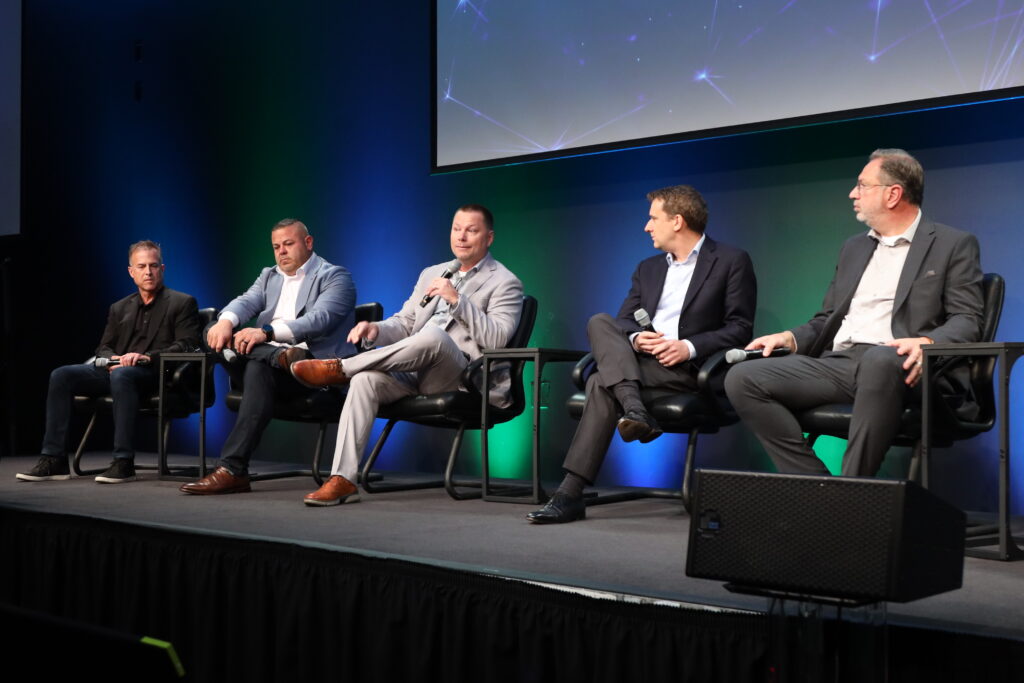
Chris Quilty (co-CEO at Quilty Space) moderated the top-level panel which comprised Tom Barton (CEO/Co-founder Antaris); Tim Lynch (VP/Space Security Missions Mission Strategy & Advanced Capabilities, Lockheed Martin Space); Matt Magaña (President, Defense & National Security, Voyager Technologies); Patrick Markus (VP & GM, DGSD Hughes, Hughes Network Systems) and Rob Mitrevski (President, Golden Dome Strategy and Integration, at L3Harris).
The panelists did not quite have dollar signs in their eyes, but each of the companies were enthusiastic supporters of the plan.
Tom Barton explained his company is focussed on the simulation of aspects of the Golden Dome including missile activity. He said the ideal situation was for a ‘vendor neutral’ policy to be employed. “Golden Dome is going to be difficult,” he admitted.
Matt Magaña told delegates that Voyager and had a portfolio of technologies capable of going into Golden Dome including guidance and navigation as well as propulsion systems for weapons and space and including AI and Machine Learning aspects. He said the industry needed to see budgets in place and then there could be discussions with supply-side vendors – and the necessary investment – as part of the overall plan. With the government’s shutdown there is considerable strain on the system as far as information flow was concerned.
Tim Lynch from Lockheed Martin said that for the best part of 50 years it had been an industry leader in missile technology and defence-related products. He said the first tactical objective was to sense [an incoming event], then to enable a response. He added that while the name of the project was new, in reality the US defense sector had been working on the challenges for years. Intercepting missiles was not new, although using a space-based missile was new but was a key part of the Golden Dome’s layered approach.
Patrick Markus from Hughes said their focus was on ground systems, tactical networking and the communications networks for Golden Dome. He said there is now an energy in this renewed problem which was good for the industry overall.
L3Harris’s Rob Mitrevski said that the government’s Executive Order needs covered a variety of steps, from regional to national, to international, and from defense of the homeland to wider activity. “We see ourselves playing a part in each of these steps”. He said that the Golden Dome plan sets out the vision for the project and the reason is the threat from China, Russia, North Korea, Iran and woild be a ‘call to action’ for the US. “We all know how to handle certain parts of the architecture but also the three tiers of the supply chain so that it works as one,” he suggested.
Mitrevski also said that L3Harris had already invested its own cash in projects that would have a relevance to Golden Dome, including new buildings and production possibilities. “You cannot wait for demand to come. We have to be ready,” he stated.
The panel agreed that Golden Dome was all about focus and improved readiness. There were plenty of reasons why government money had been diverted to other tasks and places in the past but today’s threats were very real. Indeed, it wasn’t about taking out a missile or two from a rogue nation but a much wider readiness against threats. There would certainly be a high cost, however while the complete architecture was not yet fully known it was difficult to price or provide a timeline.
There was also agreement that human system control would not be fast enough and all the systems would need to be automated although with appropriated controls in place.
One audience question asked what if the Trump administration was not around in 2028, and could the whole Golden Dome project be cancelled? The panel admitted that could happen – although unlikely – but if cancelled then today’s investments would be transferred to other projects and satisfying existing demand. The concept of ‘dual use’ is valuable and very much in the mind of the panelists and a good insurance for the future. There were also benefits that would flow from Golden Dome developments, not least Earth observation as an example.
