

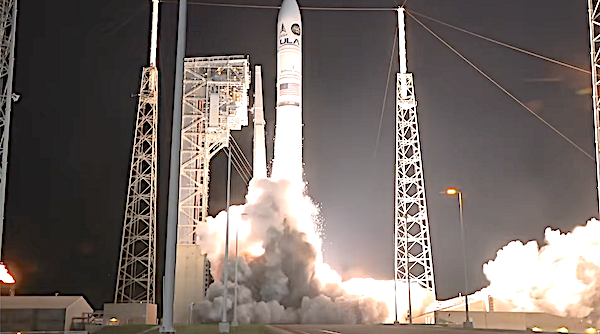

ULA’s recap: The United launch Alliance rocket departed Space Launch Complex-41 on Tuesday night at 8:56 p.m. EDT. The GEM 63XL solid rocket boosters burned for approximately 90 seconds and then separated, The methane-fueled first stage performed for five minutes before separating to allow the Centaur V to take over. Photos captured by Satnews.
The 10-hour countdown started at 10:09 a.m. EDT under the guidance of ULA Launch Conductor Scott Barney. The pad crew completed final preps at the complex and then cleared the area for fueling. The “go” for cryogenic tanking was given by ULA Launch Director James Whelan. Tanking operations were successfully performed as a million pounds of cryogenic propellants were placed into the rocket.
The clear to launch was given at 8:47 p.m. EDT by Space Force Mission Director Col. Jim Horne of Space Systems Command.
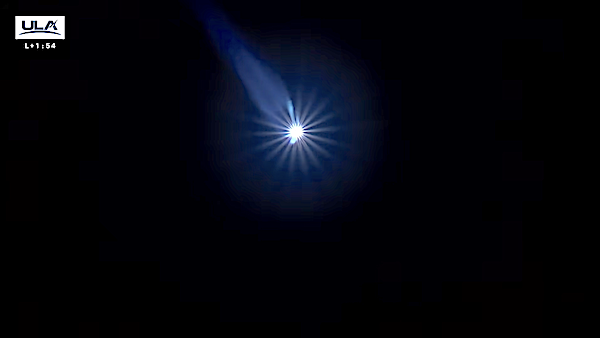
The USSF-106 payloads feature demonstrations and experiments from Department of Defense customers, including the Navigation Technology Satellite-3 (NTS-3). The Air Force Research Laboratory’s NTS-3 is the military’s first experimental navigation satellite system in nearly 50 years.
NTS-3 delivers enhanced GPS capabilities to the warfighter at faster speeds and lower cost and paves the way for a more robust, resilient and responsive architecture for satellite navigation technology.
NTS-3 will be the Department of Defense’s first experimental navigation satellite system in nearly 50 years. It builds on the legacy of NTS-1 and NTS-2, which were launched by ULA-heritage Atlas rockets in the 1970s and paved the way for today’s space-based PNT technology through the Global Positioning System (GPS).
Designed, developed, and integrated by L3Harris Technologies, NTS-3 will provide an on-orbit demonstration of game-changing technologies and techniques, preparing the way for a new generation of GPS receivers.
L-1 UPDATE: ULA Vulcan USSF-106 mission progressing towards launch of ‘2 firsts’
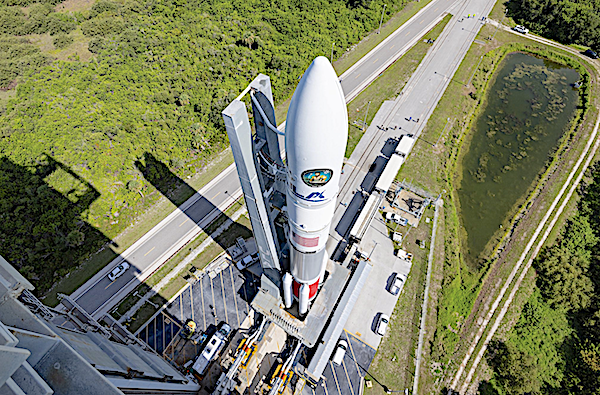
On August 12, 2025 between 7:59 and 8:59 p.m. EDT (2359-0059 UTC ) a Vulcan Centaur VC4S rocket, with four solid rocket boosters, will launch USSF-106 directly to geosynchronous orbit for the U.S. Space Force’s Space Systems Command. This will be the first National Security Space Launch (NSSL) mission on a Vulcan rocket, and an experimetal navigation satelllite. The payload is classified.
Everything continues to progress towards the ULA Vulcan launch carrying the USSF-106 mission for the United States Space Force’s Space Systems Command (SSC). The mission is planned to lift off on Tuesday, August 12 from Space Launch Complex-41 at Cape Canaveral Space Force Station in Florida. The launch window is 7:59-8:59 p.m. EDT. Today’s forecast shows an 80 percent chance of favorable weather conditions for launch.
Launch Forecast Summary:
- Overall probability of violating weather constraints: 20%
- Primary concerns: Cumulus Cloud Rule
- Overall probability of violating weather constraints for 24-hour delay: 20%
- Primary concern: Cumulus Cloud Rule
“Pretty historic point in our program history,” mission director Col. Jim Horne III said. “We officially end our reliance on Russian-made main engines with this launch, and we continue to maintain our assured access to space with at least two independent rocket service companies that we can leverage to get our capabilities on orbit.”
The first U.S. national security launch aboard a United Launch Alliance (ULA) Vulcan rocket will be the United States Space Force (USSF)-106 mission. Liftoff will occur from Space Launch Complex-41 at Cape Canaveral Space Force Station in Florida.
“I can’t tell you how excited I am to see it finally launched and finally start the on-orbit experimental mission,” said Joanna Hicks, a senior research aerospace engineer at the Air Force Research Laboratory.
L-2 Update: ULA Vulcan USSF-106 mission progresses towards Tuesday launch
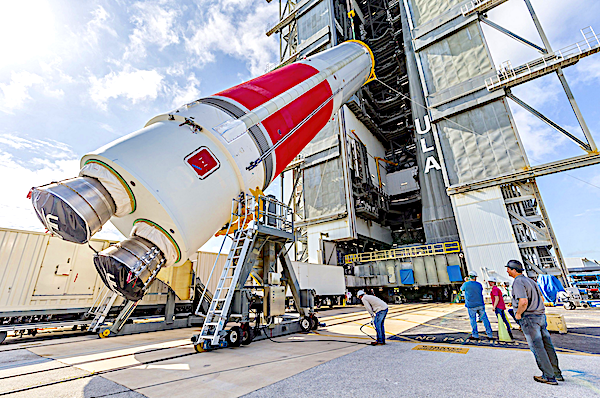
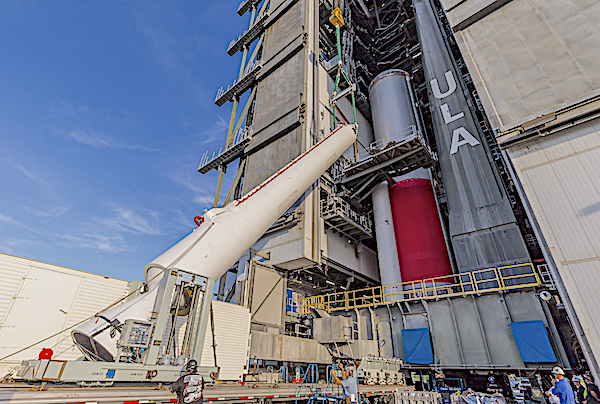
United Launch Alliance (ULA) hoists its Vulcan booster into the Government Vertical Integration Facility (VIF-G) adjacent to Space Launch Complex-41 at Cape Canaveral Space Force Station. The rocket will carry the USSF-106 mission, Vulcan’s first national security launch for the U.S. Space Force Space Systems Command (SSC). Photo credit: United Launch Alliance
Everything continues to progress towards the ULA Vulcan launch carrying the USSF-106 mission for the United States Space Force’s Space Systems Command (SSC). The mission is planned to lift off on Tuesday, August 12 from Space Launch Complex-41 at Cape Canaveral Space Force Station in Florida. The launch window is 7:59-8:59 p.m. EDT. Today’s forecast shows a 75 percent chance of favorable weather conditions for launch.
Weather 75% GO for Tuesday’s launch
The forecast from the Space Force’s Space Launch Delta 45 weather squadron and Launch Weather Officer Jimmy Taeger for Tuesday night’s launch of Vulcan indicates a 75 percent chance of acceptable conditions.
Liftoff is scheduled during a window of 7:59 to 8:59 p.m. EDT (2359-0059 UTC) from Space Launch Complex-41 at Cape Canaveral Space Force Station in Florida.
“Surface high pressure northeast of the Spaceport will maintain southeasterly surface flow across the region mid-week. The sea breeze will develop each day, with showers and thunderstorms developing across the area late morning/early afternoon and then more inland by the evening,” the weather team says.
“However, outflow boundary collisions could generate isolated showers and thunderstorms closer to the Spaceport near the launch windows. The highest Probabilities of Violation (PoV) are the Cumulus Cloud Rule and Surface Electric Fields Rule, with a lower PoV of the Lightning Rule.”
The launch time forecast includes scattered clouds and high cirrus, good visibility, southeasterly winds 9 to 14 knots and a temperature near 84 degrees F.
If the launch moves to the backup opportunity on Wednesday for some reason, there is again a 75 percent chance of meeting the weather rules with similar conditions.
Launch Forecast Summary:
Overall probability of violating weather constraints: 25%
Primary concerns: Cumulus Cloud Rule, Surface Electric Fields Rule, Lightning Rule
Overall probability of violating weather constraints for 24-hour delay: 25%
Primary concern: Cumulus Cloud Rule, Surface Electric Fields Rule, Lightning Rule
Launch Readiness Review completed
The Launch Readiness Review (LRR) is GO for Tuesday’s liftoff of the United Launch Alliance Vulcan rocket on its first U.S. national security mission, known as USSF-106.
The LRR, led by ULA Launch Director James Whelan, was completed this morning at the Advanced Spaceflight Operations Center (ASOC).
Leadership from ULA and the Space Force assessed the readiness of the rocket, payload and mission assets, discussed the status of pre-flight
ULA schedules first Vulcan rocket launch for National Security Space August 12
(Cape Canaveral Space Force Station, Fla., Aug. 5, 2025) – The launch of a United Launch Alliance Vulcan rocket carrying the U.S. Space Force (USSF)-106 mission for the United States Space Force’s Space Systems Command (SSC) is planned for Tuesday, August 12, 2025, from Space Launch Complex (SLC)-41 at Cape Canaveral Space Force Station, Florida, pending range approval.
This is the first national security space launch aboard the certified Vulcan rocket. The Vulcan rocket will deploy the USSF-106 mission directly to geosynchronous (GEO) orbit using the high-performance Centaur V upperstage.
ULA continues to be a steadfast partner to the Space Force, fulfilling the rigorous, unique requirements needed to launch tremendous capabilities into space for national defense and the protection of our nation’s allies around the world.
ULA continues launch prep of Vulcan for U.S. Space Force’s Space Systems Command USSF-106 mission
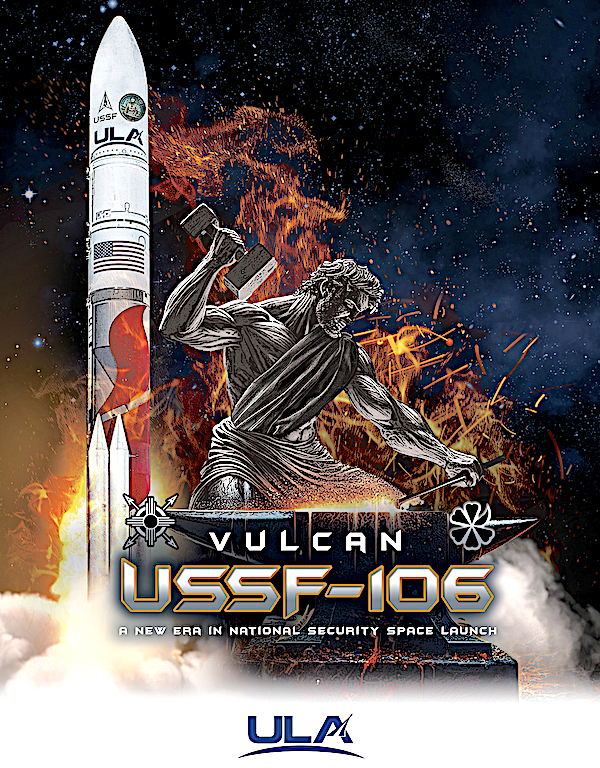
The first U.S. national security launch aboard a United Launch Alliance (ULA) Vulcan rocket will be the United States Space Force (USSF)-106 mission. Liftoff will occur at an as-yet-to-be-determined launch date from Space Launch Complex-41 at Cape Canaveral Space Force Station in Florida.
ULA is set to launch a Vulcan Centaur VC4S rocket, with four solid rocket boosters, to send USSF-106 directly to geosynchronous orbit for the U.S. Space Force’s Space Systems Command. This will be the first National Security Space Launch (NSSL) mission on a Vulcan rocket.
From its inception, the Vulcan rocket was designed to deliver heavy payloads to any orbit. The upcoming USSF-106 mission utilizes this capability with Centaur V launching a multi-manifest U.S. national security payload directly to geosynchronous orbit for the Space Force.
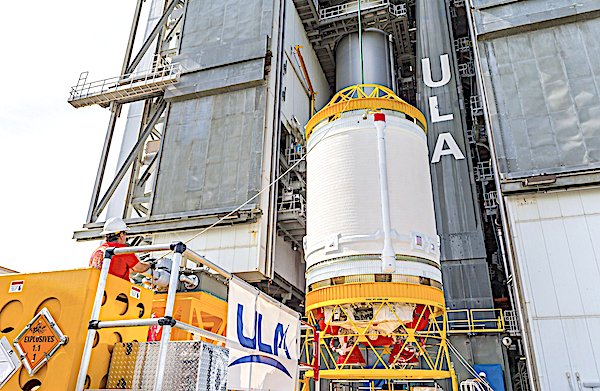
United Launch Alliance (ULA) hoists its Centaur V upper stage atop the Vulcan rocket that will launch the multi-manifest USSF-106 payload. This will be Vulcan’s first national security mission for the U.S. Space Force Space Systems Command (SSC). Photo credit: ULA
ULA technicians at Cape Canaveral are assembling the most powerful Vulcan rocket yet. Together with its twin BE-4 main engines and four side-mounted GEM 63XL solid rocket boosters, Vulcan will generate three million pounds (13 meganewtons) of liftoff thrust to launch the USSF-106 mission.
Launch Vehicle
Payload Fairing
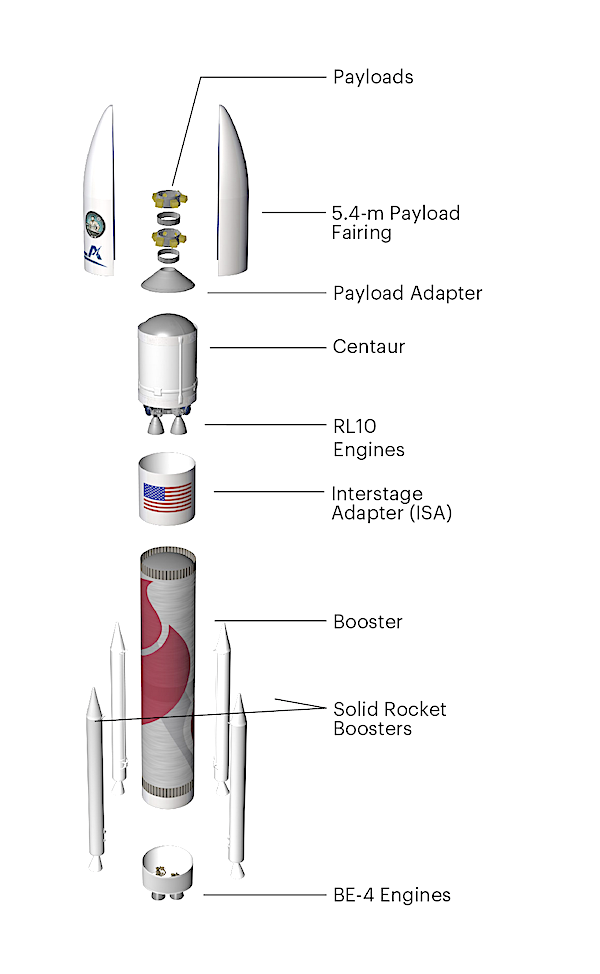
The spacecraft is encapsulated in a 5.4-m- (17.7-ft-) diameter payload fairing (PLF), a sandwich composite structure made with a vented aluminum-honeycomb core and graphite-epoxy face sheets. The bisector (two-piece shell) PLF encapsulates the spacecraft. The payload attach fitting (PAF) is a similar sandwich composite structure creating the mating interface from spacecraft to second stage and payload fairing. The PLF separates using a debris-free horizontal and vertical separation system with spring packs and frangible joint assembly. The payload fairing is available in the 15.5-m (51-ft) standard and 21.3-m (70-ft) long configurations.
Centaur V
The Centaur V second stage is 17.7 ft (5.4 m) in diameter and 38.5 ft (11.7 m) in length. Its propellant tanks are pressure-stabilized and constructed of corrosion-resistant stainless steel. Centaur is a cryogenic vehicle, fueled with liquid hydrogen and liquid oxygen, powered by two RL10C-1-1A engines producing 23,825 pounds (106 kilo-Newtons) of thrust. The cryogenic tanks are insulated with a combination of multilayer insulation (MLI) blankets, radiation shields and spray-on foam insulation (SOFI). A fault-tolerant avionics system is mounted on an aft equipment shelf. The payload attach fitting (PAF) provides structural and electrical interfaces with the spacecraft and is mounted to the Centaur V Launch Vehicle Forward Adapter (LVFA).
Booster
The booster is 17.7 ft (5.4 m) in diameter and 109.2 ft (33.3 m) in length. The booster’s tanks are structurally rigid and constructed of orthogrid aluminum barrels, spun-formed aluminum domes with a common bulkhead. The liquefied natural gas (LNG) / methane fueled booster will be powered by a pair of BE-4 engines, each producing 550,000 pounds (2,400 kN) of sea level thrust. Four graphite epoxy motor (GEM) 63XL solid rocket boosters (SRBs) generate the additional power required at liftoff, with each providing 459,600 lbs (2,044 kN) of thrust. The Centaur avionics system, provides guidance, flight control and vehicle sequencing functions during the booster and Centaur phases of flight.
