

• Skip to primary navigation
  • Skip to main content
  • Skip to primary sidebar
  • Skip to secondary sidebar
  • Skip to footer
  • NEWS:
  • SatNews
  • SatMagazine
  • MilSatMagazine
  • SmallSat News
  • |     EVENTS:
  • SmallSat Symposium
  • Satellite Innovation
  • MilSat Symposium
  • SmallSat Europe

SatNews

Satellite Industry Intelligence Since 1983

Subscribe
  • LATEST
  • SatNews Events
  • Magazines
  • Calendar
  • Subscribe
  • Missions & Constellations
    • Exploration & Science Missions
    • In-Orbit Servicing & Orbital Operations
    • LEO Constellations
    • Mission Autonomy & Onboard Systems
    • Mission Deployments & Manifests
    • Navigation & PNT
    • SmallSat
    • Spacecraft & Payload Technology
    View All in Missions & Constellations →
    Satellite Connectivity Becomes the New Anchor for a Fragmenting Wearables MarketSatellite Connectivity Becomes the New Anchor for a Fragmenting Wearables Market
    AI Investments in Extreme Environment Materials Surpass $262 MillionAI Investments in Extreme Environment Materials Surpass $262 Million
    Air Inuit Modernizes Operations with SKYTRAC TrooTrax Mission SoftwareAir Inuit Modernizes Operations with SKYTRAC TrooTrax Mission Software
    ESA Launches Arctic Field Campaign to Calibrate Future Copernicus MissionsESA Launches Arctic Field Campaign to Calibrate Future Copernicus Missions
  • Business
    • Contracts & Commercial Deals
    • Earnings & Financial Reporting
    • Events & Conferences
    • Funding & Venture Capital
    • Market Forecasts
    • Mergers & Acquisitions
    • Personnel Moves & Appointments
    View All in Business & Finance →
    HTX and ST Engineering Launch Space Tech Program for Singapore Public SafetyHTX and ST Engineering Launch Space Tech Program for Singapore Public Safety
    SmallSat Europe Speaker Focus: Tanja Masson-Zwaan, Leiden UniversitySmallSat Europe Speaker Focus: Tanja Masson-Zwaan, Leiden University
    HawkEye 360 Files for Initial Public Offering at $2.4 Billion ValuationHawkEye 360 Files for Initial Public Offering at $2.4 Billion Valuation
    SmallSat Europe Speaker Focus: Jean-François Morizur, CailabsSmallSat Europe Speaker Focus: Jean-François Morizur, Cailabs
  • Defense
    • Counterspace & ASAT
    • Defense Budgets & Procurement
    • ISR & Reconnaissance
    • MILSATCOM
    • Missile Warning & Defense
    • National Security Programs
    • Space Domain Awareness
    View All in Military & Defense →
    BAE Systems Enters Production for NavGuide M-Code GPS ReceiverBAE Systems Enters Production for NavGuide M-Code GPS Receiver
    Space Force Awards $3.2 Billion in Golden Dome Contracts for Orbital Interceptor ConstellationSpace Force Awards $3.2 Billion in Golden Dome Contracts for Orbital Interceptor Constellation
    USSF Finalizes GPS III Constellation with Successful SV-10 DeploymentUSSF Finalizes GPS III Constellation with Successful SV-10 Deployment
    Meink: Space Force Programs Ready to Execute Once FY27 Budget LandsMeink: Space Force Programs Ready to Execute Once FY27 Budget Lands
  • Gov
    • Export Controls & Compliance
    • International Space Agreements
    • National Space Policy
    • Space Law & Treaties
    • Space Sustainability & Debris Policy
    • Space Traffic Management / Debris Removal
    View All in Government & Regulation →
    How CubeSat Proliferation is Redefining Sovereignty and Diplomatic Leverage at the United NationsHow CubeSat Proliferation is Redefining Sovereignty and Diplomatic Leverage at the United Nations
    FCC Modernization of Spectrum Rules Unlocks Sevenfold Gain in Satellite CapacityFCC Modernization of Spectrum Rules Unlocks Sevenfold Gain in Satellite Capacity
    The Smartest Money in the Room Is Looking UpThe Smartest Money in the Room Is Looking Up
    NASA’s Shift to CLPS 2.0 Signals Structural Transformation of Lunar Logistics MarketNASA’s Shift to CLPS 2.0 Signals Structural Transformation of Lunar Logistics Market
  • Launch
    • Launch Providers
    • Launch Schedule & Calendars
    • Launch Sites & Infrastructure
    • Rocket Technology & Vehicles
    View All in Launch →
    Astrobotic Achieves Record 300-Second Burn with New Detonation EngineAstrobotic Achieves Record 300-Second Burn with New Detonation Engine
    Bad news, but good news followedBad news, but good news followed
    Rocket Lab Successfully Launches “Kakushin Rising” Mission for JAXARocket Lab Successfully Launches “Kakushin Rising” Mission for JAXA
    Blue Origin CEO Attributes BlueBird 7 Satellite Loss to Second-Stage Thrust AnomalyBlue Origin CEO Attributes BlueBird 7 Satellite Loss to Second-Stage Thrust Anomaly
  • Software
    • Autonomous Ground Operations
    • Data Processing & AI/ML
    • Digital Twins & Modeling
    • Ground Segment & Teleports
    • Mission Planning & Simulation
    • Space Systems Software Engineering
    • Spectrum & Licensing
    View All in Software Automation & Ground Systems →
    SmallSat Europe Speaker Focus: Giovanni Pandolfi Bortoletto, Leaf SpaceSmallSat Europe Speaker Focus: Giovanni Pandolfi Bortoletto, Leaf Space
    SpinLaunch Selects Equinix to Deploy Global Ground Infrastructure for Meridian Space ConstellationSpinLaunch Selects Equinix to Deploy Global Ground Infrastructure for Meridian Space Constellation
    RF-Design Launches FiberLink CompactLine FCLR1811S4 for Ground Segment OptimizationRF-Design Launches FiberLink CompactLine FCLR1811S4 for Ground Segment Optimization
    Sat-Lite Technologies adds  Richard Rader to Spearhead Sales ExpansionSat-Lite Technologies adds Richard Rader to Spearhead Sales Expansion
  • Services & Apps
    • Climate & Environmental Monitoring
    • Disaster Response & Security Mapping
    • Earth Observation & Imaging
    • Maritime & Aviation Satcom
    • Satellite Communications
    View All in Services & Applications →
    Solstar Confirms Successful On-Orbit Operation of Deke Space Communicator Following Launch on SpaceX Transporter-16 MissionSolstar Confirms Successful On-Orbit Operation of Deke Space Communicator Following Launch on SpaceX Transporter-16 Mission
    IEC Telecom Unveils Voucher-Based Connectivity Solution at Singapore Maritime Week 2026IEC Telecom Unveils Voucher-Based Connectivity Solution at Singapore Maritime Week 2026
    GomSpace and STETMAN Establish UASAT Joint Venture for Ukrainian Sovereign CommunicationsGomSpace and STETMAN Establish UASAT Joint Venture for Ukrainian Sovereign Communications
    Market Dynamics and Non-Terrestrial Network (NTN) ChipsetsMarket Dynamics and Non-Terrestrial Network (NTN) Chipsets

DARPA’s Robots to the Rescue: Transforming Satellite Maintenance in Space

November 18, 2024

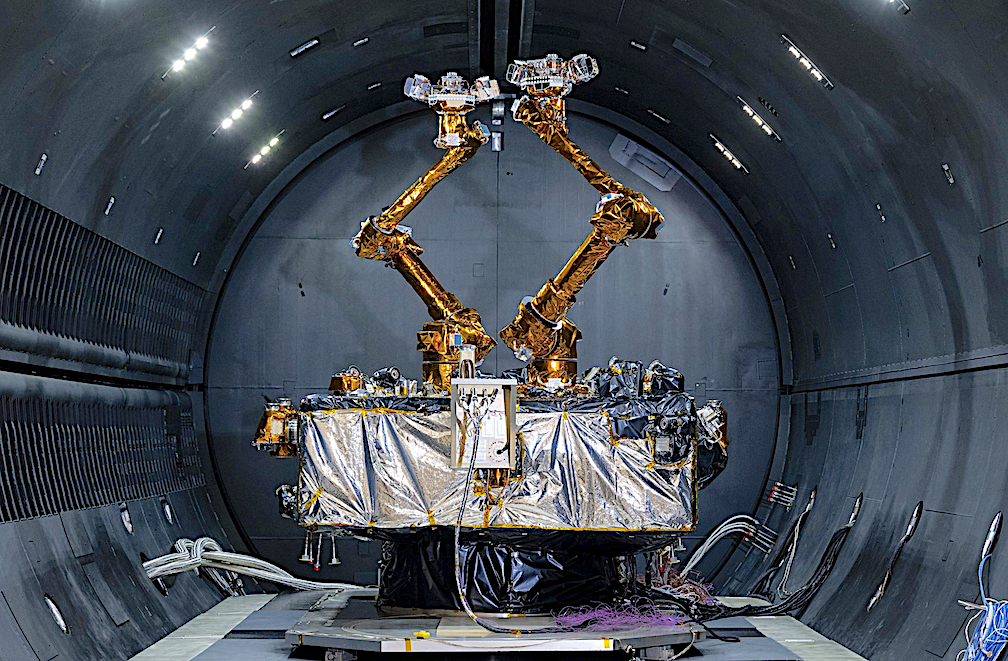
After completing testing, the Robotic Servicing of Geosynchronous Satellites (RSGS) payload resides in the cryogenic thermal vacuum chamber at the U.S. Naval Research Laboratory’s Naval Center for Space Technology in Washington, D.C. Oct. 8, 2024. Once on-orbit, the RSGS payload will inspect and service satellites in geosynchronous orbit. Credit: U.S. Navy photo by Sarah Peterson

By Naval Research Laboratory

This payload, designed to perform repairs and upgrades, promises to revolutionize satellite operations by enhancing longevity and reducing costs associated with satellite servicing. With successful thermal vacuum testing and a partnership with Northrop Grumman, the project is poised for a 2026 launch, setting the stage for a new era of resilient and adaptable space infrastructure.

Transforming Space Operations: NRL and DARPA’s Robotic Revolution

After completing testing, the Robotic Servicing of Geosynchronous Satellites (RSGS) payload resides in the cryogenic thermal vacuum chamber at the U.S. Naval Research Laboratory’s Naval Center for Space Technology in Washington, D.C. Oct. 8, 2024. Once on-orbit, the RSGS payload will inspect and service satellites in geosynchronous orbit. Credit: U.S. Navy photo by Sarah Peterson

The U.S. Naval Research Laboratory’s (NRL) Naval Center for Space Technology (NCST), in collaboration with the Defense Advanced Research Projects Agency (DARPA), has successfully completed the development of a spaceflight-qualified robotics suite designed to service satellites in orbit. The milestone was achieved on October 8.

Funded by DARPA, NRL developed the Robotic Servicing of Geosynchronous Satellites (RSGS) Integrated Robotic Payload (IRP). This groundbreaking technology has been handed over to DARPA’s commercial partner, Northrop Grumman’s SpaceLogistics, for integration with the Mission Robotics Vehicle (MRV), a spacecraft bus.

Steven Butcher, Technology Service Corporation space robotics and mechanisms engineer, performs an inspection of the Robotic Servicing of Geosynchronous Satellites (RSGS) payload after completing testing in the cryogenic thermal vacuum chamber at the U.S. Naval Research Laboratory’s Naval Center for Space Technology in Washington, D.C. Oct. 4, 2024. Once on-orbit, the RSGS payload will inspect and service satellites in geosynchronous orbit. Credit: U.S. Navy photo by Sarah Peterson

Milestones and Future Vision in Space Robotics

“The recent completion of thermal vacuum testing marks a major milestone toward achieving the program’s goal of demonstrating robotic servicing capabilities on orbit in the near future,” said Dr. Bruce Danly, NRL’s Director of Research. “NRL’s contributions to the robotic payload are an essential part of realizing this vision, which promises to transform satellite operations in geostationary orbit, reduce costs for satellite operators, and enable capabilities well beyond what we have today. In fact, the anticipated capabilities are potentially revolutionary for both national security and civil applications.”

As DARPA’s robotic payload developer for the RSGS program, NRL looked to the future to design, build, integrate, and test groundbreaking satellite servicing capabilities.

“This collaboration unlocks new servicing opportunities for both commercial and government satellites, enabling usual-close inspections, orbital adjustments, hardware upgrades, and repairs,” said Bernie Kelm, NRL NCST superintendent of the Spacecraft Engineering Division. “We’ve created advanced spaceflight hardware and software that will significantly enhance satellite servicing operations, including all robotic controls.”
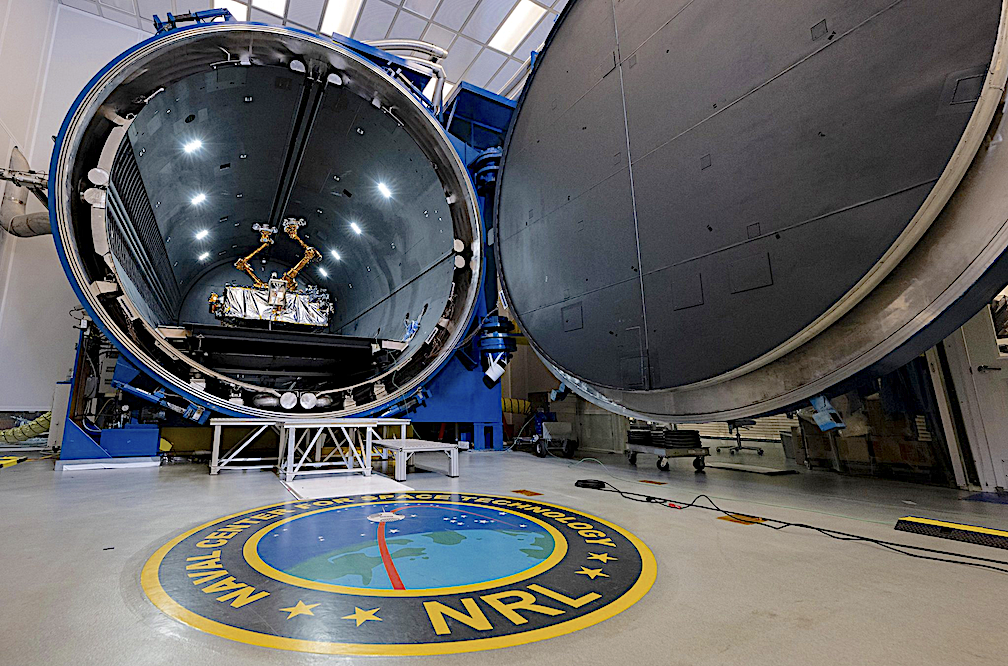
After completing testing, the Robotic Servicing of Geosynchronous Satellites (RSGS) payload resides in the cryogenic thermal vacuum chamber at the U.S. Naval Research Laboratory’s Naval Center for Space Technology in Washington, D.C. Oct. 8, 2024. Once on-orbit, the RSGS payload will inspect and service satellites in geosynchronous orbit. Credit: U.S. Navy photo by Sarah Peterson

Enhancing Satellite Servicing and Operations

Satellites in geosynchronous orbit, positioned approximately 22,000 miles above Earth, are crucial for military, government, and commercial communications, Earth-observing science, and national security services.

Currently, spacecraft face significant challenges, in part because of the inability to perform in-orbit repairs or upgrades. To compensate for the lack of servicing options, satellites are often loaded with backup systems and excess fuel, leading to increased complexity, weight, and cost. Should this project prove successful, satellites can receive in-orbit upgrades based on new technology to extend their service life, Kelm added.

“The military regularly fixes aircraft, tanks, ships, and trucks that break. We upgrade aircraft and ships with the latest radars, computers, and engines,” said Glen Henshaw, Ph.D., NRL senior scientist for Robotics and Autonomous Systems. “Satellites are the only expensive equipment we buy that can’t be repaired or upgraded once they are in the field, and this costs the taxpayer money. RSGS is intended to change this situation; we intend to demonstrate that we can upgrade and repair these valuable assets using robots.”

Thermal Vacuum (TVAC) Testing Process

The test campaign put the robotic payload through its paces across the range of temperatures it will face while on-orbit and under vacuum conditions similar to space. Engineers tested all aspects of the payload including avionics, cameras, and lights, and demonstrated all operations, with each of its two robotic arms including launch lock deployments, calibrations, and tool changing. The test also verified SpaceWire communications and robotic compliance and visual servo control modes.

“NRL’s Team RSGS has spent nearly 10 years focused on the goal of completing this first of a kind, robotic servicing payload,” said William Vincent, NRL RSGS program manager. “The completion of IRP TVAC represents a huge milestone and countless hours of work from an incredible group of dedicated personnel. Like sending a child off to college for the first time, shipping the IRP to Dulles is a bittersweet experience.”

The Future of Satellite Mechanics and Spacecraft Design

NRL worked for over two decades to mature the technology enabling the RSGS program. RSGS is designed to safely and reliably repair and upgrade valuable commercial, civil, and national security satellites, some of which cost over a billion dollars. In the near future, robotic satellite “mechanics” may extend the useful life of satellites by upgrading a variety of capabilities including new electronics, propulsion, and sensors capabilities. RSGS robots could demonstrate broad servicing as a precursor to building large structures in-orbit which could include the next great observatory, solar power stations, or other revolutionary new systems.

“We hope that this will eventually lead to spacecraft that are more modular and easier to maintain,” Henshaw said.

Following its anticipated 2026 launch on the Northrop Grumman’s MRV spacecraft bus, the robotic payload will undergo initial checkout and calibration with full operational servicing missions to follow.

“We will proudly watch RSGS as it provides resilience for the current U.S. space infrastructure and takes the first concrete steps toward a transformed space architecture with revolutionary capabilities,” Vincent said.

Filed Under: Contracts & Commercial Deals, In-Orbit Servicing & Orbital Operations

Primary Sidebar

Coverage

  • Missions & Constellations
  • Business & Finance
  • Military & Defense
  • Launch
  • Software Automation & Ground Systems
  • Government & Regulation
  • Services & Applications

Most Read Stories

  • SpaceX Loses Contact With Starlink Satellite
  • Planet Labs Imposes Indefinite Blackout on Iran Satellite Imagery at U.S. Request
  • Amazon in Reported Talks to Acquire Globalstar in $9 Billion Move to Challenge Starlink
  • What the SpaceX IPO Changes for Every Satellite Operator
  • Russia Replaces Starlink With European-Built Satellites

Secondary Sidebar

Footer


Satnews is a leading provider of satellite news, events, publications, research and other satellite industry information in both commercial and military enterprises worldwide.

Stories By Category

  • Business & Finance
  • Government & Regulation
  • Launch
  • Military & Defense
  • Missions & Constellations
  • Services & Applications
  • Software Automation & Ground Systems
  • Spectrum & Licensing
  • Startups & NewSpace Business

About Us

  • Leadership & Editorial Team
  • SatNews History
  • Free Satnews Subscription
  • SatNews Events
  • Magazines

Navigation

  • Latest Stories
  • Magazines
  • Events
  • Contact
  • Cookie & Privacy Policy for Satnews

We use cookies to ensure that we give you the best experience on our website. If you continue to use this site we will assume that you are happy with it.
x
Sign up Now (For Free)
Access daily or weekly satellite news updates covering all aspects of the commercial and military satellite industry.
Invalid email address
Notify Me Regarding ( At least one ):
We value your privacy and will not sell or share your email or other information with any other company. You may also unsubscribe at anytime.

Click Here to see our full privacy policy.
Thanks for subscribing!