• Skip to primary navigation
  • Skip to main content
  • Skip to primary sidebar
  • Skip to secondary sidebar
  • Skip to footer
  • NEWS:
  • SatNews
  • SatMagazine
  • MilSatMagazine
  • SmallSat News
  • |     EVENTS:
  • SmallSat Symposium
  • Satellite Innovation
  • MilSat Symposium
  • SmallSat Europe

SatNews

Satellite Industry Intelligence Since 1983

Subscribe
  • LATEST
  • SatNews Events
  • Magazines
  • Calendar
  • Subscribe
  • Missions & Constellations
    • Exploration & Science Missions
    • In-Orbit Servicing & Orbital Operations
    • LEO Constellations
    • Mission Autonomy & Onboard Systems
    • Mission Deployments & Manifests
    • Navigation & PNT
    • SmallSat
    • Spacecraft & Payload Technology
    View All in Missions & Constellations →
    Isar Aerospace Reaches Orbit with Spectrum Rocket Maiden Launch from NorwayIsar Aerospace Reaches Orbit with Spectrum Rocket Maiden Launch from Norway
    ISRO Clarifies National Space Mandate, Confirming Agency Will Not Face PrivatizationISRO Clarifies National Space Mandate, Confirming Agency Will Not Face Privatization
    No Robot Has Captured an Uncontrolled Satellite. The Pentagon Is Buying It Anyway.No Robot Has Captured an Uncontrolled Satellite. The Pentagon Is Buying It Anyway.
    The Labors of LoveThe Labors of Love
  • Business
    • Contracts & Commercial Deals
    • Earnings & Financial Reporting
    • Events & Conferences
    • Funding & Venture Capital
    • Market Forecasts
    • Mergers & Acquisitions
    • Personnel Moves & Appointments
    View All in Business & Finance →
    Kymeta Secures $20 Million Department of Defense Order for Resilient Flat-Panel SATCOM TerminalsKymeta Secures $20 Million Department of Defense Order for Resilient Flat-Panel SATCOM Terminals
    Silicon Valley Space Week Speaker Focus: Ashley Fieglein Johnson, PlanetSilicon Valley Space Week Speaker Focus: Ashley Fieglein Johnson, Planet
    Silicon Valley Space Week Speaker Focus: Dr. Dan Ceperley, LeoLabsSilicon Valley Space Week Speaker Focus: Dr. Dan Ceperley, LeoLabs
    Blue Origin Accelerates Engineering Hiring from Amazon Satellite Division to Expand Orbital OperationsBlue Origin Accelerates Engineering Hiring from Amazon Satellite Division to Expand Orbital Operations
  • Defense
    • Counterspace & ASAT
    • Defense Budgets & Procurement
    • ISR & Reconnaissance
    • MILSATCOM
    • Missile Warning & Defense
    • National Security Programs
    • Space Domain Awareness
    View All in Military & Defense →
    UK Government Commercial Agency Selects Open Cosmos for £8 Billion Defense Communications FrameworkUK Government Commercial Agency Selects Open Cosmos for £8 Billion Defense Communications Framework
    LeoLabs Awarded $20.7 Million U.S. Space Force Contract for Mobile Scout-S Surveillance RadarLeoLabs Awarded $20.7 Million U.S. Space Force Contract for Mobile Scout-S Surveillance Radar
    Palladyne AI and NORDA Dynamics Partner to Integrate Autonomous Swarming and Terminal Guidance SoftwarePalladyne AI and NORDA Dynamics Partner to Integrate Autonomous Swarming and Terminal Guidance Software
    How ICEYE Turned Sovereign SAR Into a 12-Month ProductHow ICEYE Turned Sovereign SAR Into a 12-Month Product
  • Gov
    • Export Controls & Compliance
    • International Space Agreements
    • National Space Policy
    • Space Law & Treaties
    • Space Sustainability & Debris Policy
    • Space Traffic Management / Debris Removal
    View All in Government & Regulation →
    U.S. Commercial Launch and Satellite Operators Withdraw from European Space Summit Following White House InterventionsU.S. Commercial Launch and Satellite Operators Withdraw from European Space Summit Following White House Interventions
    Türkiye Becomes 71st Signatory of the Artemis AccordsTürkiye Becomes 71st Signatory of the Artemis Accords
    SpaceX Petitions FCC to Block Viasat Satellite Authorization Over Starlink Interference ConcernsSpaceX Petitions FCC to Block Viasat Satellite Authorization Over Starlink Interference Concerns
    NASA Astronaut Jonny Kim Departs Agency as Civil Space Sector Navigates Broader Human Capital DemandsNASA Astronaut Jonny Kim Departs Agency as Civil Space Sector Navigates Broader Human Capital Demands
  • Launch
    • Launch Providers
    • Launch Schedule & Calendars
    • Launch Sites & Infrastructure
    • Rocket Technology & Vehicles
    View All in Launch →
    NASA Launches Nancy Grace Roman Space Telescope to Survey Dark Energy and ExoplanetsNASA Launches Nancy Grace Roman Space Telescope to Survey Dark Energy and Exoplanets
    Firefly Aerospace CEO Cites Systemic Launch Vehicle Shortage Amid Expanding Satellite BacklogsFirefly Aerospace CEO Cites Systemic Launch Vehicle Shortage Amid Expanding Satellite Backlogs
    Financial Modeling Validates SpaceX Falcon 9 Booster Economics and MarginsFinancial Modeling Validates SpaceX Falcon 9 Booster Economics and Margins
    ESA Awards PLD Space €158.9M European Launcher Challenge Contract for MIURA 5 Scaling and ReusabilityESA Awards PLD Space €158.9M European Launcher Challenge Contract for MIURA 5 Scaling and Reusability
  • Software
    • Autonomous Ground Operations
    • Data Processing & AI/ML
    • Digital Twins & Modeling
    • Ground Segment & Teleports
    • Mission Planning & Simulation
    • Space Systems Software Engineering
    • Spectrum & Licensing
    View All in Software Automation & Ground Systems →
    Royal Wagenborg Selects De Boer Marine for Fleetwide Maritime Connectivity and Cybersecurity IntegrationRoyal Wagenborg Selects De Boer Marine for Fleetwide Maritime Connectivity and Cybersecurity Integration
    Astrolight Advances End-to-End Lasercom Network to Address Orbital Bandwidth and Spectrum BottlenecksAstrolight Advances End-to-End Lasercom Network to Address Orbital Bandwidth and Spectrum Bottlenecks
    Intellian Unveils CM100 GMDSS Terminal Built for Iridium Certus 100 Safety NetworkIntellian Unveils CM100 GMDSS Terminal Built for Iridium Certus 100 Safety Network
    NASA Joins Federal Genesis Mission Initiative to Process 150 Petabytes of Space Data via AI ArchitecturesNASA Joins Federal Genesis Mission Initiative to Process 150 Petabytes of Space Data via AI Architectures
  • Services & Apps
    • Climate & Environmental Monitoring
    • Disaster Response & Security Mapping
    • Earth Observation & Imaging
    • Maritime & Aviation Satcom
    • Satellite Communications
    View All in Services & Applications →
    Final Three SES O3b mPOWER Satellites Arrive at Cape Canaveral Ahead of Falcon 9 LaunchFinal Three SES O3b mPOWER Satellites Arrive at Cape Canaveral Ahead of Falcon 9 Launch
    SynMax Secures Exclusive Maritime Channel Deal for Satellogic’s Upcoming Merlin Satellite ConstellationSynMax Secures Exclusive Maritime Channel Deal for Satellogic’s Upcoming Merlin Satellite Constellation
    Munich Startup Project-S Emerges from Stealth with Multi-Million-Euro Funding for Orbital Safety InfrastructureMunich Startup Project-S Emerges from Stealth with Multi-Million-Euro Funding for Orbital Safety Infrastructure
    Mobile Satellite Services Association Releases Reference Architecture 2.0 for Regenerative NTN PayloadsMobile Satellite Services Association Releases Reference Architecture 2.0 for Regenerative NTN Payloads

SpaceX launches Europe’s Galileo satellites the first time from U.S. and retires a record breaking Falcon 9 workhorse

April 27, 2024

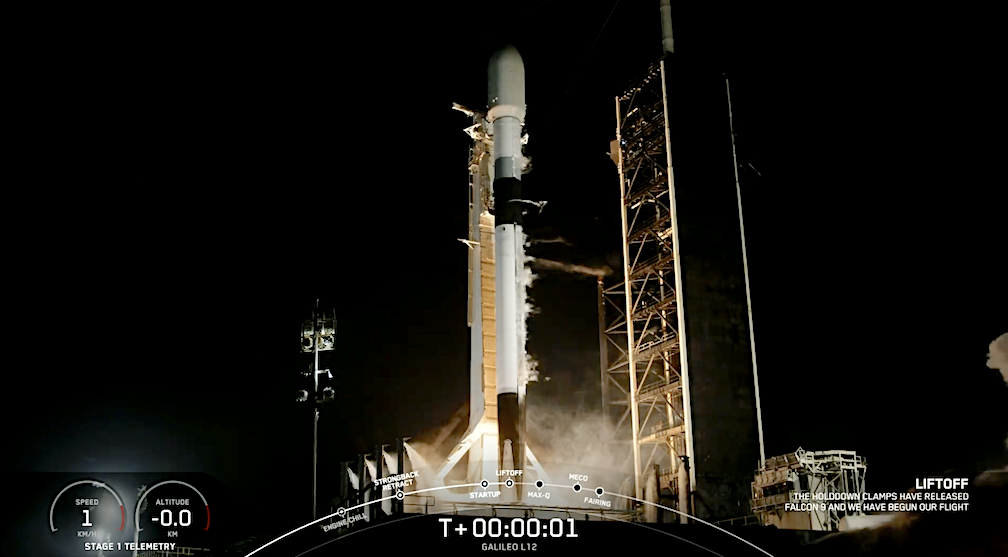
Photo of Galileo L12 launch captured by Satnews from SpaceX video stream.

SpaceX’s Falcon 9 launched the European Commission’s Galileo L12 mission to medium Earth orbit from Launch Complex 39A (LC-39A) at Kennedy Space Center in Florida on Saturday, April 27 at 8:34 p.m. ET.

SpaceX tied its rocket-reuse record on Saturday night (April 27) set earlier this month by a different Falcon 9 booster, on a launch of SpaceX’s Starlink internet satellites..

“Due to the additional performance required to deliver the payload to medium Earth orbit, this mission marks the 20th and final launch for this Falcon 9 first stage booster,” SpaceX wrote in the mission description.

SpaceX achieved other milestones with the launch of its Falcon 9 rocket from NASA’s Kennedy Space Center on Saturday. The weekend flight marked the first time that the European Commission’s Galileo satellites (similar to the United State’s Global Positioning System (GPS) satellites) launched onboard an American-made rocket and from U.S. soil.

The launch added to the Galileo constellation, Europe’s equivalent of the United States’ Global Positioning System (GPS). Twenty-eight Galileo satellites have launched to date, all of them on Russian-built Soyuz rockets or Europe’s Ariane 5.

However the Ariane 5 retired last summer without a new source and Europe had ended most of its space ties with Russia following the latter’s invasion of Ukraine in February 2022. As a result the European Space Agency contracted with SpaceX to launch up to four Galileo craft over two launches in 2024 making Saturday’s mission the first of two liftoffs.
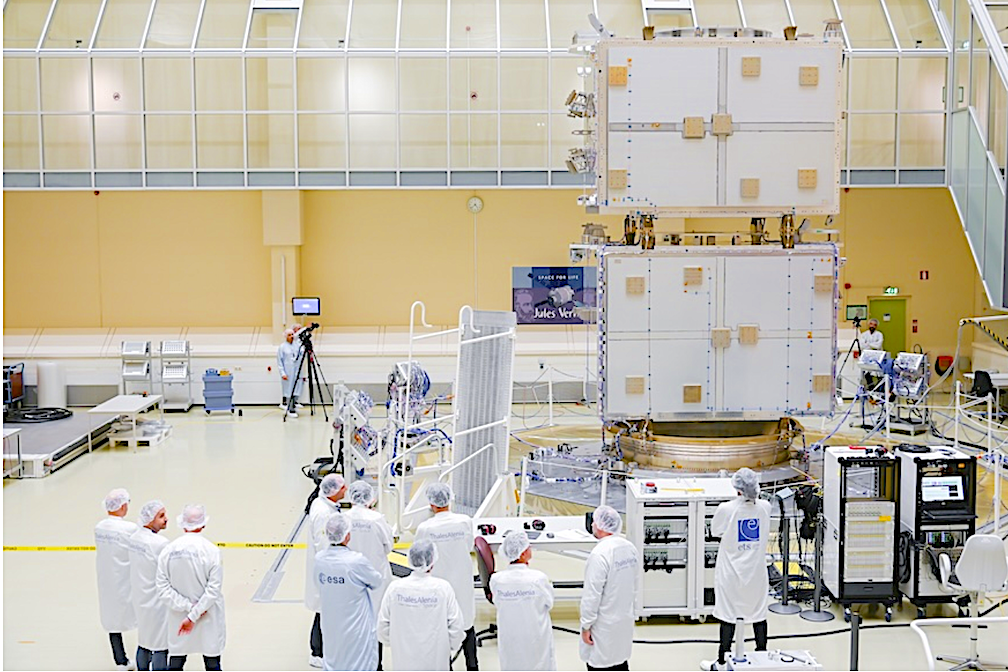
The Galileo Second Generation satellites will be launched in pairs, interconnected and connected to the launcher until separation. Each satellite is over 2000 kg and when stacked, they reach a towering height of seven meters. This configuration has undergone vibration tests at ESA’s Hydraulic Multi-axis Shaker (Hydra) and received mechanical qualification. Image: ESA

Due to the additional performance required to deliver the payload to medium Earth orbit, this mission marks the 20th and final launch for this Falcon 9 first stage booster, which previously launched GPS III-3, Turksat 5A, Transporter-2, Intelsat G-33/G-34, Transporter-6, Intuitive Machines IM-1, and 13 Starlink missions.
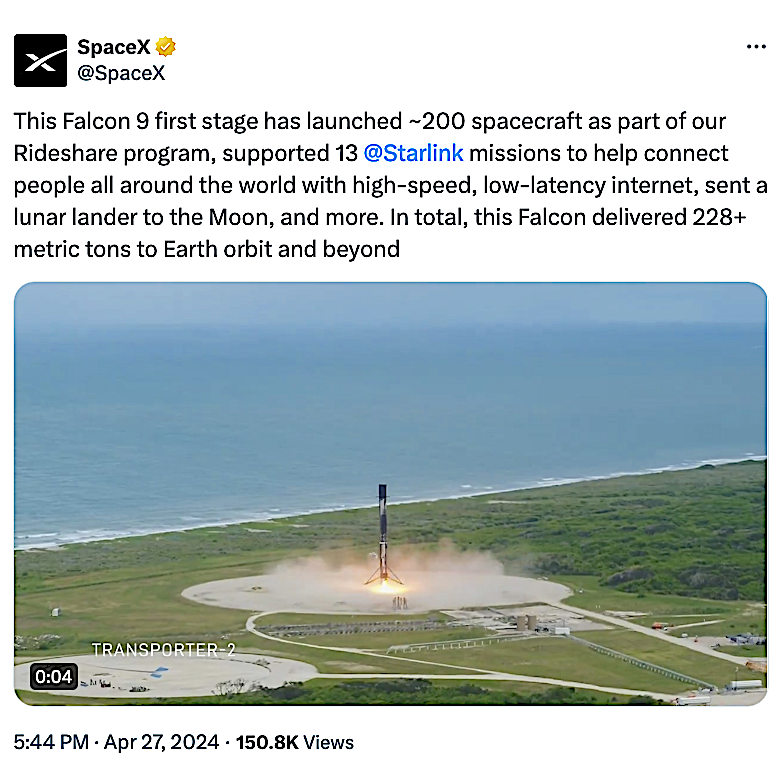
The Falcon 9 rocket lifted off from Launch Complex 39A (LC-39A) at 8:34 p.m. EDT (0034 UTC). The first stage booster on this mission, tail number B1060 in the SpaceX fleet, launched for a 20th and final time. SpaceX did not plan to recover B1060 “due to the additional performance requirement to deliver the payload to medium Earth orbit.”

“The last time a first stage was expended during a Falcon 9 mission was 146 flights ago in November 2022,” SpaceX said in a social media post following the launch. “On most Falcon 9 missions, enough propellant remains in the first stage after stage separation to enable landing, recovery, and ultimately reuse on future missions.”

Because it wasn’t recovered, SpaceX removed the hypersonic grid fins at the top of the booster as well as the four landing legs.

The two-part payload fairing protecting the two Galileo satellites were recovered from the Atlantic Ocean by the recovery vessel, Bob, named for former NASA astronaut, Bob Behnken of the Demo-2 mission. SpaceX noted that this was also the 200th mission that used flight-proven payload fairings.

SpaceX added that it is in the process of qualifying both its boosters and its payload fairings for up to 40 missions each. They credit the data gathered on Falcon vehicle flights to furthering their development of the significantly larger and entirely reusable Starship rocket and their stated goal of “making life multi-planetary.”

During a press conference at the European Space Summit in Seville, Spain, in November 2023, Thierry Breton, the European Commission’s commissioner for the internal market, said that the continent’s lack of an orbital class rocket meant America, and SpaceX in particular, was their next logical option.

“We have four satellites to launch [in 2024] and given that Ariane 6 is still not going to be available, I accepted a proposal from ESA to use SpaceX,” Breton said. “We’re talking about very critical satellites. And so, we’re still negotiating with the American side and once that’s been finalized, yes, we will have two launches for four satellites, which will be carried out by SpaceX.”

Breton noted that the second launch via SpaceX is anticipated in July 2024.

While B1060 was not being recovered on this flight, it marked the most flight proven booster to launch a customer payload. The previous record was held by the same booster when it launched Intuitive Machines’ Nova-C lunar lander on its 18th flight in February.

SpaceX’s update for Galileo L12 Mission the first of two Florida launches this weekend
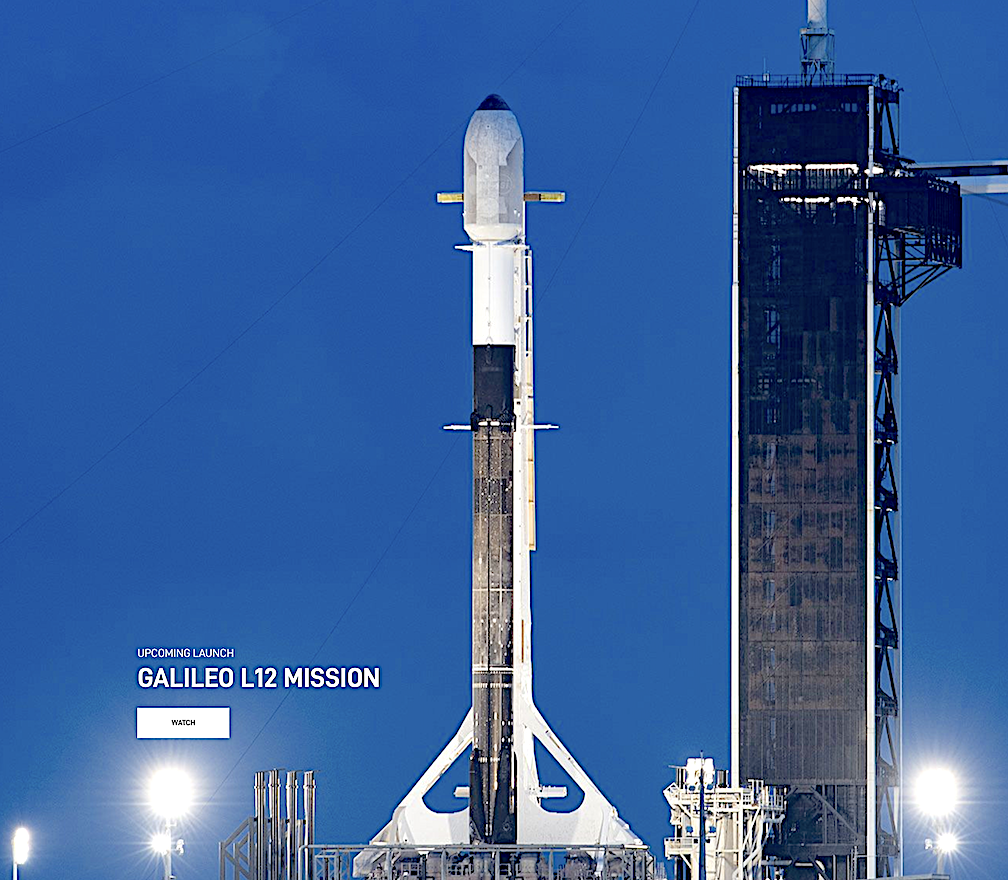
SpaceX is targeting Saturday, April 27 at 8:34 p.m. ET for a Falcon 9 launch of the European Commission’s Galileo L12 mission to medium Earth orbit from Launch Complex 39A (LC-39A) at Kennedy Space Center in Florida. If needed, there is a backup opportunity on Sunday, April 28 at 8:30 p.m. This will be the final launch for this Falcon 9 booster, more information below.

According to weather officials, there’s a 75% chance of favorable weather conditions at the time of the launch. The forecast calls for a temperature of 72°F, light rain, 94% cloud cover, a wind speed of 20mph and 0.14in of rain.

Due to the additional performance required to deliver the payload to medium Earth orbit, this mission marks the 20th and final launch for this Falcon 9 first stage booster, which previously launched GPS III-3, Turksat 5A, Transporter-2, Intelsat G-33/G-34, Transporter-6, Intuitive Machines IM-1, and 13 Starlink missions.

SpaceX has 2 weekend launches beginning with 2 satellites for Europe’s Galileo navigation system
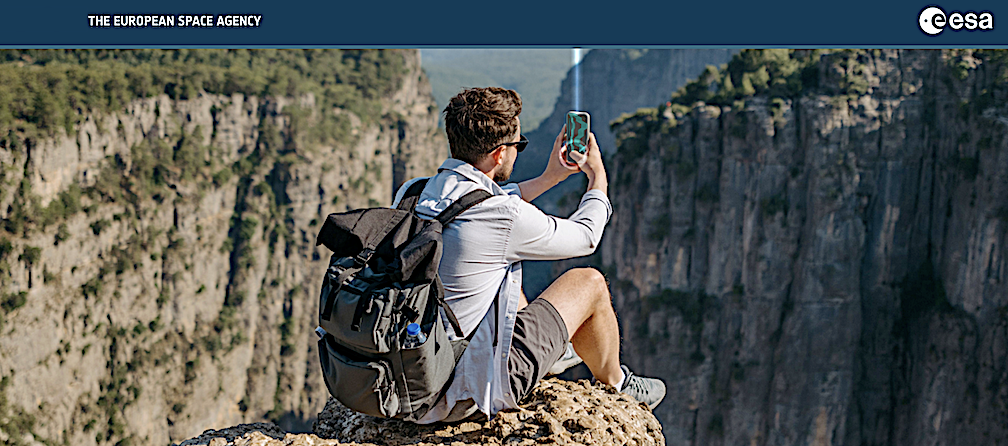
Six mind-blowing facts about Galileo

SpaceX will launch 2 Galileo satellites into MEO from Europe’s Galileo navigation system on Saturday, April 27. The launch window is from 5:34 PM – 6:11 PM PDT

Though SpaceX has not publicly announced this mission, a National Geospatial-Intelligence Agency navigational warning shows this launch window will open Saturday, April 27, 2024.

  • Mission: A SpaceX Falcon 9 rocket will launch Galileo satellites for the European Space Agency’s global navigation system from NASA’s Kennedy Space Center.
  • Launch window: 8:29 p.m. to 9:11 p.m. EDT Saturday, April 27, 2024
  • Location: Launch pad 39A
Galileo Search and Rescue

Galileo is currently the world’s most precise satellite navigation system, serving over four billion smartphone users around the globe since entering Open Service in 2017. All smartphones sold in the European Single Market are now guaranteed Galileo-enabled. In addition, Galileo is making a difference across the fields of rail, maritime, agriculture, financial timing services and rescue operations.

Galileo supporting aviation

A flagship program of the European Union (EU), Galileo is managed and funded by the European Commission. Since its inception, ESA leads the design, development and qualification of the space and ground systems, as well as procuring launches. ESA is also entrusted with research and development activities for the future of Galileo within the EU program Horizon Europe. The EU Agency for the Space Program (EUSPA) acts as the service provider, overseeing the market and application needs and closing the loop with users.

Filed Under: International Space Agreements, Launch Providers Tagged With: Featured

Primary Sidebar

Coverage

  • Missions & Constellations
  • Business & Finance
  • Military & Defense
  • Launch
  • Software Automation & Ground Systems
  • Government & Regulation
  • Services & Applications

Most Read Stories

  • SpaceX Finalizes Regulatory Procedures to Close $60 Billion Acquisition of AI Platform Cursor
  • FCC Opens Proceeding to Unlock 200 MHz of Unlicensed Spectrum for Direct-to-Device Satellite Links
  • Projected Starship Cost Collapse Redefines Low Earth Orbit Infrastructure Economics
  • Norway's Sovereign Wealth Fund Expands AST SpaceMobile Stake and Discloses $1.22 Billion SpaceX Holding
  • DarkSky International Petitions Full FCC to Overturn Approval of Reflect Orbital's Space-Mirror Satellite

Secondary Sidebar

Footer


Satnews is a leading provider of satellite news, events, publications, research and other satellite industry information in both commercial and military enterprises worldwide.

Stories By Category

  • Business & Finance
  • Government & Regulation
  • Launch
  • Military & Defense
  • Missions & Constellations
  • Services & Applications
  • Software Automation & Ground Systems
  • Spectrum & Licensing
  • Startups & NewSpace Business

About Us

  • Leadership & Editorial Team
  • SatNews History
  • Free Satnews Subscription
  • SatNews Events
  • Magazines

Navigation

  • Latest Stories
  • Magazines
  • Events
  • Contact
  • Cookie & Privacy Policy for Satnews

We use cookies to ensure that we give you the best experience on our website. If you continue to use this site we will assume that you are happy with it.
x
Sign up Now (For Free)
Access daily or weekly satellite news updates covering all aspects of the commercial and military satellite industry.
Invalid email address
Notify Me Regarding ( At least one ):
We value your privacy and will not sell or share your email or other information with any other company. You may also unsubscribe at anytime.

Click Here to see our full privacy policy.
Thanks for subscribing!