


• Skip to primary navigation
  • Skip to main content
  • Skip to primary sidebar
  • Skip to secondary sidebar
  • Skip to footer
  • NEWS:
  • SatNews
  • SatMagazine
  • MilSatMagazine
  • SmallSat News
  • |     EVENTS:
  • SmallSat Symposium
  • Satellite Innovation
  • MilSat Symposium
  • SmallSat Europe

SatNews

Satellite Industry Intelligence Since 1983

Subscribe
  • LATEST
  • SatNews Events
  • Magazines
  • Calendar
  • Subscribe
  • Missions & Constellations
    • Exploration & Science Missions
    • In-Orbit Servicing & Orbital Operations
    • LEO Constellations
    • Mission Autonomy & Onboard Systems
    • Mission Deployments & Manifests
    • Navigation & PNT
    • SmallSat
    • Spacecraft & Payload Technology
    View All in Missions & Constellations →
    Iridium Unveils Core Role in Artemis II and Next-Gen PNT at Space Symposium 2026Iridium Unveils Core Role in Artemis II and Next-Gen PNT at Space Symposium 2026
    Boeing and Millennium Unveil Resolute Mid-Class Satellite PlatformBoeing and Millennium Unveil Resolute Mid-Class Satellite Platform
    NASA Shifts Focus to Permanent Lunar Base and Nuclear PropulsionNASA Shifts Focus to Permanent Lunar Base and Nuclear Propulsion
    Kepler and Astrolight Secure ESA Contract for HydRON Optical NetworkKepler and Astrolight Secure ESA Contract for HydRON Optical Network
  • Business
    • Contracts & Commercial Deals
    • Earnings & Financial Reporting
    • Events & Conferences
    • Funding & Venture Capital
    • Market Forecasts
    • Mergers & Acquisitions
    • Personnel Moves & Appointments
    View All in Business & Finance →
    Geographic Hotspots: Where Demand Is AcceleratingGeographic Hotspots: Where Demand Is Accelerating
    SmallSat Europe Speaker Focus: Martin Langer, OroraTechSmallSat Europe Speaker Focus: Martin Langer, OroraTech
    SmallSat Europe Speaker Focus: Jaume Sanpera, SateliotSmallSat Europe Speaker Focus: Jaume Sanpera, Sateliot
    Ericsson Initiates SEK 15 Billion Share Buyback ProgramEricsson Initiates SEK 15 Billion Share Buyback Program
  • Defense
    • Counterspace & ASAT
    • Defense Budgets & Procurement
    • ISR & Reconnaissance
    • MILSATCOM
    • Missile Warning & Defense
    • National Security Programs
    • Space Domain Awareness
    View All in Military & Defense →
    Saltzman Unveils 2040 Blueprint to Scale Space Force for Great Power CompetitionSaltzman Unveils 2040 Blueprint to Scale Space Force for Great Power Competition
    The Rise of Grey Zone Satellites: Ambiguity as a Tactical AdvantageThe Rise of Grey Zone Satellites: Ambiguity as a Tactical Advantage
    SmallSat Europe Speaker Focus: Col. Marcin Mazur, Polish Space AgencySmallSat Europe Speaker Focus: Col. Marcin Mazur, Polish Space Agency
    US Space Force Awards $68.6M Modification to Lockheed Martin for Next-Gen OPIRUS Space Force Awards $68.6M Modification to Lockheed Martin for Next-Gen OPIR
  • Gov
    • Export Controls & Compliance
    • International Space Agreements
    • National Space Policy
    • Space Law & Treaties
    • Space Sustainability & Debris Policy
    • Space Traffic Management / Debris Removal
    View All in Government & Regulation →
    SmallSat Europe Speaker Focus: Chris Quilty, Quilty SpaceSmallSat Europe Speaker Focus: Chris Quilty, Quilty Space
    NRL to Showcase Sovereign Space Capabilities at 41st Space SymposiumNRL to Showcase Sovereign Space Capabilities at 41st Space Symposium
    FCC Modernizes Satellite Spectrum Rules to Unleash Next-Generation BroadbandFCC Modernizes Satellite Spectrum Rules to Unleash Next-Generation Broadband
    SmallSat Europe Speaker Focus: Daniel Bock, Morpheus SpaceSmallSat Europe Speaker Focus: Daniel Bock, Morpheus Space
  • Launch
    • Launch Providers
    • Launch Schedule & Calendars
    • Launch Sites & Infrastructure
    • Rocket Technology & Vehicles
    View All in Launch →
    Ensign-Bickford Hardware Supports Successful Artemis II Lunar MissionEnsign-Bickford Hardware Supports Successful Artemis II Lunar Mission
    China Accelerates Orbital Internet Deployment with Successful Smart Dragon-3 Sea LaunchChina Accelerates Orbital Internet Deployment with Successful Smart Dragon-3 Sea Launch
    What the SpaceX IPO Changes for Every Satellite OperatorWhat the SpaceX IPO Changes for Every Satellite Operator
    €30 million Financing for PLD Space’s Small Satellite Launcher€30 million Financing for PLD Space’s Small Satellite Launcher
  • Software
    • Autonomous Ground Operations
    • Data Processing & AI/ML
    • Digital Twins & Modeling
    • Ground Segment & Teleports
    • Mission Planning & Simulation
    • Space Systems Software Engineering
    • Spectrum & Licensing
    View All in Software Automation & Ground Systems →
    Blue Origin Unveils Project Quartz Global Ground Station NetworkBlue Origin Unveils Project Quartz Global Ground Station Network
    Cloudcomputing Targets 1.5M Identities in Spain and Finalizes Innovate IT AcquisitionCloudcomputing Targets 1.5M Identities in Spain and Finalizes Innovate IT Acquisition
    Archangel Lightworks Secures £10M Series A to Scale Optical Ground InfrastructureArchangel Lightworks Secures £10M Series A to Scale Optical Ground Infrastructure
    Keysight and Sateliot Win ESA and GSMA Foundry Challenge for 6G InnovationKeysight and Sateliot Win ESA and GSMA Foundry Challenge for 6G Innovation
  • Services & Apps
    • Climate & Environmental Monitoring
    • Disaster Response & Security Mapping
    • Earth Observation & Imaging
    • Maritime & Aviation Satcom
    • Satellite Communications
    View All in Services & Applications →
    NASA Targets Commercial Relays to Replace Aging TDRSS InfrastructureNASA Targets Commercial Relays to Replace Aging TDRSS Infrastructure
    OQ Technology Awarded ESA Contract to Adapt 5G Beamforming for SpaceOQ Technology Awarded ESA Contract to Adapt 5G Beamforming for Space
    Kraken Robotics Integrates KATFISH Sonar on SEFINE RD-22 USV Following Multi-Naval DemonstrationsKraken Robotics Integrates KATFISH Sonar on SEFINE RD-22 USV Following Multi-Naval Demonstrations
    Astroscale Plans World-First Multi-Orbit Satellite Inspection MissionAstroscale Plans World-First Multi-Orbit Satellite Inspection Mission

NASA’s Psyche Gets Huge Solar Arrays For Trip To Metal-Rich Asteroid

March 8, 2022

With its solar arrays installed, the spacecraft is close to its final configuration ahead of a planned August launch.
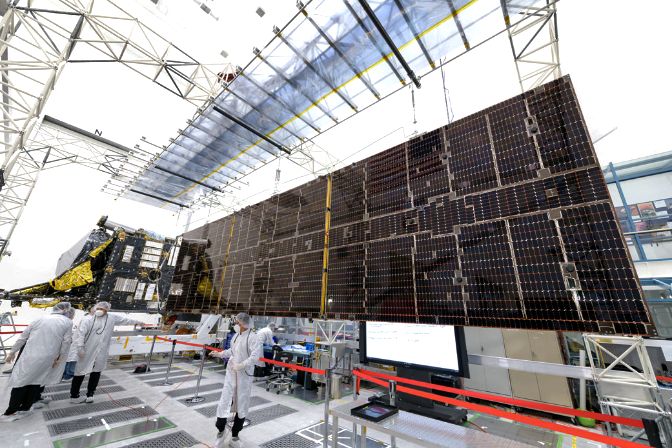
The first of two solar arrays on NASA’s Psyche spacecraft is successfully deployed in JPL’s storied High Bay 2 clean room. One of two solar arrays on NASA’s Psyche spacecraft is successfully deployed in JPL’s storied High Bay 2 clean room. The twin arrays will power the spacecraft and its science instruments during a mission to the asteroid belt between Mars and Jupiter. Credits: NASA/JPL-Caltech

NASA’s Psyche mission is almost ready for its moment in the Sun – a 1.5-billion-mile (2.4-billion-kilometer) solar-powered journey to a mysterious, metal-rich asteroid of the same name. Twin solar arrays have been attached to the spacecraft body, unfolded lengthwise, and then restowed. This test brings the craft that much closer to completion before its August launch.

“Seeing the spacecraft fully assembled for the first time is a huge accomplishment; there’s a lot of pride,” said Brian Bone, who leads assembly, test, and launch operations for the mission at NASA’s Jet Propulsion Laboratory in Southern California. “This is the true fun part. You’re feeling it all come together. You feel the energy change and shift.” This video shows the deployment of the three center panels on one of the 37-foot-long (11.3-meter-long) twin solar arrays on NASA’s Psyche spacecraft. Because they are so long, only one array at a time can be deployed in JPL’s High Bay 2 clean room. Credits: NASA/JPL-Caltech

At 800 square feet (75 square meters), the five-panel, cross-shaped solar arrays are the largest ever installed at JPL, which has built many spacecraft over the decades. When the arrays fully deploy in flight, the spacecraft will be about the size of a singles tennis court. After a 3 ½-year solar-powered cruise, the craft will arrive in 2026 at the asteroid Psyche, which is 173 miles (280 kilometers) at its widest point and thought to be unusually rich in metal. The spacecraft will spend nearly two years making increasingly close orbits of the asteroid to study it.

Venturing to the asteroid belt between Mars and Jupiter, far from the Sun, presents challenges for this mission, which adapted standard Earth-orbiting commercial satellite technology for use in the cold and dark of deep space. Near Earth, the solar arrays generate 21 kilowatts – enough electricity to power three or four average U.S. homes. But at Psyche, they’ll produce only about 2 kilowatts – sufficient for little more than a hair dryer.

The underlying technology isn’t much different from solar panels installed on a home, but Psyche’s are hyper-efficient, lightweight, radiation resistant, and able to provide more power with less sunlight, said Peter Lord, Psyche technical director at Maxar Technologies in Palo Alto, California, where the arrays and solar electric propulsion chassis were built. “These arrays are designed to work in low-light conditions, far away from the Sun,” he added. Before a deployment test in a clean room at JPL, engineers examine one of Psyche’s two solar arrays.

Before a deployment test in a clean room at JPL, engineers examine one of Psyche’s two solar arrays.
Before a deployment test in a clean room at JPL, engineers examine one of Psyche’s two solar arrays. The arrays are folded and stowed flush with the chassis, as shown here, before launch and then deployed in flight.
Credits: NASA/JPL-Caltech

After the successful installation and deployment of the three center panels inside a clean room at JPL, Psyche’s arrays were folded back against the chassis and stowed for additional spacecraft testing. The arrays will return to Maxar, which has specialized equipment to test the deployment of the two perpendicular cross panels. Later this spring, the arrays will be reunited with the spacecraft at NASA’s Kennedy Space Center in Florida and stowed for launch from Cape Canaveral.
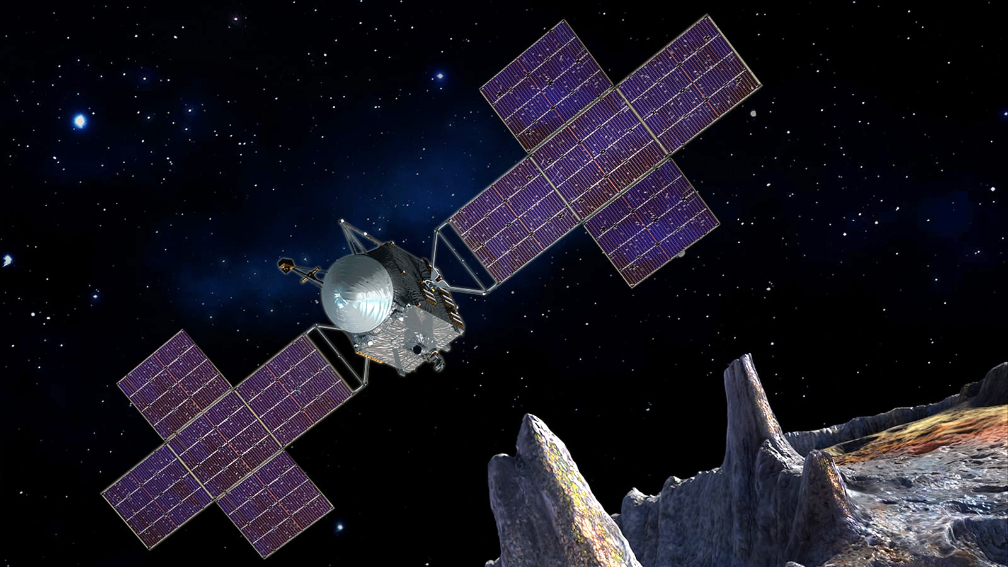
Artistic rendition of NASA Psyche satellite, courtesy of Maxar Technologies.

About an hour after launch, the arrays will deploy and latch into place in a process that will take 7-½ minutes per wing. They will then provide all the power for the journey to asteroid Psyche, as well as the power needed to operate the science instruments: a magnetometer to measure any magnetic field the asteroid may have, imagers to photograph and map its surface, and spectrometers to reveal the composition of that surface. The arrays also power the Deep Space Optical Communications technology demonstration that will test high-data-rate laser communications.

What those instruments relay to scientists will help them better understand the mysterious asteroid. One possible explanation for Psyche’s unusually high metal content is that it formed early in our solar system’s history, either as remnant core material from a planetesimal – one of the building blocks of rocky planets – or as primordial material that never melted. This mission aims to find out, and to help answer fundamental questions about Earth’s own metal core and the formation of our solar system.

Arizona State University leads the Psyche mission. JPL, which is managed for NASA by Caltech in Pasadena, California, is responsible for the mission’s overall management, system engineering, integration and test, and mission operations. Maxar is providing the high-power solar electric propulsion spacecraft chassis.

Psyche was selected in 2017 as the 14th mission under NASA’s Discovery Program.

For more information about NASA’s Psyche mission go to www.nasa.gov/psyche or psyche.asu.edu/

Filed Under: Business & Finance, Exploration & Science Missions Tagged With: Featured

Primary Sidebar

Coverage

  • Missions & Constellations
  • Business & Finance
  • Military & Defense
  • Launch
  • Software Automation & Ground Systems
  • Government & Regulation
  • Services & Applications

Most Read Stories

  • SpaceX Loses Contact With Starlink Satellite
  • Rocket Lab Emerging as Potential Bus Provider for 2,800-Satellite Equatys Constellation
  • SpaceX Accelerates Record-Breaking IPO Following Trillion-Dollar xAI Merger
  • Planet Labs Imposes Indefinite Blackout on Iran Satellite Imagery at U.S. Request
  • Amazon in Reported Talks to Acquire Globalstar in $9 Billion Move to Challenge Starlink

Secondary Sidebar

Footer


Satnews is a leading provider of satellite news, events, publications, research and other satellite industry information in both commercial and military enterprises worldwide.

Stories By Category

  • Business & Finance
  • Government & Regulation
  • Launch
  • Military & Defense
  • Missions & Constellations
  • Services & Applications
  • Software Automation & Ground Systems
  • Spectrum & Licensing
  • Startups & NewSpace Business

About Us

  • Leadership & Editorial Team
  • SatNews History
  • Free Satnews Subscription
  • SatNews Events
  • Magazines

Navigation

  • Latest Stories
  • Magazines
  • Events
  • Contact
  • Cookie & Privacy Policy for Satnews

We use cookies to ensure that we give you the best experience on our website. If you continue to use this site we will assume that you are happy with it.
x
Sign up Now (For Free)
Access daily or weekly satellite news updates covering all aspects of the commercial and military satellite industry.
Invalid email address
Notify Me Regarding ( At least one ):
We value your privacy and will not sell or share your email or other information with any other company. You may also unsubscribe at anytime.

Click Here to see our full privacy policy.
Thanks for subscribing!
