

• Skip to primary navigation
  • Skip to main content
  • Skip to primary sidebar
  • Skip to secondary sidebar
  • Skip to footer
  • NEWS:
  • SatNews
  • SatMagazine
  • MilSatMagazine
  • SmallSat News
  • |     EVENTS:
  • SmallSat Symposium
  • Satellite Innovation
  • MilSat Symposium
  • SmallSat Europe

SatNews

Satellite Industry Intelligence Since 1983

Subscribe
  • LATEST
  • Missions & Constellations
    • Exploration & Science Missions
    • In-Orbit Servicing & Orbital Operations
    • LEO Constellations
    • Mission Autonomy & Onboard Systems
    • Mission Deployments & Manifests
    • Navigation & PNT
    • SmallSat
    • Spacecraft & Payload Technology
    View All in Missions & Constellations →
    Satellite Deployers to be Used on JAXA Small Satellite Mission by ExolaunchSatellite Deployers to be Used on JAXA Small Satellite Mission by Exolaunch
    SmallSat Europe Speaker Focus: Dr. Ane Aanesland, ThrustMeSmallSat Europe Speaker Focus: Dr. Ane Aanesland, ThrustMe
    EarthEarth
    CAS Space Successfully Launches Kinetica-2, Aiming for Global Cost LeadershipCAS Space Successfully Launches Kinetica-2, Aiming for Global Cost Leadership
  • Business
    • Contracts & Commercial Deals
    • Earnings & Financial Reporting
    • Events & Conferences
    • Funding & Venture Capital
    • Market Forecasts
    • Mergers & Acquisitions
    • Personnel Moves & Appointments
    View All in Business & Finance →
    Azercosmos and Viasat Sign Partnership Agreement for In-Flight ConnectivityAzercosmos and Viasat Sign Partnership Agreement for In-Flight Connectivity
    Redwire’s ESA Quantum Satellite Deal Expands European Defense Growth StoryRedwire’s ESA Quantum Satellite Deal Expands European Defense Growth Story
    PMGC Holdings Launches NorthStrive Defense Tech to Capture Drone and Autonomous Systems MarketPMGC Holdings Launches NorthStrive Defense Tech to Capture Drone and Autonomous Systems Market
    Space42 and Viasat: Contract close for 2800 satellitesSpace42 and Viasat: Contract close for 2800 satellites
  • Defense
    • Counterspace & ASAT
    • Defense Budgets & Procurement
    • ISR & Reconnaissance
    • MILSATCOM
    • Missile Warning & Defense
    • National Security Programs
    • Space Domain Awareness
    View All in Military & Defense →
    Russia Replaces Starlink With European-Built SatellitesRussia Replaces Starlink With European-Built Satellites
    Chief Data and Artificial Intelligence Officer for the United States Space Force, Chandra Donelson, Steps AwayChief Data and Artificial Intelligence Officer for the United States Space Force, Chandra Donelson, Steps Away
    What Doubling Space Force Funding Actually Means for the IndustryWhat Doubling Space Force Funding Actually Means for the Industry
    Planet Labs Imposes Indefinite Blackout on Iran Satellite Imagery at U.S. RequestPlanet Labs Imposes Indefinite Blackout on Iran Satellite Imagery at U.S. Request
  • Gov
    • Export Controls & Compliance
    • International Space Agreements
    • National Space Policy
    • Space Law & Treaties
    • Space Sustainability & Debris Policy
    • Space Traffic Management / Debris Removal
    View All in Government & Regulation →
    Isaacman’s Budget Math: How NASA Plans to Reach the Moon With a Quarter Less MoneyIsaacman’s Budget Math: How NASA Plans to Reach the Moon With a Quarter Less Money
    FCC Seeks Comment on Expanding Spectrum Access for “Weird Space Stuff”FCC Seeks Comment on Expanding Spectrum Access for “Weird Space Stuff”
    The FCC Must Choose: Enforce the Rules or Preserve LEO CompetitionThe FCC Must Choose: Enforce the Rules or Preserve LEO Competition
    Space Force Reassigns Final GPS III Mission to SpaceX Following Vulcan AnomalySpace Force Reassigns Final GPS III Mission to SpaceX Following Vulcan Anomaly
  • Launch
    • Launch Providers
    • Launch Schedule & Calendars
    • Launch Sites & Infrastructure
    • Rocket Technology & Vehicles
    View All in Launch →
    Liftoff: NASA Successfully Launches Artemis II to the MoonLiftoff: NASA Successfully Launches Artemis II to the Moon
    AAC Clyde Space Expands Orbital Presence with Transporter-16 LaunchAAC Clyde Space Expands Orbital Presence with Transporter-16 Launch
    Built by Thales Alenia Space for ESA’s Celeste mission, IOD-2 Satellite lifts off today from New ZealandBuilt by Thales Alenia Space for ESA’s Celeste mission, IOD-2 Satellite lifts off today from New Zealand
    Defense Economics and the European SmallSat MarketDefense Economics and the European SmallSat Market
  • Software
    • Autonomous Ground Operations
    • Data Processing & AI/ML
    • Digital Twins & Modeling
    • Ground Segment & Teleports
    • Mission Planning & Simulation
    • Space Systems Software Engineering
    • Spectrum & Licensing
    View All in Software Automation & Ground Systems →
    The Downlink Deficit: The Pentagon’s Optical Mesh Network and the Terrestrial BottleneckThe Downlink Deficit: The Pentagon’s Optical Mesh Network and the Terrestrial Bottleneck
    NexSat Space Systems Debuts with ACE ‘Invisible’ Aero-Conformal AntennaNexSat Space Systems Debuts with ACE ‘Invisible’ Aero-Conformal Antenna
    Laser Communications and the Rise of Orbital Data CentersLaser Communications and the Rise of Orbital Data Centers
    ThinKom Showcases Modular MILSATCOM Architecture for Contested EnvironmentsThinKom Showcases Modular MILSATCOM Architecture for Contested Environments
  • Services & Apps
    • Climate & Environmental Monitoring
    • Disaster Response & Security Mapping
    • Earth Observation & Imaging
    • Maritime & Aviation Satcom
    • Satellite Communications
    View All in Services & Applications →
    Cinemo Reimagines the Vehicle as a Software-Defined Entertainment HubCinemo Reimagines the Vehicle as a Software-Defined Entertainment Hub
    IEC Telecom Wins CSR Initiative of the Year at the Oil & Gas Middle East Awards 2026IEC Telecom Wins CSR Initiative of the Year at the Oil & Gas Middle East Awards 2026
    Can SMEs Compete in Starlink-Dominated Space?Can SMEs Compete in Starlink-Dominated Space?
    Traditional Media and Online Video Revenues Projected to Exceed One Trillion Dollars by 2030Traditional Media and Online Video Revenues Projected to Exceed One Trillion Dollars by 2030
  • SatNews Events
  • Magazines
  • Calendar

NASA’s Double Asteroid DART Mission Launched By SpaceX

November 24, 2021

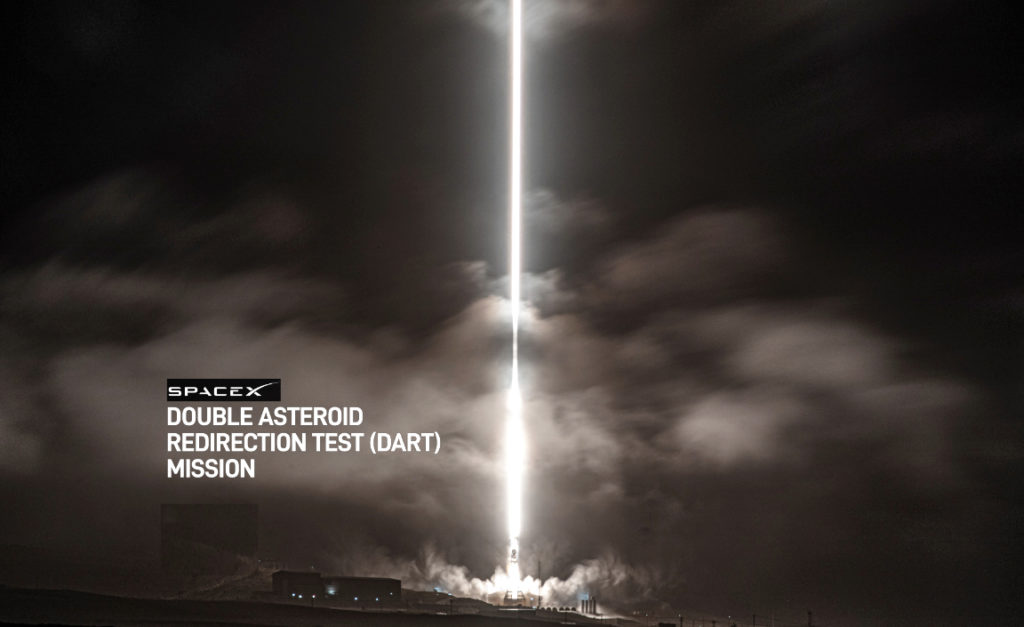
Photo of the SpaceX Falcon 9 launch of NASA’s DART mission from Vandenberg Space Force Base. Image is courtesy of the company.

NASA’s Double Asteroid Redirection Test (DART), the world’s first full-scale mission to test technology for defending Earth against potential asteroid or comet hazards, launched on Wednesday, November 24, at 1:21 a.m., EST, on a SpaceX Falcon 9 rocket from Space Launch Complex 4 East at Vandenberg Space Force Base in California. This was the third flight for this Falcon 9’s first stage booster, which previously supported launch of Sentinel-6 Michael Freilich and a Starlink mission.
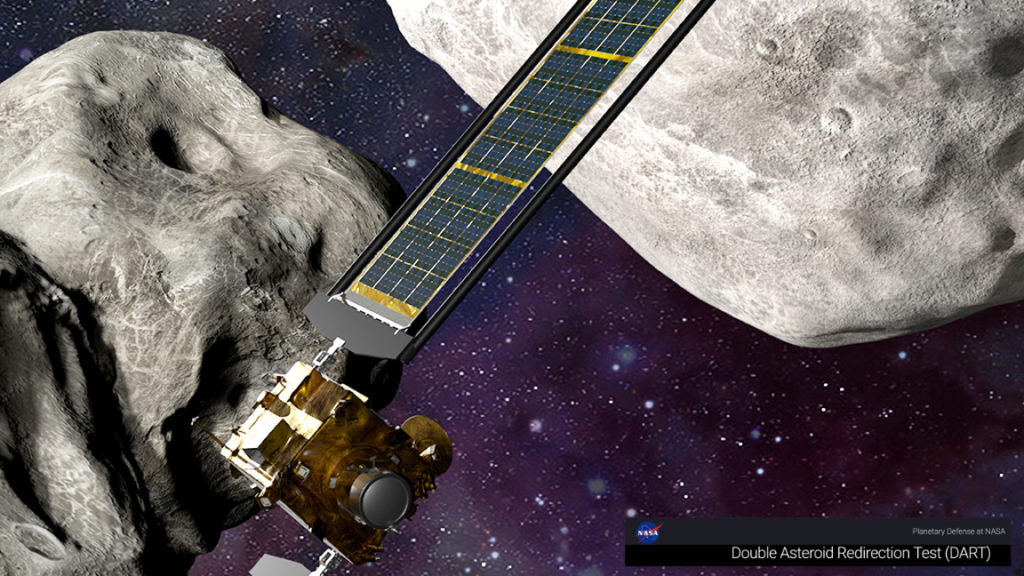

Just one part of NASA’s larger planetary defense strategy, DART – built and managed by the Johns Hopkins Applied Physics Laboratory (APL) in Laurel, Maryland – will impact a known asteroid that is not a threat to Earth. Its goal is to slightly change the asteroid’s motion in a way that can be accurately measured using ground-based telescopes.

DART will show that a spacecraft can autonomously navigate to a target asteroid and intentionally collide with it – a method of deflection called kinetic impact. The test will provide important data to help better prepare for an asteroid that might pose an impact hazard to Earth, should one ever be discovered.

DART’s one-way trip is to the Didymos asteroid system, which comprises a pair of asteroids. DART’s target is the moonlet, Dimorphos, which is approximately 530 feet (160 meters) in diameter. The moonlet orbits Didymos, which is approximately 2,560 feet (780 meters) in diameter. As Dimorphos orbits Didymos at much a slower relative speed than the pair orbits the Sun, the result of DART’s kinetic impact within the binary system can be measured much more easily than a change in the orbit of a single asteroid around the Sun.
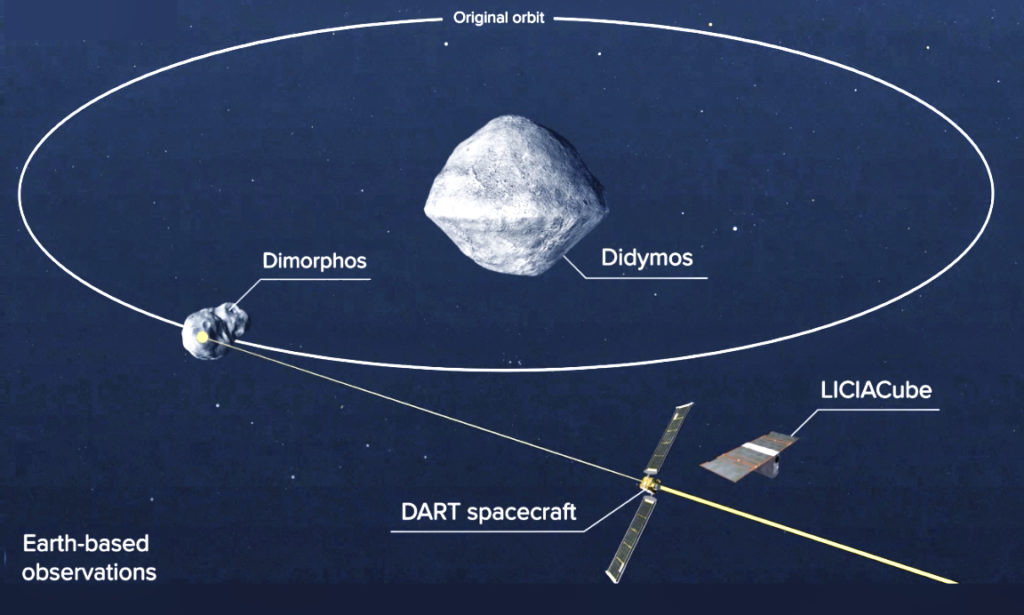
LICIACube, a cubesat riding with DART and provided by the Italian Space Agency (ASI), will be released prior to DART’s impact to capture images of the impact and the resulting cloud of ejected matter. Roughly four years after DART’s impact, the European Space Agency’s Hera project will conduct detailed surveys of both asteroids, with particular focus on the crater left by DART’s collision and a precise determination of Dimorphos’ mass.

At 2:17 a.m., DART separated from the second stage of the rocket. Minutes later, mission operators received the first spacecraft telemetry data and started the process of orienting the spacecraft to a safe position for deploying its solar arrays. About two hours later, the spacecraft completed the successful unfurling of its two, 28-foot-long, roll-out solar arrays. They will power both the spacecraft and NASA’s Evolutionary Xenon Thruster – Commercial ion engine, one of several technologies being tested on DART for future application on space missions.
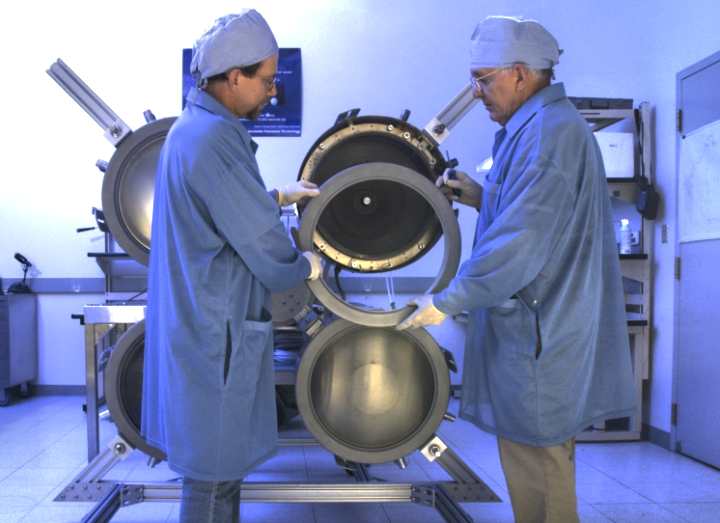
Glenn engineers assemble a NASA Evolutionary Xenon Thruster (NEXT) for testing. NEXT is a next generation propulsion system that could revolutionize science missions are sent deeper into the solar system. The thruster will use xenon gas and electrical power to drive future spacecraft.

The spacecraft will intercept the Didymos system between Sept. 26 and Oct. 1, 2022, intentionally slamming into Dimorphos at roughly 4 miles per second (6 kilometers per second). Scientists estimate the kinetic impact will shorten Dimorphos’ orbit around Didymos by several minutes. Researchers will precisely measure that change using telescopes on Earth. Their results will validate and improve scientific computer models critical to predicting the effectiveness of the kinetic impact as a reliable method for asteroid deflection.

DART’s single instrument, the Didymos Reconnaissance and Asteroid Camera for Optical navigation (DRACO), will turn on a week from now and provide first images from the spacecraft. DART will continue to travel just outside of Earth’s orbit around the Sun for the next 10 months until Didymos and Dimorphos will be a relatively close 6.8 million miles (11 million kilometers) from Earth.

A sophisticated guidance, navigation, and control system, working together with algorithms called Small-body Maneuvering Autonomous Real Time Navigation (SMART Nav), will enable the DART spacecraft to identify and distinguish between the two asteroids. The system will then direct the spacecraft toward Dimorphos. This process will all occur within roughly an hour of impact.

“DART is turning science fiction into science fact and is a testament to NASA’s proactivity and innovation for the benefit of all,” said NASA Administrator Bill Nelson. “In addition to all the ways NASA studies our universe and our home planet, we’re also working to protect that home, and this test will help prove out one viable way to protect our planet from a hazardous asteroid should one ever be discovered that is headed toward Earth.”
“At its core, DART is a mission of preparedness, and it is also a mission of unity,” said Thomas Zurbuchen, associate administrator for the Science Mission Directorate at NASA Headquarters in Washington. “This international collaboration involves DART, ASI’s LICIACube, and ESA’s Hera investigations and science teams, which will follow up on this groundbreaking space mission."
“We have not yet found any significant asteroid impact threat to Earth, but we continue to search for that sizable population we know is still to be found. Our goal is to find any possible impact, years to decades in advance, so it can be deflected with a capability like DART that is possible with the technology we currently have,” said Lindley Johnson, planetary defense officer at NASA Headquarters. “DART is one aspect of NASA’s work to prepare Earth should we ever be faced with an asteroid hazard. In tandem with this test, we are preparing the Near-Earth Object Surveyor Mission, an space-based infrared telescope scheduled for launch later this decade and designed to expedite our ability to discover and characterize the potentially hazardous asteroids and comets that come within 30 million miles of Earth’s orbit.”
“It is an indescribable feeling to see something you’ve been involved with since the ‘words on paper’ stage become real and launched into space,” said Andy Cheng, one of the DART investigation leads at Johns Hopkins APL and the individual who came up with the idea of DART. “This is just the end of the first act, and the DART investigation and engineering teams have much work to do over the next year preparing for the main event ─ DART’s kinetic impact on Dimorphos. But tonight we celebrate!”

Johns Hopkins APL manages the DART mission for NASA’s Planetary Defense Coordination Office as a project of the agency’s Planetary Missions Program Office. NASA provides support for the mission from several centers, including the Jet Propulsion Laboratory in Southern California, Goddard Space Flight Center in Greenbelt, Maryland, Johnson Space Center in Houston, Glenn Research Center in Cleveland, and Langley Research Center in Hampton, Virginia. The launch is managed by NASA’s Launch Services Program, based at the agency’s Kennedy Space Center in Florida. SpaceX is the launch services provider for the DART mission.

Filed Under: Exploration & Science Missions, Government & Regulation Tagged With: Featured

Primary Sidebar

Coverage

  • Missions & Constellations
  • Business & Finance
  • Military & Defense
  • Launch
  • Software Automation & Ground Systems
  • Government & Regulation
  • Services & Applications

Most Read Stories

  • Rheinmetall Withdraws From Mynaric Bidding Process; Rocket Lab Acquisition Clears Major Competitive Hurdle
  • L3Harris Unveils XL-300P: The First P25 Handheld with 5G and Satellite Direct-to-Device Connectivity
  • Rheinmetall Walked Away. Germany Should Take the Hint.
  • Rocket Lab Emerging as Potential Bus Provider for 2,800-Satellite Equatys Constellation
  • Guardians in the Kill Chain: How the Space Force Led the Opening Salvo of Operation Epic Fury

Secondary Sidebar

Footer


Satnews is a leading provider of satellite news, events, publications, research and other satellite industry information in both commercial and military enterprises worldwide.

Stories By Category

  • Business & Finance
  • Government & Regulation
  • Launch
  • Military & Defense
  • Missions & Constellations
  • Services & Applications
  • Software Automation & Ground Systems
  • Spectrum & Licensing
  • Startups & NewSpace Business

About Us

  • Leadership & Editorial Team
  • SatNews History
  • Free Satnews Subscription
  • SatNews Events
  • Magazines

Navigation

  • Latest Stories
  • Magazines
  • Events
  • Contact
  • Cookie & Privacy Policy for Satnews

We use cookies to ensure that we give you the best experience on our website. If you continue to use this site we will assume that you are happy with it.
x
Sign up Now (For Free)
Access daily or weekly satellite news updates covering all aspects of the commercial and military satellite industry.
Invalid email address
Notify Me Regarding ( At least one ):
We value your privacy and will not sell or share your email or other information with any other company. You may also unsubscribe at anytime.

Click Here to see our full privacy policy.
Thanks for subscribing!