


• Skip to primary navigation
  • Skip to main content
  • Skip to primary sidebar
  • Skip to secondary sidebar
  • Skip to footer
  • NEWS:
  • SatNews
  • SatMagazine
  • MilSatMagazine
  • SmallSat News
  • |     EVENTS:
  • SmallSat Symposium
  • Satellite Innovation
  • MilSat Symposium
  • SmallSat Europe

SatNews

Satellite Industry Intelligence Since 1983

Subscribe
  • LATEST
  • Missions & Constellations
    • Exploration & Science Missions
    • In-Orbit Servicing & Orbital Operations
    • LEO Constellations
    • Mission Autonomy & Onboard Systems
    • Mission Deployments & Manifests
    • Navigation & PNT
    • SmallSat
    • Spacecraft & Payload Technology
    View All in Missions & Constellations →
    Hanwha Re-Enters KAI Shareholder Registry to Accelerate ‘Korean SpaceX’ StrategyHanwha Re-Enters KAI Shareholder Registry to Accelerate ‘Korean SpaceX’ Strategy
    Voyager Technologies Executes Strategic Investment in Max Space Expandable Habitat ArchitectureVoyager Technologies Executes Strategic Investment in Max Space Expandable Habitat Architecture
    Titans of LEO in a Heavenly Price battleTitans of LEO in a Heavenly Price battle
    Satellite Connectivity in a Post Capacity EraSatellite Connectivity in a Post Capacity Era
  • Business
    • Contracts & Commercial Deals
    • Earnings & Financial Reporting
    • Events & Conferences
    • Funding & Venture Capital
    • Market Forecasts
    • Mergers & Acquisitions
    • Personnel Moves & Appointments
    View All in Business & Finance →
    General John Hyten Joins Astranis as Chairman of New Strategic Advisory BoardGeneral John Hyten Joins Astranis as Chairman of New Strategic Advisory Board
    Orbital Data Centers: Data or Debris?Orbital Data Centers: Data or Debris?
    Volatus Aerospace Finalizes 100% Acquisition of Synergy AviationVolatus Aerospace Finalizes 100% Acquisition of Synergy Aviation
    Contrivian Named Authorized Reseller for Amazon Leo Government ConnectivityContrivian Named Authorized Reseller for Amazon Leo Government Connectivity
  • Defense
    • Counterspace & ASAT
    • Defense Budgets & Procurement
    • ISR & Reconnaissance
    • MILSATCOM
    • Missile Warning & Defense
    • National Security Programs
    • Space Domain Awareness
    View All in Military & Defense →
    ICEYE Targets €1 Billion Revenue Threshold as Defense Demand Drives Production ScalingICEYE Targets €1 Billion Revenue Threshold as Defense Demand Drives Production Scaling
    Air Force Triples AEHF Terminal Contract Ceiling to Nearly $3 BillionAir Force Triples AEHF Terminal Contract Ceiling to Nearly $3 Billion
    Your Teleport Can’t Dodge a MissileYour Teleport Can’t Dodge a Missile
    BAE Systems Completes Preliminary Design Review for $1.2 Billion Space Force Epoch 2 ProgramBAE Systems Completes Preliminary Design Review for $1.2 Billion Space Force Epoch 2 Program
  • Gov
    • Export Controls & Compliance
    • International Space Agreements
    • National Space Policy
    • Space Law & Treaties
    • Space Sustainability & Debris Policy
    • Space Traffic Management / Debris Removal
    View All in Government & Regulation →
    Saying Goodbye to the ISS, and Hello to the Orbital Tenancy Trap Saying Goodbye to the ISS, and Hello to the Orbital Tenancy Trap 
    FAA Rescinds Proposed Orbital Debris Rule Amid Industry Pressure and Regulatory ReassessmentFAA Rescinds Proposed Orbital Debris Rule Amid Industry Pressure and Regulatory Reassessment
    The Iran Precedent: Operation Epic Fury and the Law of Armed Conflict in SpaceThe Iran Precedent: Operation Epic Fury and the Law of Armed Conflict in Space
    Geopolitical Scrutiny: The Strategic Implications of APT Satellite’s Chinese State OwnershipGeopolitical Scrutiny: The Strategic Implications of APT Satellite’s Chinese State Ownership
  • Launch
    • Launch Providers
    • Launch Schedule & Calendars
    • Launch Sites & Infrastructure
    • Rocket Technology & Vehicles
    View All in Launch →
    Firefly Aerospace Returns to Flight with Successful “Stairway to Seven” MissionFirefly Aerospace Returns to Flight with Successful “Stairway to Seven” Mission
    SpaceX Evolves Beyond Broadband with “Million-Satellite” AI Data Center Plan; Amazon Mounts Legal ChallengeSpaceX Evolves Beyond Broadband with “Million-Satellite” AI Data Center Plan; Amazon Mounts Legal Challenge
    Times Microwave Systems Launches Levitate™ Ultra-Lightweight Cables for UAV and Defense AvionicsTimes Microwave Systems Launches Levitate™ Ultra-Lightweight Cables for UAV and Defense Avionics
    Blue Origin Accelerates New Glenn 9×4 Production and TeraWave Constellation DevelopmentBlue Origin Accelerates New Glenn 9×4 Production and TeraWave Constellation Development
  • Software
    • Autonomous Ground Operations
    • Data Processing & AI/ML
    • Digital Twins & Modeling
    • Ground Segment & Teleports
    • Mission Planning & Simulation
    • Space Systems Software Engineering
    • Spectrum & Licensing
    View All in Software Automation & Ground Systems →
    Your Teleport Can’t Dodge a MissileYour Teleport Can’t Dodge a Missile
    Missile Strike Targets Strategic SES Ha’Ela Teleport in Central IsraelMissile Strike Targets Strategic SES Ha’Ela Teleport in Central Israel
    ATLAS Space Operations Establishes South Pacific Hub with New Ground Station in American SamoaATLAS Space Operations Establishes South Pacific Hub with New Ground Station in American Samoa
    Danish Army Selects BAE Systems OneArc for 7-Year Simulation Modernization ProgramDanish Army Selects BAE Systems OneArc for 7-Year Simulation Modernization Program
  • Services & Apps
    • Climate & Environmental Monitoring
    • Disaster Response & Security Mapping
    • Earth Observation & Imaging
    • Maritime & Aviation Satcom
    • Satellite Communications
    View All in Services & Applications →
    Your Teleport Can’t Dodge a MissileYour Teleport Can’t Dodge a Missile
    Jazz Secures Industry-Leading 190 MHz in Pakistan’s Landmark $507M 5G Spectrum AuctionJazz Secures Industry-Leading 190 MHz in Pakistan’s Landmark $507M 5G Spectrum Auction
    Spring Forward: Legacy Operators Are Killing GEO. That’s the Plan.Spring Forward: Legacy Operators Are Killing GEO. That’s the Plan.
    Synthetic Aperture Radar as the Modern Backbone of Maritime Domain AwarenessSynthetic Aperture Radar as the Modern Backbone of Maritime Domain Awareness
  • SatNews Events
  • Magazines
  • Calendar
  • Jobs

Jupiter’s Trojan Asteroids Are The Target For NASA’s Lucy Mission, Now Being Prepared

September 28, 2021

NASA has tested the functions of Lucy, the agency’s first spacecraft to study Jupiter’s Trojan asteroids, filled it with fuel and is preparing to pack it into a capsule for launch on Saturday, October 16.

Named after characters in Greek mythology, these asteroids circle the Sun in two swarms, with one group leading ahead of Jupiter in its path, the other trailing behind it. Lucy will be the first spacecraft to visit these asteroids. By studying these asteroids up close, scientists hope to hone their theories on how our solar system’s planets formed 4.5 billion years ago and why they ended up in their current configuration.

“With Lucy, we’re going to eight never-before-seen asteroids in 12 years with a single spacecraft,” said Tom Statler, Lucy project scientist at NASA Headquarters in Washington. “This is a fantastic opportunity for discovery as we probe into our solar system’s distant past.”
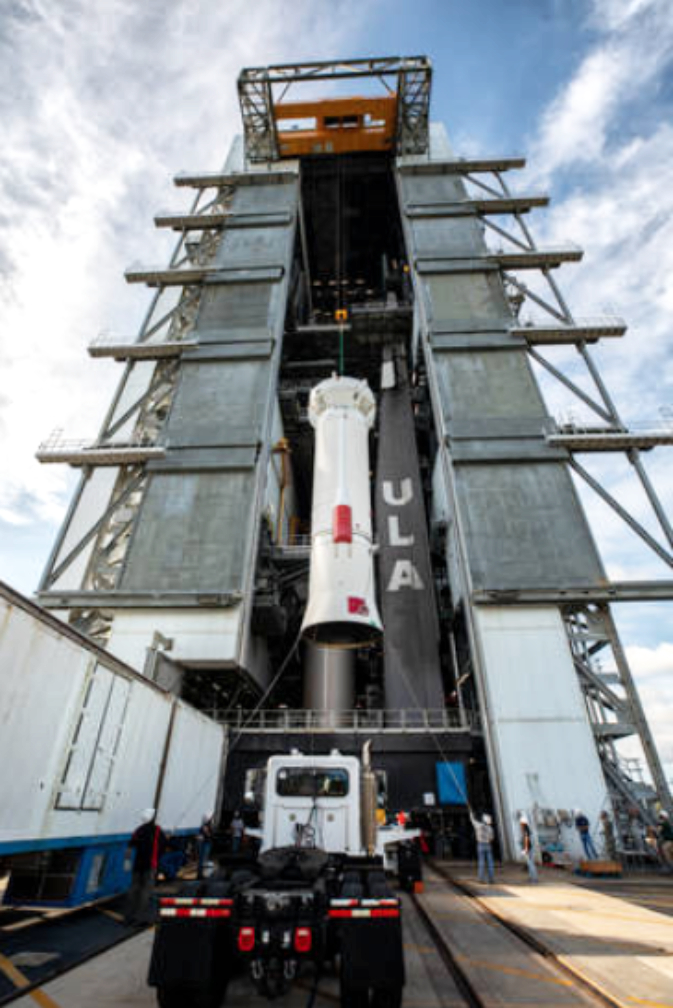
The United Launch Alliance (ULA) Centaur stage for NASA’s Lucy mission is lifted by crane into the Vertical Integration Facility near Space Launch Complex 41 at Cape Canaveral Space Force Station in Florida on Thursday, September 16, 2021. Over its 12-year primary mission, Lucy will explore a record-breaking number of asteroids, flying by one asteroid in the solar system’s main belt and seven Trojan asteroids. Additionally, Lucy’s path will circle back to Earth three times for gravity assists, making it the first spacecraft ever to return to the vicinity of Earth from the outer solar system.

Following all pandemic protocols, Lucy team members have spent the past eight weeks at NASA’s Kennedy Space Center in Florida, preparing the spacecraft for flight. Engineers have tested the spacecraft’s mechanical, electrical, and thermal systems and practiced executing the launch sequence from the mission operations centers at Kennedy and Lockheed Martin Space in Littleton, Colorado. In early August, engineers installed the spacecraft’s high-gain antenna, its second most prominent feature after the expansive solar arrays, which will allow the spacecraft to communicate with Earth.

“There has been a lot of hands-on work,” said Donya Douglas-Bradshaw, Lucy project manager at NASA’s Goddard Space Flight Center in Greenbelt, Maryland. “This summer has gone by so fast; it’s hard to believe we’re nearly at launch.”

On September 18, propulsion engineers finished filling Lucy’s fuel tanks with approximately 1,600 pounds (725 kilograms) of liquid hydrazine and liquid oxygen, which make up 40% of the mass of the spacecraft. The fuel will be used for precise maneuvers that will propel Lucy to its asteroid destinations on schedule, while the solar arrays – each the width of a school bus – will recharge the batteries that will power spacecraft instruments.

The Lucy spacecraft will soon be packed into the two halves of the launch vehicle fairing, which will close around it like a clamshell. After the spacecraft is encapsulated, the Lucy team will be able to communicate with it electrically through an “umbilical cord.”

“Launching a spacecraft is almost like sending a child off to college – you’ve done what can for them to get them ready for that next big step on their own,” said Hal Levison, the principal investigator of the Lucy mission, based at the Southwest Research Institute in Boulder, Colorado.

This diagram illustrates Lucy’s orbital path. The spacecraft’s path (green) is shown in a frame of reference where Jupiter remains stationary, giving the trajectory its pretzel-like shape. After launch in October 2021, Lucy has two close Earth flybys before encountering its Trojan targets. In the L4 cloud Lucy will fly by (3548) Eurybates (white) and its satellite, (15094) Polymele (pink), (11351) Leucus (red), and (21900) Orus (red) from 2027-2028. After diving past Earth again Lucy will visit the L5 cloud and encounter the (617) Patroclus-Menoetius binary (pink) in 2033. As a bonus, in 2025 on the way to the L4, Lucy flies by a small Main Belt asteroid, (52246) Donaldjohanson (white), named for the discoverer of the Lucy fossil. After flying by the Patroclus-Menoetius binary in 2033, Lucy will continue cycling between the two Trojan clouds every six years.
Credits: Southwest Research Institute

In early October, the encapsulated spacecraft will be transported to the Vehicle Integration Facility at the Cape Canaveral Space Force Station, where it will be “mated” with the United Launch Alliance Atlas V 401 rocket. The Atlas V will lift off from Space Launch Complex 41. The rocket will carry Lucy outside Earth’s atmosphere to begin the long journey to the Trojan asteroids.

A few days prior to launch, engineers will power up the Lucy spacecraft in preparation for the mission. This process will take about 20 minutes.

“The spacecraft will sit in launch configuration and the engineering team will continuously monitor its health and status to make sure Lucy is ready to go,” said Jessica Lounsbury, the Lucy project systems engineer at Goddard. “And then it’s launch day.”

Lucy’s first launch attempt is scheduled for 5:34 a.m. EDT on October 16. That day, the team will be “called to stations” at 1:00 a.m., which is when everyone is expected to arrive at mission control and other stations to monitor the spacecraft and run through the full launch countdown procedures. If weather or any other issues prohibit a launch that day, the team will have additional launch opportunities beginning the following day.

Southwest Research Institute in Boulder, Colorado, is the home institution of the principal investigator for the Lucy mission. Goddard provides overall mission management, systems engineering, and safety and mission assurance. Lockheed Martin Space in Littleton, Colorado, built the spacecraft.

Lucy is the 13th mission in NASA’s Discovery Program. NASA’s Marshall Space Flight Center in Huntsville, Alabama, manages the Discovery Program for the agency’s Science Mission Directorate in Washington. The launch is managed by NASA’s Launch Services Program based at Kennedy.

Filed Under: Exploration & Science Missions, Government & Regulation

Primary Sidebar

Coverage

  • Missions & Constellations
  • Business & Finance
  • Military & Defense
  • Launch
  • Software Automation & Ground Systems
  • Government & Regulation
  • Services & Applications

Most Read Stories

  • Global Shift Toward Sovereign Launch Gains Momentum Amid Geopolitical Tensions
  • SpaceX Unveils ‘Stargaze’ System to Revolutionize Space Traffic Management
  • AST SpaceMobile Encapsulates BlueBird 7 Satellite for Inaugural New Glenn Mission
  • SpaceX Prepares for Record-Breaking $1.75 Trillion Confidential IPO Filing in March
  • Bidding War Intensifies for Mynaric as Rheinmetall Challenges Rocket Lab Acquisition

Secondary Sidebar

Footer


Satnews is a leading provider of satellite news, events, publications, research and other satellite industry information in both commercial and military enterprises worldwide.

Stories By Category

  • Business & Finance
  • Government & Regulation
  • Launch
  • Military & Defense
  • Missions & Constellations
  • Services & Applications
  • Software Automation & Ground Systems
  • Spectrum & Licensing
  • Startups & NewSpace Business

About Us

  • Leadership & Editorial Team
  • SatNews History
  • Free Satnews Subscription
  • SatNews Events
  • Magazines

Navigation

  • Latest Stories
  • Magazines
  • Events
  • Contact
  • Cookie & Privacy Policy for Satnews

We use cookies to ensure that we give you the best experience on our website. If you continue to use this site we will assume that you are happy with it.
x
Sign up Now (For Free)
Access daily or weekly satellite news updates covering all aspects of the commercial and military satellite industry.
Invalid email address
Notify Me Regarding ( At least one ):
We value your privacy and will not sell or share your email or other information with any other company. You may also unsubscribe at anytime.

Click Here to see our full privacy policy.
Thanks for subscribing!