

On Tuesday the U.S. Navy launched an unmanned aircraft the size of a fighter jet from a warship in the Atlantic Ocean making two low approaches to the ship before heading back toward land.
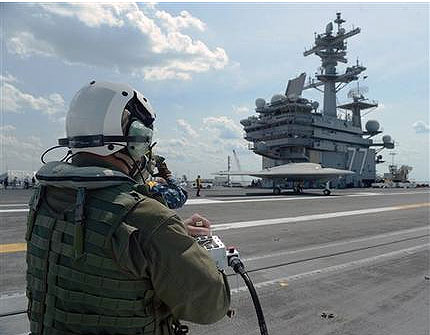
In this image provided by the U.S. Navy, Dave Lorenz, a Northrop Grumman deck operator, drives an X-47B Unmanned Combat Air System demonstrator using an arm-mounted controller on the flight deck of the aircraft carrier USS George H.W. Bush Friday May 10, 2013. The George H.W. Bush is scheduled to be the first aircraft carrier to catapult launch an unmanned aircraft from its flight deck Tuesday May 14, 2013. (AP Photo/US Navy, Specialist 2nd Class Timothy Walter)
The drone, or the X-47B, is the first to specifically take off and land on an aircraft carrier. This puts it in its own class as the carrier enables the drone to be used around the world without needing the permission of other countries to serve as a home base.
Navy officials say the drone will provide around-the-clock intelligence, surveillance and targeting capabilities. The X-47B isn’t intended for operational use; instead, the military is using the information it gathers during these demonstrations to develop the drone program.
The Navy operates two other unmanned aircraft; the small, low cost unarmed ScanEagle; and the armed Fire Scout which resembles a helicopter. Both the military and the CIA use armed Predator and Reaper drones in surveillance and strike operations around the world. The military uses them routinely in Afghanistan and other warzones, while the CIA has conducted frequent strikes in the border region of Pakistan—most often secret operations that trigger sharp criticism from the government there.
The X-47B is capable of reaching an altitude of more than 40,000 feet, has a range of more than 2,100 nautical miles and can reach high subsonic speeds, according to the Navy. It is also fully autonomous in flight. It relies on computer programs to tell it where it to go unless a mission operator needs to step in. That differs from other drones used by the military, that are usually piloted from remote locations.
Some critics have said the military’s use of drones, furthered by Tuesday’s tests, create concerns over the development of systems that could become weaponized and have less and less human control over launching attacks.
Those protesting the use of drones include Human Rights Watch which has called for a pre-emptive prohibition of the development and use of any unmanned systems that carry weapons and are fully autonomous.
While current models, like the X-47B, retain some level of supervision over decisions whether to use lethal force, the group predicts that fully autonomous weapons could be developed within decades that select and engage targets with no human intervention.
Tuesday’s tests show the trend toward greater autonomy “is not one that is going to be stopped,” said Steve Goose, director of the arms division at Human Rights Watch. “For us, the question is where do you draw line?” Goose said. “We’re saying you need to draw the line when you have a fully autonomous system that is weaponized. We’re saying you must have meaningful human control over key battlefield decisions of who lives and who dies. That should not be left up to the weapons system itself.”
Addressing this very issue last year the Department of Defense delivered a directive stating it would not pursue fully autonomous weapons, at least for the next few years. The U.S. is the only country with such a directive, Goose said.
Before the planes can become commonplace the military must prove they can operate in the harsh conditions aboard an aircraft carrier at sea. The aircraft used a steam catapult to launch, just like a traditional Navy warplane does.
“These are exciting times for the Navy as we are truly doing something that has never been done before—something I never imagined could be done during my 29-year naval career,” Rear Adm. Mat Winter, the Navy’s program executive officer for unmanned aviation and strike weapons, wrote in a Monday blog post.
The tailless plane won’t land on the aircraft carrier on Tuesday, the Navy plans to conduct those tests soon. Landing on a moving aircraft carrier is considered one of the most difficult challenges Navy pilots face. Following the test launch, the plane will make a series of approaches toward the aircraft carrier before landing at Naval Air Station Patuxent River in Maryland.
Earlier this month, the Navy successfully conducted a landing at that air station where the X-47B used a tailhook on the aircraft to catch a cable and suddenly stop, just as planes landing on carriers have to do.
In the 2014 fiscal year, the Navy plans to demonstrate that the X-47B can be refueled in flight. The program cost is $1.4 billion over eight years. Northrop Grumman was awarded the primary contract in 2007.
