

• Skip to primary navigation
  • Skip to main content
  • Skip to primary sidebar
  • Skip to secondary sidebar
  • Skip to footer
  • NEWS:
  • SatNews
  • SatMagazine
  • MilSatMagazine
  • SmallSat News
  • |     EVENTS:
  • SmallSat Symposium
  • Satellite Innovation
  • MilSat Symposium
  • SmallSat Europe

SatNews

Satellite Industry Intelligence Since 1983

Subscribe
  • LATEST
  • SatNews Events
  • Magazines
  • Calendar
  • Subscribe
  • Missions & Constellations
    • Exploration & Science Missions
    • In-Orbit Servicing & Orbital Operations
    • LEO Constellations
    • Mission Autonomy & Onboard Systems
    • Mission Deployments & Manifests
    • Navigation & PNT
    • SmallSat
    • Spacecraft & Payload Technology
    View All in Missions & Constellations →
    Satellite Connectivity Becomes the New Anchor for a Fragmenting Wearables MarketSatellite Connectivity Becomes the New Anchor for a Fragmenting Wearables Market
    AI Investments in Extreme Environment Materials Surpass $262 MillionAI Investments in Extreme Environment Materials Surpass $262 Million
    Air Inuit Modernizes Operations with SKYTRAC TrooTrax Mission SoftwareAir Inuit Modernizes Operations with SKYTRAC TrooTrax Mission Software
    ESA Launches Arctic Field Campaign to Calibrate Future Copernicus MissionsESA Launches Arctic Field Campaign to Calibrate Future Copernicus Missions
  • Business
    • Contracts & Commercial Deals
    • Earnings & Financial Reporting
    • Events & Conferences
    • Funding & Venture Capital
    • Market Forecasts
    • Mergers & Acquisitions
    • Personnel Moves & Appointments
    View All in Business & Finance →
    HTX and ST Engineering Launch Space Tech Program for Singapore Public SafetyHTX and ST Engineering Launch Space Tech Program for Singapore Public Safety
    SmallSat Europe Speaker Focus: Tanja Masson-Zwaan, Leiden UniversitySmallSat Europe Speaker Focus: Tanja Masson-Zwaan, Leiden University
    HawkEye 360 Files for Initial Public Offering at $2.4 Billion ValuationHawkEye 360 Files for Initial Public Offering at $2.4 Billion Valuation
    SmallSat Europe Speaker Focus: Jean-François Morizur, CailabsSmallSat Europe Speaker Focus: Jean-François Morizur, Cailabs
  • Defense
    • Counterspace & ASAT
    • Defense Budgets & Procurement
    • ISR & Reconnaissance
    • MILSATCOM
    • Missile Warning & Defense
    • National Security Programs
    • Space Domain Awareness
    View All in Military & Defense →
    BAE Systems Enters Production for NavGuide M-Code GPS ReceiverBAE Systems Enters Production for NavGuide M-Code GPS Receiver
    Space Force Awards $3.2 Billion in Golden Dome Contracts for Orbital Interceptor ConstellationSpace Force Awards $3.2 Billion in Golden Dome Contracts for Orbital Interceptor Constellation
    USSF Finalizes GPS III Constellation with Successful SV-10 DeploymentUSSF Finalizes GPS III Constellation with Successful SV-10 Deployment
    Meink: Space Force Programs Ready to Execute Once FY27 Budget LandsMeink: Space Force Programs Ready to Execute Once FY27 Budget Lands
  • Gov
    • Export Controls & Compliance
    • International Space Agreements
    • National Space Policy
    • Space Law & Treaties
    • Space Sustainability & Debris Policy
    • Space Traffic Management / Debris Removal
    View All in Government & Regulation →
    How CubeSat Proliferation is Redefining Sovereignty and Diplomatic Leverage at the United NationsHow CubeSat Proliferation is Redefining Sovereignty and Diplomatic Leverage at the United Nations
    FCC Modernization of Spectrum Rules Unlocks Sevenfold Gain in Satellite CapacityFCC Modernization of Spectrum Rules Unlocks Sevenfold Gain in Satellite Capacity
    The Smartest Money in the Room Is Looking UpThe Smartest Money in the Room Is Looking Up
    NASA’s Shift to CLPS 2.0 Signals Structural Transformation of Lunar Logistics MarketNASA’s Shift to CLPS 2.0 Signals Structural Transformation of Lunar Logistics Market
  • Launch
    • Launch Providers
    • Launch Schedule & Calendars
    • Launch Sites & Infrastructure
    • Rocket Technology & Vehicles
    View All in Launch →
    Astrobotic Achieves Record 300-Second Burn with New Detonation EngineAstrobotic Achieves Record 300-Second Burn with New Detonation Engine
    Bad news, but good news followedBad news, but good news followed
    Rocket Lab Successfully Launches “Kakushin Rising” Mission for JAXARocket Lab Successfully Launches “Kakushin Rising” Mission for JAXA
    Blue Origin CEO Attributes BlueBird 7 Satellite Loss to Second-Stage Thrust AnomalyBlue Origin CEO Attributes BlueBird 7 Satellite Loss to Second-Stage Thrust Anomaly
  • Software
    • Autonomous Ground Operations
    • Data Processing & AI/ML
    • Digital Twins & Modeling
    • Ground Segment & Teleports
    • Mission Planning & Simulation
    • Space Systems Software Engineering
    • Spectrum & Licensing
    View All in Software Automation & Ground Systems →
    SmallSat Europe Speaker Focus: Giovanni Pandolfi Bortoletto, Leaf SpaceSmallSat Europe Speaker Focus: Giovanni Pandolfi Bortoletto, Leaf Space
    SpinLaunch Selects Equinix to Deploy Global Ground Infrastructure for Meridian Space ConstellationSpinLaunch Selects Equinix to Deploy Global Ground Infrastructure for Meridian Space Constellation
    RF-Design Launches FiberLink CompactLine FCLR1811S4 for Ground Segment OptimizationRF-Design Launches FiberLink CompactLine FCLR1811S4 for Ground Segment Optimization
    Sat-Lite Technologies adds  Richard Rader to Spearhead Sales ExpansionSat-Lite Technologies adds Richard Rader to Spearhead Sales Expansion
  • Services & Apps
    • Climate & Environmental Monitoring
    • Disaster Response & Security Mapping
    • Earth Observation & Imaging
    • Maritime & Aviation Satcom
    • Satellite Communications
    View All in Services & Applications →
    Solstar Confirms Successful On-Orbit Operation of Deke Space Communicator Following Launch on SpaceX Transporter-16 MissionSolstar Confirms Successful On-Orbit Operation of Deke Space Communicator Following Launch on SpaceX Transporter-16 Mission
    IEC Telecom Unveils Voucher-Based Connectivity Solution at Singapore Maritime Week 2026IEC Telecom Unveils Voucher-Based Connectivity Solution at Singapore Maritime Week 2026
    GomSpace and STETMAN Establish UASAT Joint Venture for Ukrainian Sovereign CommunicationsGomSpace and STETMAN Establish UASAT Joint Venture for Ukrainian Sovereign Communications
    Market Dynamics and Non-Terrestrial Network (NTN) ChipsetsMarket Dynamics and Non-Terrestrial Network (NTN) Chipsets

NASA’s Chandra Records Extraordinary Outburst Leads To New Population Of Old Black Holes

May 1, 2012

[SatNews] “The flaring up of this ULX took us by surprise and was a sure sign we had discovered something new about the way black holes grow…”


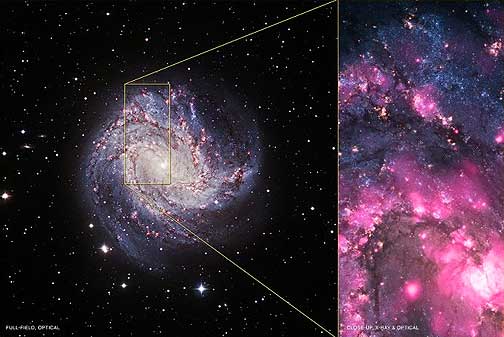
Composite image of spiral galaxy M83. (X-ray: NASA/CXC/Curtin University/R. Soria et al., Optical: NASA/STScI/ Middlebury College/F. Winkler et al.) For Chandra images, multimedia and related materials visit.

An extraordinary outburst produced by a black hole in a nearby galaxy has provided direct evidence for a population of old, volatile stellar black holes. The discovery, made by astronomers using NASA’s Chandra X-ray Observatory, provides new insight into the nature of a mysterious class of black holes that can produce as much energy in X-rays as a million suns radiate at all wavelengths.

Researchers used Chandra to discover a new ultraluminous X-ray source, or ULX. These objects give off more X-rays than most binary systems, in which a companion star orbits the remains of a collapsed star. These collapsed stars form either a dense core called a neutron star or a black hole. The extra X-ray emission suggests ULXs contain black holes that might be much more massive than the ones found elsewhere in our galaxy.

The companion stars to ULXs, when identified, are usually young, massive stars, implying their black holes are also young. The latest research, however, provides direct evidence that ULXs can contain much older black holes and some sources may have been misidentified as young ones.

The intriguing new ULX is located in M83, a spiral galaxy about 15 million light years from Earth, discovered in 2010 with Chandra. Astronomers compared this data with Chandra images from 2000 and 2001, which showed the source had increased in X-ray brightness by at least 3,000 times and has since become the brightest X-ray source in M83.

The sudden brightening of the M83 ULX is one of the largest changes in X-rays ever seen for this type of object, which do not usually show dormant periods. No sign of the ULX was found in historical X-ray images made with Einstein Observatory in 1980, ROSAT in 1994, the European Space Agency’s XMM-Newton in 2003 and 2008, or NASA’s Swift observatory in 2005.

“The flaring up of this ULX took us by surprise and was a sure sign we had discovered something new about the way black holes grow,” said Roberto Soria of Curtin University in Australia, who led the new study. The dramatic jump in X-ray brightness, according to the researchers, likely occurred because of a sudden increase in the amount of material falling into the black hole.

In 2011, Soria and his colleagues used optical images from the Gemini Observatory and NASA’s Hubble Space Telescope to discover a bright blue source at the position of the X-ray source. The object had not been previously observed in a Magellan Telescope image taken in April 2009 or a Hubble image obtained in August 2009. The lack of a blue source in the earlier images indicates the black hole’s companion star is fainter, redder and has a much lower mass than most of the companions that previously have been directly linked to ULXs. The bright, blue optical emission seen in 2011 must have been caused by a dramatic accumulation of more material from the companion star.

“If the ULX only had been observed during its peak of X-ray emission in 2010, the system easily could have been mistaken for a black hole with a massive, much younger stellar companion, about 10 to 20 million years old,” said co-author William Blair of Johns Hopkins University in Baltimore.

The companion to the black hole in M83 is likely a red giant star at least 500 million years old, with a mass less than four times the sun’s. Theoretical models for the evolution of stars suggest the black hole should be almost as old as its companion.

Another ULX containing a volatile, old black hole recently was discovered in the Andromeda galaxy by Amanpreet Kaur, from Clemson University, and colleagues and published in the February 2012 issue of Astronomy and Astrophysics. Matthew Middleton and colleagues from the University of Durham reported more information in the March 2012 issue of the Monthly Notices of the Royal Astronomical Society. They used data from Chandra, XMM-Newton and HST to show the ULX is highly variable and its companion is an old, red star.

“With these two objects, it’s becoming clear there are two classes of ULX, one containing young, persistently growing black holes and the other containing old black holes that grow erratically,” said Kip Kuntz, a co-author of the new M83 paper, also of Johns Hopkins University. “We were very fortunate to observe the M83 object at just the right time to make the before and after comparison.”

A paper describing these results will appear in the May 10th issue of The Astrophysical Journal.

NASA’s Marshall Space Flight Center in Huntsville, Alabama, manages the Chandra program for NASA’s Science Mission Directorate in Washington. The Smithsonian Astrophysical Observatory controls Chandra’s science and flight operations from Cambridge, Mass.

Filed Under: Exploration & Science Missions, Missions & Constellations

Primary Sidebar

Coverage

  • Missions & Constellations
  • Business & Finance
  • Military & Defense
  • Launch
  • Software Automation & Ground Systems
  • Government & Regulation
  • Services & Applications

Most Read Stories

  • SpaceX Loses Contact With Starlink Satellite
  • Planet Labs Imposes Indefinite Blackout on Iran Satellite Imagery at U.S. Request
  • Amazon in Reported Talks to Acquire Globalstar in $9 Billion Move to Challenge Starlink
  • What the SpaceX IPO Changes for Every Satellite Operator
  • Russia Replaces Starlink With European-Built Satellites

Secondary Sidebar

Footer


Satnews is a leading provider of satellite news, events, publications, research and other satellite industry information in both commercial and military enterprises worldwide.

Stories By Category

  • Business & Finance
  • Government & Regulation
  • Launch
  • Military & Defense
  • Missions & Constellations
  • Services & Applications
  • Software Automation & Ground Systems
  • Spectrum & Licensing
  • Startups & NewSpace Business

About Us

  • Leadership & Editorial Team
  • SatNews History
  • Free Satnews Subscription
  • SatNews Events
  • Magazines

Navigation

  • Latest Stories
  • Magazines
  • Events
  • Contact
  • Cookie & Privacy Policy for Satnews

We use cookies to ensure that we give you the best experience on our website. If you continue to use this site we will assume that you are happy with it.
x
Sign up Now (For Free)
Access daily or weekly satellite news updates covering all aspects of the commercial and military satellite industry.
Invalid email address
Notify Me Regarding ( At least one ):
We value your privacy and will not sell or share your email or other information with any other company. You may also unsubscribe at anytime.

Click Here to see our full privacy policy.
Thanks for subscribing!