

• Skip to primary navigation
  • Skip to main content
  • Skip to primary sidebar
  • Skip to secondary sidebar
  • Skip to footer
  • NEWS:
  • SatNews
  • SatMagazine
  • MilSatMagazine
  • SmallSat News
  • |     EVENTS:
  • SmallSat Symposium
  • Satellite Innovation
  • MilSat Symposium
  • SmallSat Europe

SatNews

Satellite Industry Intelligence Since 1983

Subscribe
  • LATEST
  • SatNews Events
  • Magazines
  • Calendar
  • Subscribe
  • Missions & Constellations
    • Exploration & Science Missions
    • In-Orbit Servicing & Orbital Operations
    • LEO Constellations
    • Mission Autonomy & Onboard Systems
    • Mission Deployments & Manifests
    • Navigation & PNT
    • SmallSat
    • Spacecraft & Payload Technology
    View All in Missions & Constellations →
    Blue Origin CEO Attributes BlueBird 7 Satellite Loss to Second-Stage Thrust AnomalyBlue Origin CEO Attributes BlueBird 7 Satellite Loss to Second-Stage Thrust Anomaly
    STMicroelectronics Targets $3 Billion in LEO Satellite Revenue; Announces Dedicated Investor CallSTMicroelectronics Targets $3 Billion in LEO Satellite Revenue; Announces Dedicated Investor Call
    NASA’s Shift to CLPS 2.0 Signals Structural Transformation of Lunar Logistics MarketNASA’s Shift to CLPS 2.0 Signals Structural Transformation of Lunar Logistics Market
    Teledyne to Showcase Integrated Sensing Ecosystem and New Low-Light Module at SPIE 2026Teledyne to Showcase Integrated Sensing Ecosystem and New Low-Light Module at SPIE 2026
  • Business
    • Contracts & Commercial Deals
    • Earnings & Financial Reporting
    • Events & Conferences
    • Funding & Venture Capital
    • Market Forecasts
    • Mergers & Acquisitions
    • Personnel Moves & Appointments
    View All in Business & Finance →
    Vision Meets Profit: Why Modern Space Exploration Requires Both Dreamers and BusinessVision Meets Profit: Why Modern Space Exploration Requires Both Dreamers and Business
    Insider Activity and Space Force Budget Outlook Shift Intuitive Machines’ Financial NarrativeInsider Activity and Space Force Budget Outlook Shift Intuitive Machines’ Financial Narrative
    The Smartest Money in the Room Is Looking UpThe Smartest Money in the Room Is Looking Up
    SmallSat Europe Speaker Focus: Giovanni Pandolfi Bortoletto, Leaf SpaceSmallSat Europe Speaker Focus: Giovanni Pandolfi Bortoletto, Leaf Space
  • Defense
    • Counterspace & ASAT
    • Defense Budgets & Procurement
    • ISR & Reconnaissance
    • MILSATCOM
    • Missile Warning & Defense
    • National Security Programs
    • Space Domain Awareness
    View All in Military & Defense →
    Space Force Awards $3.2 Billion in Golden Dome Contracts for Orbital Interceptor ConstellationSpace Force Awards $3.2 Billion in Golden Dome Contracts for Orbital Interceptor Constellation
    USSF Finalizes GPS III Constellation with Successful SV-10 DeploymentUSSF Finalizes GPS III Constellation with Successful SV-10 Deployment
    Meink: Space Force Programs Ready to Execute Once FY27 Budget LandsMeink: Space Force Programs Ready to Execute Once FY27 Budget Lands
    SDA’s Sandhoo: Tranche 1 Launches Resume in May or JuneSDA’s Sandhoo: Tranche 1 Launches Resume in May or June
  • Gov
    • Export Controls & Compliance
    • International Space Agreements
    • National Space Policy
    • Space Law & Treaties
    • Space Sustainability & Debris Policy
    • Space Traffic Management / Debris Removal
    View All in Government & Regulation →
    How CubeSat Proliferation is Redefining Sovereignty and Diplomatic Leverage at the United NationsHow CubeSat Proliferation is Redefining Sovereignty and Diplomatic Leverage at the United Nations
    FCC Modernization of Spectrum Rules Unlocks Sevenfold Gain in Satellite CapacityFCC Modernization of Spectrum Rules Unlocks Sevenfold Gain in Satellite Capacity
    FCC Grants AST SpaceMobile Authority for 248-Satellite Constellation and Direct-to-Cell ServiceFCC Grants AST SpaceMobile Authority for 248-Satellite Constellation and Direct-to-Cell Service
    Saltzman Rolls Out Space Force Objective Force, Flags CR as Top RiskSaltzman Rolls Out Space Force Objective Force, Flags CR as Top Risk
  • Launch
    • Launch Providers
    • Launch Schedule & Calendars
    • Launch Sites & Infrastructure
    • Rocket Technology & Vehicles
    View All in Launch →
    Bad news, but good news followedBad news, but good news followed
    Rocket Lab Successfully Launches “Kakushin Rising” Mission for JAXARocket Lab Successfully Launches “Kakushin Rising” Mission for JAXA
    Blue Origin Achieves First Booster Reuse but Satellite Enters Off-Nominal OrbitBlue Origin Achieves First Booster Reuse but Satellite Enters Off-Nominal Orbit
    Ensign-Bickford Hardware Supports Successful Artemis II Lunar MissionEnsign-Bickford Hardware Supports Successful Artemis II Lunar Mission
  • Software
    • Autonomous Ground Operations
    • Data Processing & AI/ML
    • Digital Twins & Modeling
    • Ground Segment & Teleports
    • Mission Planning & Simulation
    • Space Systems Software Engineering
    • Spectrum & Licensing
    View All in Software Automation & Ground Systems →
    SpinLaunch Selects Equinix to Deploy Global Ground Infrastructure for Meridian Space ConstellationSpinLaunch Selects Equinix to Deploy Global Ground Infrastructure for Meridian Space Constellation
    RF-Design Launches FiberLink CompactLine FCLR1811S4 for Ground Segment OptimizationRF-Design Launches FiberLink CompactLine FCLR1811S4 for Ground Segment Optimization
    Sat-Lite Technologies adds  Richard Rader to Spearhead Sales ExpansionSat-Lite Technologies adds Richard Rader to Spearhead Sales Expansion
    Blue Origin Unveils Project Quartz Global Ground Station NetworkBlue Origin Unveils Project Quartz Global Ground Station Network
  • Services & Apps
    • Climate & Environmental Monitoring
    • Disaster Response & Security Mapping
    • Earth Observation & Imaging
    • Maritime & Aviation Satcom
    • Satellite Communications
    View All in Services & Applications →
    Solstar Confirms Successful On-Orbit Operation of Deke Space Communicator Following Launch on SpaceX Transporter-16 MissionSolstar Confirms Successful On-Orbit Operation of Deke Space Communicator Following Launch on SpaceX Transporter-16 Mission
    IEC Telecom Unveils Voucher-Based Connectivity Solution at Singapore Maritime Week 2026IEC Telecom Unveils Voucher-Based Connectivity Solution at Singapore Maritime Week 2026
    GomSpace and STETMAN Establish UASAT Joint Venture for Ukrainian Sovereign CommunicationsGomSpace and STETMAN Establish UASAT Joint Venture for Ukrainian Sovereign Communications
    Market Dynamics and Non-Terrestrial Network (NTN) ChipsetsMarket Dynamics and Non-Terrestrial Network (NTN) Chipsets

NASA… Busy, Busy, Busy… (Imagery)

September 19, 2011

[SatNews] During the first two weeks of September, and the peak of the Atlantic Hurricane season, NASA satellites were keeping tabs on a number of tropical systems.


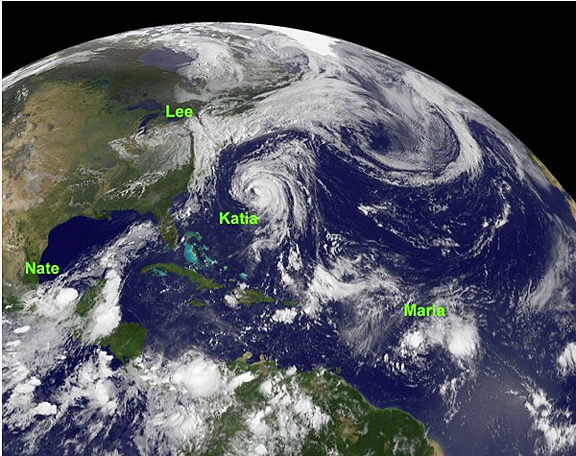
GOES-13 satellite took a stunning image of 4 tropical systems in the Atlantic today, Sept. 8, 2011. Hurricane Katia in the western Atlantic between Bermuda and the U.S. East coast; Tropical Storm Lee’s remnants affecting the northeastern U.S.; Tropical Storm Maria in the central Atlantic; and newborn Tropical Storm Nate in the Bay of Campeche, Gulf of Mexico. (Credit: NASA/NOAA GOES Project)

NASA‘s Aqua, Terra, EO-1 and Tropical Rainfall Measuring Mission (TRMM) satellites provided rainfall rates, cloud height, cloud temperature, sea surface temperatures, and extent of cloud cover throughout the life of all the tropical cyclones. NASA/NOAA’s GOES Project also created images and animations from NOAA’s GOES-13 satellite that followed the track of each system through the Atlantic, Caribbean or Gulf of Mexico.

Hurricane Irene lashed the East Coast of the U.S. from South Carolina to the New England states and caused record flooding in Vermont. Tropical Storm Jose lived and died in the Atlantic Ocean, only to give way to Hurricane Katia, which brought rough surf to the U.S. East Coast and did a sling-shot across the Atlantic to bring hurricane-force winds to the U.K. during the second week of September. Nate formed in the Bay of Campeche and after a couple of days made landfall in southeastern Mexico.

Tropical Storm Lee formed south of Louisiana and sat off-shore for days, soaking the northern Gulf coast before making landfall and merging with a frontal system. Lee was then absorbed into a low-pressure area over the Ohio Valley and produced massive rainfall from Florida to Illinois. NASA’s rain gauge in space, TRMM, mapped the massive rainfall generated by Lee. After forming in the north central Gulf of Mexico, Lee came ashore over south central Louisiana on the morning of Sept. 4th. That day, an infrared image of Tropical Storm Lee from the Atmospheric Infrared Sounder instrument on NASA’s Aqua satellite measured cloud-top temperatures to tell forecasters where the coldest, highest thunderstorm cloud tops were located. Those cloud-top temperatures were colder than -62 Fahrenheit (-52 Celsius). The strongest rainfall at that time was occurring over coastal Alabama and Mississippi and the Gulf of Mexico. Over the next two and a half days, the slow-moving storm worked its way across central Louisiana and central Mississippi and into northern Alabama, dumping heavy rains along the way. Tropical Storm Lee joined a frontal system to soak the eastern U.S.

Rainfall estimates from the TRMM-based, near-real time Multi-satellite Precipitation Analysis (TMPA) at the NASA Goddard Space Flight Center in Greenbelt, Maryland, for the period Aug. 31- Sept. 8 for the eastern half of the U.S. showed heavy rains extending inland from the northern Gulf of Mexico across eastern Louisiana, Mississippi, northwestern Alabama, and into central Tennessee. Rainfall totals in this region generally exceed 100 mm (~4 inches), with some parts of Mississippi and Louisiana receiving upwards of 250 mm (~10 inches). Chattanooga, Tennessee, broke its all-time, 24-hour rainfall total with 9.69 inches. TMPA rainfall totals of 125 mm (~5 inches) to as much as 200 to 250 mm (~8 to 10 inches) extended from south central Pennsylvania up into central New York, where the Susquehanna River reached record flood levels in downtown Binghamton. Elsewhere across the mid-Atlantic, rain totals exceeded anywhere from 100 to 150 mm (~4 to 6 inches).


NASA’s EO-1 satellite captured this natural-color image on September 10 of the Susquehanna River, loaded with sediment. The Susquehanna flows through the city and appears confined within its embankments. Credit: NASA Earth Observatory/Jesse Allen, Robert Simmon/ NASA EO-1 team

On Sept. 8, NOAA’s GOES-13 satellite captured an image of the cloud cover from Tropical Storm Lee’s remnants that extended from the northern Gulf of Mexico to New England. There also was other activity that satellites were monitoring in the Atlantic, because Katia, Maria and Nate were active and all four systems were captured on one image. By Sept. 10, another NASA satellite, EO-1, captured a natural-color image of the Susquehanna River, in central Pennsylvania, that was loaded with sediment as a result of Lee’s flooding rainfall.

On Sunday, Sept. 11, at 10 a.m. EDT, the GOES-13 satellite captured Nate’s center as it was just about to make landfall north of Barra de Nautla in the Mexican state of Veracruz, bringing heavy rainfall and sustained winds were near 45 mph. Thirteen hours after making landfall, Tropical Storm Nate weakened into a remnant low-pressure area. By Sept. 14, Hurricane Katia had made its mark, bringing hurricane-force, heavy rains and rough surf. On the same date, Tropical Storm Maria caused Tropical Storm Warnings for Bermuda, and was expected to follow much the same path as Katia did earlier in the week.

Text credit: Rob Gutro, NASA’s Goddard Space Flight Center, Greenbelt, Md

Filed Under: Climate & Environmental Monitoring, Earth Observation & Imaging

Primary Sidebar

Coverage

  • Missions & Constellations
  • Business & Finance
  • Military & Defense
  • Launch
  • Software Automation & Ground Systems
  • Government & Regulation
  • Services & Applications

Most Read Stories

  • SpaceX Loses Contact With Starlink Satellite
  • Planet Labs Imposes Indefinite Blackout on Iran Satellite Imagery at U.S. Request
  • Amazon in Reported Talks to Acquire Globalstar in $9 Billion Move to Challenge Starlink
  • What the SpaceX IPO Changes for Every Satellite Operator
  • Russia Replaces Starlink With European-Built Satellites

Secondary Sidebar

Footer


Satnews is a leading provider of satellite news, events, publications, research and other satellite industry information in both commercial and military enterprises worldwide.

Stories By Category

  • Business & Finance
  • Government & Regulation
  • Launch
  • Military & Defense
  • Missions & Constellations
  • Services & Applications
  • Software Automation & Ground Systems
  • Spectrum & Licensing
  • Startups & NewSpace Business

About Us

  • Leadership & Editorial Team
  • SatNews History
  • Free Satnews Subscription
  • SatNews Events
  • Magazines

Navigation

  • Latest Stories
  • Magazines
  • Events
  • Contact
  • Cookie & Privacy Policy for Satnews

We use cookies to ensure that we give you the best experience on our website. If you continue to use this site we will assume that you are happy with it.
x
Sign up Now (For Free)
Access daily or weekly satellite news updates covering all aspects of the commercial and military satellite industry.
Invalid email address
Notify Me Regarding ( At least one ):
We value your privacy and will not sell or share your email or other information with any other company. You may also unsubscribe at anytime.

Click Here to see our full privacy policy.
Thanks for subscribing!