

• Skip to primary navigation
  • Skip to main content
  • Skip to primary sidebar
  • Skip to secondary sidebar
  • Skip to footer
  • NEWS:
  • SatNews
  • SatMagazine
  • MilSatMagazine
  • SmallSat News
  • |     EVENTS:
  • SmallSat Symposium
  • Satellite Innovation
  • MilSat Symposium
  • SmallSat Europe

SatNews

Satellite Industry Intelligence Since 1983

Subscribe
  • LATEST
  • SatNews Events
  • Magazines
  • Calendar
  • Subscribe
  • Missions & Constellations
    • Exploration & Science Missions
    • In-Orbit Servicing & Orbital Operations
    • LEO Constellations
    • Mission Autonomy & Onboard Systems
    • Mission Deployments & Manifests
    • Navigation & PNT
    • SmallSat
    • Spacecraft & Payload Technology
    View All in Missions & Constellations →
    China Accelerates Orbital Internet Deployment with Successful Smart Dragon-3 Sea LaunchChina Accelerates Orbital Internet Deployment with Successful Smart Dragon-3 Sea Launch
    Smallsats Dominate 2025 Launch Landscape as Mass Efficiency PeaksSmallsats Dominate 2025 Launch Landscape as Mass Efficiency Peaks
    MIT STAR Lab Expands Scope from Lasercom Innovation to Space Policy ArchitectureMIT STAR Lab Expands Scope from Lasercom Innovation to Space Policy Architecture
    Northrop Grumman Contracted for Hungary’s HUGEO Sovereign Communications SatelliteNorthrop Grumman Contracted for Hungary’s HUGEO Sovereign Communications Satellite
  • Business
    • Contracts & Commercial Deals
    • Earnings & Financial Reporting
    • Events & Conferences
    • Funding & Venture Capital
    • Market Forecasts
    • Mergers & Acquisitions
    • Personnel Moves & Appointments
    View All in Business & Finance →
    SmallSat Europe Speaker Focus: Chiara Manfletti, NeuraspaceSmallSat Europe Speaker Focus: Chiara Manfletti, Neuraspace
    SmallSat Europe Speaker Focus: Daniel Bock, Morpheus SpaceSmallSat Europe Speaker Focus: Daniel Bock, Morpheus Space
    Lockheed Martin Outlines Strategic Space Technology Roadmap for 2026Lockheed Martin Outlines Strategic Space Technology Roadmap for 2026
    Industry Sentiment Shifts as Quilty Space Reveals Top 5 Takeaways from Satellite 2026Industry Sentiment Shifts as Quilty Space Reveals Top 5 Takeaways from Satellite 2026
  • Defense
    • Counterspace & ASAT
    • Defense Budgets & Procurement
    • ISR & Reconnaissance
    • MILSATCOM
    • Missile Warning & Defense
    • National Security Programs
    • Space Domain Awareness
    View All in Military & Defense →
    NRL to Showcase Sovereign Space Capabilities at 41st Space SymposiumNRL to Showcase Sovereign Space Capabilities at 41st Space Symposium
    Northrop Grumman Minotaur IV Lofted USSF Tech Demonstration Payloads to OrbitNorthrop Grumman Minotaur IV Lofted USSF Tech Demonstration Payloads to Orbit
    The End of the VSAT Parts BinThe End of the VSAT Parts Bin
    Procurement Lag vs. Conflict Speed: Can Defense Buying Cycles Keep Up with Space Innovation?Procurement Lag vs. Conflict Speed: Can Defense Buying Cycles Keep Up with Space Innovation?
  • Gov
    • Export Controls & Compliance
    • International Space Agreements
    • National Space Policy
    • Space Law & Treaties
    • Space Sustainability & Debris Policy
    • Space Traffic Management / Debris Removal
    View All in Government & Regulation →
    FCC Modernizes Satellite Spectrum Rules to Unleash Next-Generation BroadbandFCC Modernizes Satellite Spectrum Rules to Unleash Next-Generation Broadband
    SmallSat Europe Speaker Focus: Dr. Ane Aanesland, ThrustMeSmallSat Europe Speaker Focus: Dr. Ane Aanesland, ThrustMe
    Isaacman’s Budget Math: How NASA Plans to Reach the Moon With a Quarter Less MoneyIsaacman’s Budget Math: How NASA Plans to Reach the Moon With a Quarter Less Money
    FCC Seeks Comment on Expanding Spectrum Access for “Weird Space Stuff”FCC Seeks Comment on Expanding Spectrum Access for “Weird Space Stuff”
  • Launch
    • Launch Providers
    • Launch Schedule & Calendars
    • Launch Sites & Infrastructure
    • Rocket Technology & Vehicles
    View All in Launch →
    What the SpaceX IPO Changes for Every Satellite OperatorWhat the SpaceX IPO Changes for Every Satellite Operator
    €30 million Financing for PLD Space’s Small Satellite Launcher€30 million Financing for PLD Space’s Small Satellite Launcher
    Satellite Deployers to be Used on JAXA Small Satellite Mission by ExolaunchSatellite Deployers to be Used on JAXA Small Satellite Mission by Exolaunch
    CAS Space Successfully Launches Kinetica-2, Aiming for Global Cost LeadershipCAS Space Successfully Launches Kinetica-2, Aiming for Global Cost Leadership
  • Software
    • Autonomous Ground Operations
    • Data Processing & AI/ML
    • Digital Twins & Modeling
    • Ground Segment & Teleports
    • Mission Planning & Simulation
    • Space Systems Software Engineering
    • Spectrum & Licensing
    View All in Software Automation & Ground Systems →
    Keysight and Sateliot Win ESA and GSMA Foundry Challenge for 6G InnovationKeysight and Sateliot Win ESA and GSMA Foundry Challenge for 6G Innovation
    Automation and Agility: How SSC Space Go is Designed for the New Age of GroundAutomation and Agility: How SSC Space Go is Designed for the New Age of Ground
    Intellian Unveils Future Military and Aerospace Antenna Technologies at Satellite 2026Intellian Unveils Future Military and Aerospace Antenna Technologies at Satellite 2026
    The Downlink Deficit: The Pentagon’s Optical Mesh Network and the Terrestrial BottleneckThe Downlink Deficit: The Pentagon’s Optical Mesh Network and the Terrestrial Bottleneck
  • Services & Apps
    • Climate & Environmental Monitoring
    • Disaster Response & Security Mapping
    • Earth Observation & Imaging
    • Maritime & Aviation Satcom
    • Satellite Communications
    View All in Services & Applications →
    Kraken Robotics Integrates KATFISH Sonar on SEFINE RD-22 USV Following Multi-Naval DemonstrationsKraken Robotics Integrates KATFISH Sonar on SEFINE RD-22 USV Following Multi-Naval Demonstrations
    Astroscale Plans World-First Multi-Orbit Satellite Inspection MissionAstroscale Plans World-First Multi-Orbit Satellite Inspection Mission
    Cinemo Reimagines the Vehicle as a Software-Defined Entertainment HubCinemo Reimagines the Vehicle as a Software-Defined Entertainment Hub
    IEC Telecom Wins CSR Initiative of the Year at the Oil & Gas Middle East Awards 2026IEC Telecom Wins CSR Initiative of the Year at the Oil & Gas Middle East Awards 2026

Hubble And ESO’s Telescopes Discover Pandora’s Violent Cluster

June 22, 2011


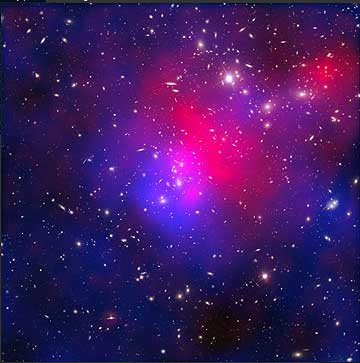
X-rays, dark matter and galaxies in the cluster Abell 2744 Credit: NASA, ESA, ESO, CXC & D. Coe (STScI)/J. Merten (Heidelberg/Bologna)
[SatNews] When galaxies over 350 million years ago crashed together the results are a treasure trove.

A team of scientists has studied the galaxy cluster Abell 2744, nicknamed Pandora’s Cluster. They have pieced together the cluster’s complex and violent history using telescopes in space and on the ground, including European Southern Observatory (ESO’s) Very Large Telescope and the Hubble Space Telescope. Abell 2744 seems to be the result of a simultaneous pile-up of at least four separate galaxy clusters and this complex collision has produced strange effects that have never been seen together before.

When huge clusters of galaxies crash together, the resulting mess is a treasure trove of information for astronomers. By investigating one of the most complex and unusual colliding clusters in the sky, an international team of astronomers has pieced together the history of a cosmic crash that took place over a period of 350 million years.

Julian Merten, one of the lead scientists for this new study of cluster Abell 2744, explains: “Like a crash investigator piecing together the cause of an accident, we can use observations of these cosmic pile-ups to reconstruct events that happened over a period of hundreds of millions of years. This can reveal how structures form in the Universe, and how different types of matter interact with each other when they are smashed together.”

“We nicknamed it Pandora’s Cluster because so many different and strange phenomena were unleashed by the collision. Some of these phenomena had never been seen before,” adds Renato Dupke, another member of the team.

Abell 2744 has now been studied in more detail than ever before by combining data from ESO’s Very Large Telescope (VLT), the Japanese Subaru telescope, the NASA/ESA Hubble Space Telescope, and NASA’s Chandra X-Ray Observatory. The galaxies in the cluster are clearly visible in the VLT and Hubble images. Although the galaxies are bright they make up less than 5 percent of the mass there. The rest is gas (around 20 percent), which is so hot that it shines only in X-rays, and dark matter (around 75 percent), which is completely invisible. To understand what was going on in the collision the team needed to map the positions of all three types of matter in Abell 2744.

Dark matter is particularly elusive as it does not emit, absorb or reflect light (hence its name), but only makes itself apparent through its gravitational attraction. To pinpoint the location of this mysterious substance the team exploited a phenomenon known as gravitational lensing. This is the bending of light rays from distant galaxies as they pass through the gravitational fields present in the cluster. The result is a series of telltale distortions in the images of galaxies in the background of the VLT and Hubble observations. By carefully plotting the way that these images are distorted, it is possible to map quite accurately where the hidden mass — and hence the dark matter — actually lies.

By comparison, finding the hot gas in the cluster is simpler as NASA’s Chandra X-ray Observatory can observe it directly. These observations are not just crucial to find out where the gas is, but also to show the angles and speeds at which different components of the cluster came together. When the astronomers looked at the results they found many curious features. “Abell 2744 seems to have formed from four different clusters involved in a series of collisions over a period of some 350 million years. The complicated and uneven distribution of the different types of matter is extremely unusual and fascinating,” says Dan Coe, the other lead author of the study.

It seems that the complex collision has separated out some of the hot gas and dark matter so that they now lie apart from each other, and from the visible galaxies. Pandora’s Cluster combines several phenomena that have only ever been seen singly in other systems.

Near the core of the cluster is a “bullet”, where the gas of one cluster collided with that of another to create a shock wave. The dark matter passed through the collision unaffected [1].

In another part of the cluster there seem to be galaxies and dark matter, but no hot gas. The gas may have been stripped away during the collision, leaving behind no more than a faint trail.

Even odder features lie in the outer parts of the cluster. One region contains lots of dark matter, but no luminous galaxies or hot gas. A separate ghostly clump of gas has been ejected, which precedes rather than follows the associated dark matter. This puzzling arrangement may be telling astronomers something about how dark matter behaves and how the various ingredients of the Universe interact with each other.

Galaxy clusters are the biggest structures in the cosmos, containing literally trillions of stars. The way they form and develop through repeated collisions has profound implications for our understanding of the Universe. Further studies of the Pandora’s Cluster, the most complex and fascinating merger yet found, are in progress.

Notes
[1] This effect has been seen before in a few galaxy cluster collisions, including the original “Bullet Cluster”, 1E 0657-56.

This research is presented in a paper entitled “Creation of cosmic structure in the complex galaxy cluster merger Abell 2744”, to appear in Monthly Notices of the Royal Astronomical Society.

You can learn more at.

Filed Under: Exploration & Science Missions

Primary Sidebar

Coverage

  • Missions & Constellations
  • Business & Finance
  • Military & Defense
  • Launch
  • Software Automation & Ground Systems
  • Government & Regulation
  • Services & Applications

Most Read Stories

  • L3Harris Unveils XL-300P: The First P25 Handheld with 5G and Satellite Direct-to-Device Connectivity
  • Rheinmetall Walked Away. Germany Should Take the Hint.
  • SpaceX Loses Contact With Starlink Satellite
  • Rocket Lab Emerging as Potential Bus Provider for 2,800-Satellite Equatys Constellation
  • SpaceX Accelerates Record-Breaking IPO Following Trillion-Dollar xAI Merger

Secondary Sidebar

Footer


Satnews is a leading provider of satellite news, events, publications, research and other satellite industry information in both commercial and military enterprises worldwide.

Stories By Category

  • Business & Finance
  • Government & Regulation
  • Launch
  • Military & Defense
  • Missions & Constellations
  • Services & Applications
  • Software Automation & Ground Systems
  • Spectrum & Licensing
  • Startups & NewSpace Business

About Us

  • Leadership & Editorial Team
  • SatNews History
  • Free Satnews Subscription
  • SatNews Events
  • Magazines

Navigation

  • Latest Stories
  • Magazines
  • Events
  • Contact
  • Cookie & Privacy Policy for Satnews

We use cookies to ensure that we give you the best experience on our website. If you continue to use this site we will assume that you are happy with it.
x
Sign up Now (For Free)
Access daily or weekly satellite news updates covering all aspects of the commercial and military satellite industry.
Invalid email address
Notify Me Regarding ( At least one ):
We value your privacy and will not sell or share your email or other information with any other company. You may also unsubscribe at anytime.

Click Here to see our full privacy policy.
Thanks for subscribing!