

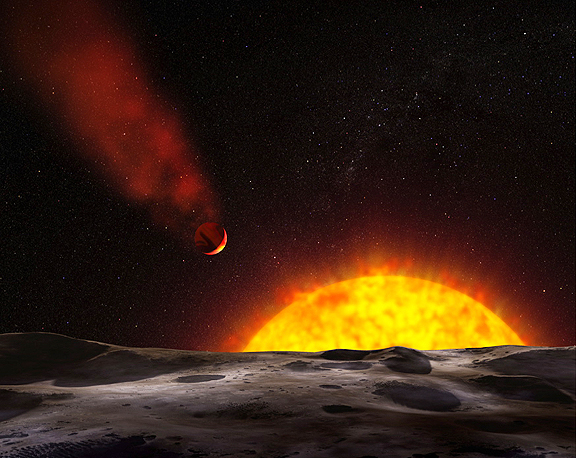
Illustration Credit: NASA, ESA, and G. Bacon (STScI)
Observations taken with Hubble‘s Cosmic Origins Spectrograph (COS) suggest powerful stellar winds are sweeping the cast-off atmospheric material behind the scorched planet and shaping it into a comet-like tail. The planet, located 153 light-years from Earth, weighs slightly less than Jupiter but orbits 100 times closer to its star than the Jovian giant. The roasted planet zips around its star in a short 3.5 days. In contrast, our solar system’s fastest planet, Mercury, orbits the Sun in 88 days. The extrasolar planet is one of the most intensely scrutinized, as it is the first of the few known alien worlds that can be seen passing in front of, or transiting, its star. During a transit, astronomers study the structure and chemical makeup of a planet’s atmosphere by sampling the starlight that passes through it. The dip in starlight because of the planet’s passage, excluding the atmosphere, is very small, only about 1.5 percent. When the atmosphere is added, the dip jumps to 8 percent, indicating a bloated atmosphere.
COS detected the heavy elements carbon and silicon in the planet’s super-hot, 2,000-degree-Fahrenheit atmosphere. This detection revealed the parent star is heating the entire atmosphere, dredging up the heavier elements and allowing them to escape the planet. The COS data also showed the material leaving the planet was not all traveling at the same speed. Hubble’s newest spectrograph has the ability to probe a planet’s chemistry at ultraviolet wavelengths not accessible to ground-based telescopes. COS is proving to be an important instrument for probing the atmospheres of “hot Jupiters” like HD 209458b.
Another Hubble instrument, the Space Telescope Imaging Spectrograph (STIS), observed the planet in 2003. The STIS data showed an active, evaporating atmosphere, and a comet-tail-like structure was suggested as a possibility. But STIS wasn’t able to obtain the spectroscopic detail necessary to show a tail, or an Earthward-moving component of the gas, during transits. The tail was detected for the first time because of the unique combination of very high ultraviolet sensitivity and good spectral resolution provided by COS.
