

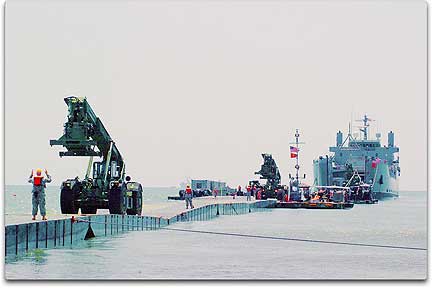
 Photo Right: ARMY TESTS NEW ASSET TRACKING SYSTEM – Hundreds of U.S. Army assets, including vehicles like these Kalmar trucks, were fitted with electronic asset tags for shipment from Norfolk, VA to the beach at Camp Lejeune, NC, during the recent amphibious exercise JLOTS 2009. A secure RF- and satellite-based tracking system developed by ARINC and Impeva furnished continuous asset visibility, allowing the Army to monitor the locations of military assets in real time while in transit. Photo Credit: Mike Petersen, U.S. Army, SDDC
The Army knew exactly where each container and vehicle was located at every step of the way, thanks to a next-generation logistics and asset tracking system developed by ARINC Incorporated and its partner Impeva Labs. Based on radio frequency (RF) asset tags and satellite technology, the new system allowed authorized military observers anywhere in the world to monitor the GPS locations of their tagged materiel in real time, from Norfolk to the destination beach—with accuracies associated with civil GPS. The successful tracking demonstration played a key role in JLOTS ’09, a multi-service cargo distribution exercise.
Known as Next Generation Wireless Communications for Logistics Applications, or NGWC, the advanced tracking system requires no local power or ground communications infrastructure of any kind. It uses rugged, battery-powered electronic asset tags that form secure local mesh networks and link to mobile RF gateways. The gateways transmit GPS tag locations and sensor data over secure long-range communications channels such as satellite, cellular, or other available networks. The JLOTS exercise demonstrated the ability of NGWC to be deployed very rapidly, and at a lower cost than systems commonly used today.
ARINC and Impeva developed the NGWC logistics and asset tracking system under a contract from the Army G4’s Logistics Innovation Agency (LIA). The recent JLOTS exercise marked the Army’s third successful major test of the system, in a series that started in 2008.
“The testing at JLOTS demonstrated that the NGWC mesh works well in dynamic DoD logistics environments,” said Dave Evans of LMI Government Consulting, a company evaluating NGWC development for LIA. “The new NGWC mesh technology has the potential to assist these logistics processes at the local, tactical level by providing frequent position updates that could assist personnel managing the operation. This type of application is not readily available with other AIT (Automated Information Technology) solutions, without using extensive local infrastructure.”
Evans continued, “During the off-load at Norfolk, following the return from Lejeune, we had complete visibility including mapping, without any locally deployed equipment and without any human action or presence. The Humvee-mounted mobile gateways and mesh tagged equipment provided automatic position reports on the pier and within the staging yard, as soon as they came off the ship. This was a major milestone for the program.”
Later this year, the NGWC logistics system is scheduled to be deployed for additional performance testing at the 36,000-acre Sierra Army Depot (SIAD) in California. The Army is also looking at other potential deployments within the coming months.
The JLOTS ’09 exercise also helped validate the unique strength of NGWC known as mesh networking. “When a large number of NGWC tags are placed in the same local area, as on a ship, convoy, storage yard, or train, they link automatically into their own local mesh network without human intervention. The network sends GPS location and monitoring data from the group of asset tags over a single, secure, long range communications channel,” said Randall Shepard, Impeva Labs’ NGWC Program Director and COO. “NGWC’s advance in technology minimizes labor, hardware, and data transmission costs. It also provides an end-to-end view of assets in transit, which is exactly what military commanders want but could not get before NGWC. The commander can now see where each asset is right now—not where it was previously. The JLOTS exercise gave us an excellent opportunity to show the many benefits of this advanced capability.”
JLOTS ‘09, the annual Joint Logistics Over-The-Shore (JLOTS) training exercise, was designed to ensure the capability of the Department of Defense to meet deployment and sustainment requirements if seaports are unavailable. Temporary piers, causeways, and landing craft are used to move cargo and vehicles from ship to shore and back. During JLOTS ‘09, the NGWC system successfully monitored hundreds of individual assets as they were moved to and from shore by numerous modes of transport.
