


• Skip to primary navigation
  • Skip to main content
  • Skip to primary sidebar
  • Skip to secondary sidebar
  • Skip to footer
  • NEWS:
  • SatNews
  • SatMagazine
  • MilSatMagazine
  • SmallSat News
  • |     EVENTS:
  • SmallSat Symposium
  • Satellite Innovation
  • MilSat Symposium
  • SmallSat Europe

SatNews

Satellite Industry Intelligence Since 1983

Subscribe
  • LATEST
  • SatNews Events
  • Magazines
  • Calendar
  • Subscribe
  • Missions & Constellations
    • Exploration & Science Missions
    • In-Orbit Servicing & Orbital Operations
    • LEO Constellations
    • Mission Autonomy & Onboard Systems
    • Mission Deployments & Manifests
    • Navigation & PNT
    • SmallSat
    • Spacecraft & Payload Technology
    View All in Missions & Constellations →
    Blue Origin CEO Attributes BlueBird 7 Satellite Loss to Second-Stage Thrust AnomalyBlue Origin CEO Attributes BlueBird 7 Satellite Loss to Second-Stage Thrust Anomaly
    STMicroelectronics Targets $3 Billion in LEO Satellite Revenue; Announces Dedicated Investor CallSTMicroelectronics Targets $3 Billion in LEO Satellite Revenue; Announces Dedicated Investor Call
    NASA’s Shift to CLPS 2.0 Signals Structural Transformation of Lunar Logistics MarketNASA’s Shift to CLPS 2.0 Signals Structural Transformation of Lunar Logistics Market
    Teledyne to Showcase Integrated Sensing Ecosystem and New Low-Light Module at SPIE 2026Teledyne to Showcase Integrated Sensing Ecosystem and New Low-Light Module at SPIE 2026
  • Business
    • Contracts & Commercial Deals
    • Earnings & Financial Reporting
    • Events & Conferences
    • Funding & Venture Capital
    • Market Forecasts
    • Mergers & Acquisitions
    • Personnel Moves & Appointments
    View All in Business & Finance →
    Vision Meets Profit: Why Modern Space Exploration Requires Both Dreamers and BusinessVision Meets Profit: Why Modern Space Exploration Requires Both Dreamers and Business
    Insider Activity and Space Force Budget Outlook Shift Intuitive Machines’ Financial NarrativeInsider Activity and Space Force Budget Outlook Shift Intuitive Machines’ Financial Narrative
    The Smartest Money in the Room Is Looking UpThe Smartest Money in the Room Is Looking Up
    SmallSat Europe Speaker Focus: Giovanni Pandolfi Bortoletto, Leaf SpaceSmallSat Europe Speaker Focus: Giovanni Pandolfi Bortoletto, Leaf Space
  • Defense
    • Counterspace & ASAT
    • Defense Budgets & Procurement
    • ISR & Reconnaissance
    • MILSATCOM
    • Missile Warning & Defense
    • National Security Programs
    • Space Domain Awareness
    View All in Military & Defense →
    Space Force Awards $3.2 Billion in Golden Dome Contracts for Orbital Interceptor ConstellationSpace Force Awards $3.2 Billion in Golden Dome Contracts for Orbital Interceptor Constellation
    USSF Finalizes GPS III Constellation with Successful SV-10 DeploymentUSSF Finalizes GPS III Constellation with Successful SV-10 Deployment
    Meink: Space Force Programs Ready to Execute Once FY27 Budget LandsMeink: Space Force Programs Ready to Execute Once FY27 Budget Lands
    SDA’s Sandhoo: Tranche 1 Launches Resume in May or JuneSDA’s Sandhoo: Tranche 1 Launches Resume in May or June
  • Gov
    • Export Controls & Compliance
    • International Space Agreements
    • National Space Policy
    • Space Law & Treaties
    • Space Sustainability & Debris Policy
    • Space Traffic Management / Debris Removal
    View All in Government & Regulation →
    How CubeSat Proliferation is Redefining Sovereignty and Diplomatic Leverage at the United NationsHow CubeSat Proliferation is Redefining Sovereignty and Diplomatic Leverage at the United Nations
    FCC Modernization of Spectrum Rules Unlocks Sevenfold Gain in Satellite CapacityFCC Modernization of Spectrum Rules Unlocks Sevenfold Gain in Satellite Capacity
    FCC Grants AST SpaceMobile Authority for 248-Satellite Constellation and Direct-to-Cell ServiceFCC Grants AST SpaceMobile Authority for 248-Satellite Constellation and Direct-to-Cell Service
    Saltzman Rolls Out Space Force Objective Force, Flags CR as Top RiskSaltzman Rolls Out Space Force Objective Force, Flags CR as Top Risk
  • Launch
    • Launch Providers
    • Launch Schedule & Calendars
    • Launch Sites & Infrastructure
    • Rocket Technology & Vehicles
    View All in Launch →
    Bad news, but good news followedBad news, but good news followed
    Rocket Lab Successfully Launches “Kakushin Rising” Mission for JAXARocket Lab Successfully Launches “Kakushin Rising” Mission for JAXA
    Blue Origin Achieves First Booster Reuse but Satellite Enters Off-Nominal OrbitBlue Origin Achieves First Booster Reuse but Satellite Enters Off-Nominal Orbit
    Ensign-Bickford Hardware Supports Successful Artemis II Lunar MissionEnsign-Bickford Hardware Supports Successful Artemis II Lunar Mission
  • Software
    • Autonomous Ground Operations
    • Data Processing & AI/ML
    • Digital Twins & Modeling
    • Ground Segment & Teleports
    • Mission Planning & Simulation
    • Space Systems Software Engineering
    • Spectrum & Licensing
    View All in Software Automation & Ground Systems →
    SpinLaunch Selects Equinix to Deploy Global Ground Infrastructure for Meridian Space ConstellationSpinLaunch Selects Equinix to Deploy Global Ground Infrastructure for Meridian Space Constellation
    RF-Design Launches FiberLink CompactLine FCLR1811S4 for Ground Segment OptimizationRF-Design Launches FiberLink CompactLine FCLR1811S4 for Ground Segment Optimization
    Sat-Lite Technologies adds  Richard Rader to Spearhead Sales ExpansionSat-Lite Technologies adds Richard Rader to Spearhead Sales Expansion
    Blue Origin Unveils Project Quartz Global Ground Station NetworkBlue Origin Unveils Project Quartz Global Ground Station Network
  • Services & Apps
    • Climate & Environmental Monitoring
    • Disaster Response & Security Mapping
    • Earth Observation & Imaging
    • Maritime & Aviation Satcom
    • Satellite Communications
    View All in Services & Applications →
    IEC Telecom Unveils Voucher-Based Connectivity Solution at Singapore Maritime Week 2026IEC Telecom Unveils Voucher-Based Connectivity Solution at Singapore Maritime Week 2026
    GomSpace and STETMAN Establish UASAT Joint Venture for Ukrainian Sovereign CommunicationsGomSpace and STETMAN Establish UASAT Joint Venture for Ukrainian Sovereign Communications
    Market Dynamics and Non-Terrestrial Network (NTN) ChipsetsMarket Dynamics and Non-Terrestrial Network (NTN) Chipsets
    ISS National Lab Launches 2026 Orbital Edge Accelerator to Scale Space-Based R&DISS National Lab Launches 2026 Orbital Edge Accelerator to Scale Space-Based R&D

Trash Bins In Space to Eliminate the Junk?

February 16, 2009

dumpster SatNews found the following article to be of potential interest to our subscribers, courtesy of Trevor Williams University of Victoria Mechanical Engineering PhD candidate:

After launching 6000 satellites since 1957, on 4600 rockets, 70% of the debris in-orbit today remains in low earth orbit, up to 2000kms above the planet surface. An ESA/ESOC (European Space Agency/European Space Operations Centre) artist impression of this debris is shown above (not to scale of course). Orbital debris is a growing problem and one that needs to be dealt with before large parts of the orbital planes become un-usable for centuries.


Many satellites have their orbits at roughly 800kms above the planet Earth, almost exactly at the same altitude that the Iridium (900kgs/1980lbs) and Cosmos 2251 (685kg/1507lbs) spacecraft recently collided (485 miles, 780 km, above the Russian Arctic on Tuesday 10th February 2009 at a combined speed of 15,000mph/24,000kph). The collision most likely produced 1000-3000 thousand extra orbital debris fragments. These fragments are dispersed around the original orbit paths of these satellites but will continue to drift in this orbit path, most likely affecting other Iridium satellites (currently there are 66 in multiple orbit planes) and others. It will take some time to determine exactly where all the fragments will end up.

Low earth orbit In the 800km orbit plane there are numerous communication and earth observation satellites, which are at this altitude because it offers an orbit where there is a balance between repeat visit times over the same spot on the planet, sun illumination with only short eclipse periods where there is no electrical power available so they rely on battery storage. Low Earth Orbit Debris: Image Courtesy of ESA/ESOC.

However, it seems it has been getting a little crowded in this orbit – not just with spacecraft but also with various other space junk and orbital debris. Iridium Corporation had been receiving hundreds of weekly notifications from the US Strategic Command’s Joint Space Operations Centre, the one that tracks debris in space, about potential close approaches within five kilometres (3 miles) of their satellites.

There is not much you can do about it anyway, the margin of error in prediction and the difficulty in altering trajectory means it is just as much a ‘crap-shoot’ to attempt to move a satellite’s orbital path, as it is to not do anything about it. It is kind of like closing your eyes when you think you are about to hit something in your car and hope that you miss it.
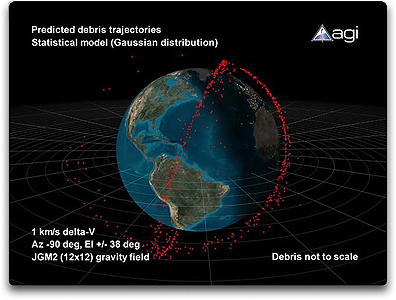
Prredicted debris With at least 18,000 pieces of known orbiting junk there is always a risk of collisions. The odds of hitting something remain quite remote at around 0.000002% though the risk is growing every time a satellite is launched, not only from the satellite itself but more so from the spent rocket engines that have delivered it to orbit. These spent rocket engines are programmed to de-orbit but this can take months. Before de-orbiting, there is always the risk of collision with other debris before they de-orbit themselves, explode due to fuel residues igniting or simply when bits fall off them. Photo on right: Image courtesy of Analytical Graphics, Inc.

It seems wherever humans go, we leave a tell-tale trail of trash behind us. Right now there are no binding international rules forcing satellite owners and launch vehicle to clean up their mess in an orderly and timely fashion. There is a ‘gentlemen’s agreement’ to either de-orbit the satellite when in low earth orbit, or raise it to a ‘graveyard’ orbit  some 300kms above the geo-synchronous orbit of most large communications and television broadcast satellites.

The problem stems from when the satellite is designed and it requires a large quantity of fuel to de-orbit, fuel that most satellite operators prefer to use for station-keeping and orbit control (momentum dumping), thereby prolonging its useful, paying life. When geo-communication satellites have yearly revenues of 60-80 million dollars, it is difficult for an operator to use-up a year’s supply of fuel to scrap the satellite, so they wait until the very last predicted time and then run-out of fuel before they get to the graveyard orbit. Sometimes the satellites fail before they can be scrapped and they drift slowly backwards around the planet, with other operators moving their spacecraft out of the way.

Orbital ‘real-estate’ is another finite resource on this planet, one that is rapidly being used and abused, so it would be a wise decision to ensure all users to be legally bound to dispose of their future-trash wisely, safely and assuredly. For those that fail to do so, penalize them, fine them sufficient monies to attempt a clean-up operation – which would be a remarkable feat of engineering, though not completely impossible to achieve. The US Defense Advanced Research Projects Agency (DARPA) flew the Orbital Express Satellite rendezvous and re-fuelling mission that successfully docked two spacecraft and refueled one of them. The same procedure could be used to attach a module that de-orbits or moves out of the way, defunct satellites.

Resources

Analytical Graphics, Inc.: https://www.agi.com

The Orbital Express Project: https://www.darpa.mil/tto/programs/oe.htm

ESA/ESOC article on debris and spacecraft: https://www.esa.int/SPECIALS/ESOC/SEMN2VM5NDF_mg_1.html

Trevor Williams is a University of Victoria Mechanical Engineering PhD candidate specialising in renewable energy, power grid modelling and plug-in hybrid electric vehicles. He has a bachelors in Aeronautical Engineering, a Masters in Management Science and over 23 years international experience in the space industry, having worked on Earth observation and telecommunications satellites.

Filed Under: Space Sustainability & Debris Policy

Primary Sidebar

Coverage

  • Missions & Constellations
  • Business & Finance
  • Military & Defense
  • Launch
  • Software Automation & Ground Systems
  • Government & Regulation
  • Services & Applications

Most Read Stories

  • SpaceX Loses Contact With Starlink Satellite
  • Planet Labs Imposes Indefinite Blackout on Iran Satellite Imagery at U.S. Request
  • Amazon in Reported Talks to Acquire Globalstar in $9 Billion Move to Challenge Starlink
  • What the SpaceX IPO Changes for Every Satellite Operator
  • Russia Replaces Starlink With European-Built Satellites

Secondary Sidebar

Footer


Satnews is a leading provider of satellite news, events, publications, research and other satellite industry information in both commercial and military enterprises worldwide.

Stories By Category

  • Business & Finance
  • Government & Regulation
  • Launch
  • Military & Defense
  • Missions & Constellations
  • Services & Applications
  • Software Automation & Ground Systems
  • Spectrum & Licensing
  • Startups & NewSpace Business

About Us

  • Leadership & Editorial Team
  • SatNews History
  • Free Satnews Subscription
  • SatNews Events
  • Magazines

Navigation

  • Latest Stories
  • Magazines
  • Events
  • Contact
  • Cookie & Privacy Policy for Satnews

We use cookies to ensure that we give you the best experience on our website. If you continue to use this site we will assume that you are happy with it.
x
Sign up Now (For Free)
Access daily or weekly satellite news updates covering all aspects of the commercial and military satellite industry.
Invalid email address
Notify Me Regarding ( At least one ):
We value your privacy and will not sell or share your email or other information with any other company. You may also unsubscribe at anytime.

Click Here to see our full privacy policy.
Thanks for subscribing!