

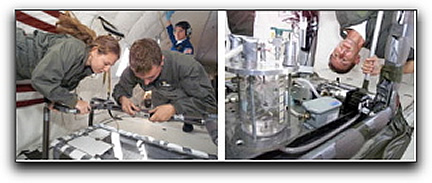
 Prepare to be swept off your feet. That’s what NASA might have said to their Innovative Partnerships Program, which has selected seven Small Business Innovation Research program, or SBIR, companies to participate in reduced-gravity test flights in early September. The companies will have the opportunity to test their newly developed hardware on an aircraft that simulates the weightless conditions of spaceflight. The fights will the first by NASA’s Facilitated Access to the Space Environment for Technology Development and Training program, called FAST.
The importance of testing new technologies in weightless conditions is part of the process of making them available for applications in NASA space projects. An aircraft flying on a parabolic trajectory can create weightless conditions for up to 30 seconds at a time, and simulate the reduced gravity conditions of the moon or Mars. While 30 seconds may seem to be a short amount of time, it enables developers to test new technologies to ensure that they will work in space or, if they do not work during testing, understand why. It is difficult for emerging technology developers, especially small businesses, to gain access to parabolic aircraft flights. Through FAST, NASA will provide a flight demonstration opportunity while the developer provides the technology.
 The selection for the first round of flights was limited to companies
that already have SBIR contracts with NASA. The technologies being
flown address needs in each of NASA’s four core mission directorates.
In the future, the competition will be extended to any companies and
laboratories working in partnerships on technology of value to NASA’s
missions. Another important aspect of FAST is that the Zero-Gravity
Corporation of Las Vegas will conduct the flights as a commercial
service to NASA.
The selection for the first round of flights was limited to companies
that already have SBIR contracts with NASA. The technologies being
flown address needs in each of NASA’s four core mission directorates.
In the future, the competition will be extended to any companies and
laboratories working in partnerships on technology of value to NASA’s
missions. Another important aspect of FAST is that the Zero-Gravity
Corporation of Las Vegas will conduct the flights as a commercial
service to NASA.
The Zero-Gravity Corporation contract is managed by NASA’s Glenn Research Center in Cleveland and is part of an effort to expand the agency’s use of commercial services. The reduced-gravity flights will be conducted from Ellington Field in Houston. NASA’s Johnson Space Center in Houston and Glenn are providing technical support to the participating companies.
The September flights will include the following projects and companies: Vacuum-Compatible Multi-Axis Manipulator/Machining Center for Long-Duration Space Missions, Beck Engineering Inc., Port Orchard, Washington; Investigation of Pneumatic Mining System under Lunar Gravity Conditions, Honeybee Robotics Spacecraft Mechanisms Corporation, New York; Aircraft Sensor Logger, Metis Design Corporation, Cambridge, Massachusetts; Microgravity Flight Testing of Passively Self-Deploying Shells, Mevicon Inc., Sunnyvale California; Virtual Sensor Test Instrumentation, Mobitrum Corporation, Silver Spring, Maryland; Nanofluid Coolants, nanoComposix Inc., San Diego, California; Constant-Force-Exercise Sled, Valeo Human Performance LLC, Houston, Texas. Congratulations to all!
