

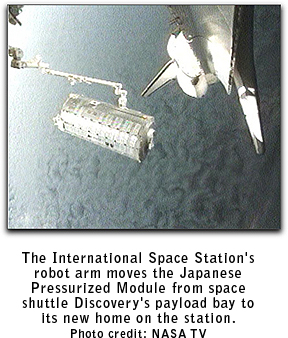
 The Boeing Company [NYSE: BA] provided more than 1,600 of the components in the payload that Space Shuttle Discovery is delivering to the International Space Station (ISS). Discovery launched Saturday from Kennedy Space Center, Florida, on a 14-day mission to deliver the Kibo Japanese Experiment Module-Pressured Module (JEM-PM), which includes the Japanese Experiment Module-Remote Manipulator System (JEM-RMS), a robotic arm to support experiments and maintenance.
In addition to providing common gear components for Kibo under an agreement with Mitsubishi Heavy Industries, Boeing also contributed essential payload processing. The common gear components include lights, fans, power switches and converters, racks, air diffusers, smoke detectors, berthing mechanisms and optical window assemblies. The components that help keep the JEM-PM operating properly are similar to those that Boeing developed for the U.S. Destiny laboratory and the Harmony connecting utility node built by Italy. Boeing also provided a new restraint mechanism that had to be developed for the space shuttle’s robotic camera because of the immense size of the JEM-PM. JEM-PM is the Kibo module’s main science component and the second of three Kibo elements to be delivered to the ISS. The largest payload and habitable module ever delivered to the ISS, the JEM-PM is the size of a 16-ton school bus.
