

On Sept. 23, 2026, speaking during an industry webinar, Col. Scott Carstetter, director of servicing, mobility, and logistics at Space Systems Command (SSC), outlined military plans to execute two commercial satellite servicing demonstration missions in 2027.
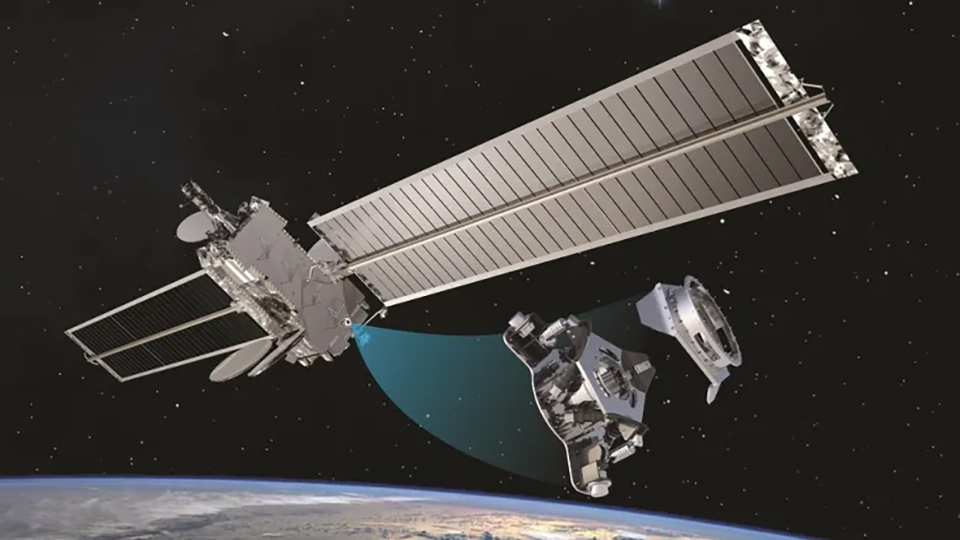
The upcoming flight operations will evaluate commercial refueling and maneuvering services for high-value defense payloads operating in geosynchronous Earth orbit (GEO) and low Earth orbit regimes.
Space Systems Command Servicing Strategy and Historical Context
The planned 2027 demonstrations represent a transition in the Department of Defense’s approach to space domain awareness, mobility, and logistics. Historically, military and intelligence satellites operating in GEO were treated as single-use, non-serviceable assets, designed with finite station-keeping propellant reserves that dictated their operational lifespans regardless of payload health.
Under SSC’s Space Mobility and Logistics (SML) portfolio, the U.S. Space Force is shifting toward dynamic space operations, where orbiting assets can be maneuvered to avoid threats, refueled in flight, or repositioned across orbital planes without exhausting core operational lifespans. By partnering with commercial servicing primes, SSC seeks to establish standardized interfaces for fluid transfer, mechanical docking, and orbital relocation across defense constellations.
The dual demonstration program aims to establish operational baselines for commercial service procurement, measure the infrastructure required to sustain routine in-space logistics, and define clear economic thresholds where satellite life extension or refueling provides greater cost efficiency than deploying replacement spacecraft.
Mission Architectures and Technical Servicing Framework
The 2027 flight campaign comprises two distinct mission architectures designed to test propellant transfer and mechanical tug capabilities:
The Astroscale U.S. mission will focus on high-altitude propellant transfer within geosynchronous orbit. Under the mission concept, an Astroscale servicer spacecraft will rendezvous and dock with a military target satellite in GEO to transfer hydrazine or specialized green propellant. Following the primary satellite refueling sequence, the servicer craft will maneuver to a separate commercial fuel depot orbiting in GEO to replenish its own internal tanks, validating multi-use, repeatable refueling operations in deep space.
The Starfish Space mission will deploy an autonomous satellite servicing vehicle, known as the Otter tug, to execute proximity operations and mechanical docking maneuvers. The Starfish Space tug will perform rendezvous and proximity operations (RPO) with multiple national security satellites, docking with client craft to adjust their orbital inclinations and relocate them to new strategic operational slots before uncoupling to engage subsequent targets.
Both missions will rely on standardized docking fixtures and robotic capture interfaces designed to allow third-party servicing vehicles to engage military spacecraft without damaging delicate thermal blankets, solar arrays, or sensitive payload antennas.
Executive Statement
“These two commercial servicing missions planned for 2027 will help us answer fundamental questions about how the military buys on-orbit services,” stated Col. Scott Carstetter, director of servicing, mobility, and logistics at Space Systems Command. “We need to determine how much infrastructure is required to support routine servicing, while establishing the exact operational conditions where refueling or life extension makes better financial and military sense than launching a replacement satellite.”
Procurement Roadmap and Orbital Infrastructure Outlook
Space Systems Command will continue coordinating joint integration campaigns with Astroscale U.S. and Starfish Space through late 2026 to qualify launch manifests, finalize rendezvous flight software, and complete safety reviews for target spacecraft. The operational data gathered during the 2027 flights will inform future Space Force acquisition frameworks for permanent in-space servicing, assembly, and manufacturing (ISAM) capabilities across upcoming defense constellations.
