


-
All You Can Eat Apple Ah, free enterprise! Where the bidding, blinking and bullying contests take place to see who will cave-in first and the customer wins. This time the blinking contest involves Apple and Nokia and the world of music. Currently, Apple is in discussions with the big music companies about a radical new business model. The model would give customers free access to its entire iTunes music library in exchange for paying a premium for its iPod and iPhone devices. Reportedly, Apple is talking to music companies about offering a subscription service and package deals that include a device and music.
Apple’s deal is described as the “all you can eat” model, which resembles Nokia‘s device that comes with music after Nokia struck a pact with Universal Music last December. Pundits speculate that this/these ventures could pump up the struggling recorded music industry and create a demand for a new generation of Apple’s hardware. Again, word on the street is that Nokia is said to be offering almost $80 per handset to music industry partners, to be divided according to their share of the market. Apple has, so far, offered only about $20 per device. Several music libraries have been offering subscription services for Windows Media Audio without much success in its customer numbers, and RealNetworks has also tried.
Where Apple could come out ahead is that they are in a different position, and such an enterprise could boost hardware sales and bring in extra traffic for an already successful business. Market research indicates that customers would pay up to $100 for unlimited access to music for the device’s lifetime, or a monthly subscription rate of $7-8. But the subscriptions would be available only for its iPhone, because of the monthly billing process already in place with its customers. However the “comes with music” model would work with iPhones and with iPods. If Apple goes the subscription route, the customers would get to keep up to 40 or 50 tracks a year. The client would be able to keep the tracks even if they changed their device or their subscription lapses.
Meanwhile, back to Nokia, who is said to be anxious to sign up as many of the major labels as possible before they launch their first version of “comes with music” (is that like “Dances with Wolves”?) devices in the second half of this year. Word from Apple is… no word—yet. Stay tuned—Cupertino, California

-
Arqiva’s Satellite Media Solutions division has announced they are providing a dedicated 36MHz transponder, plus associated multiplexing and uplinking, to support growth by sports TV broadcaster Setanta. Content will be delivered via a number of fibre sources and a dedicated multiplex capable of uplinking up to eight channels. A proportion of the available capacity is used to support a range of interactive services including Sky Bet and the Setanta ISub applications. Setanta is an owner and operator of premium, subscription-based, sports TV channels with more than three million customers worldwide. The dedicated transponder provides Setanta with greater efficiencies in broadcasting their growing number of sports-related channels, which include Racing World, Racing UK, Setanta Commercial, NASN, Setanta Island, Liverpool TV and Arsenal TV, which was launched on 14 January 2008—Hampshire, United Kingdom
-
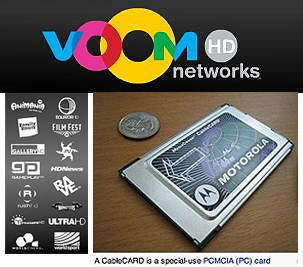
Cablevision Sets Voom HD. Cablevision Systems will provide Voom HD Networks’ 15 hi-def channels using switched digital video to subscribers with CableCard-based systems. This includes free use of a HD set-top for one year. The offer went to customers with CableCards and with non-Cablevision supplied equipment—such as TiVo digital video recorders. Switched digital video allows operators to free up bandwidth, by delivering linear TV channels only when subscribers in a service group request them. Currently, one-way cable-ready consumer electronics that use CableCards to access cable programming such as TiVo DVRs can’t tune to switched digital video channels. With a Cablevision HD set-top, TiVo users would be able to receive the Voom networks and other SDV channels that will be moved in April and May and include 15 Voom HD channels; Animania HD, Equator HD, Family Room HD, Film Fest HD, Gallery HD, GamePlay HD, HDNews, Kung Fu HD, Monsters HD, Rave HD, Rush HD, Treasure HD, Ultra HD, WorldCinema HD and WorldSport HD.
-
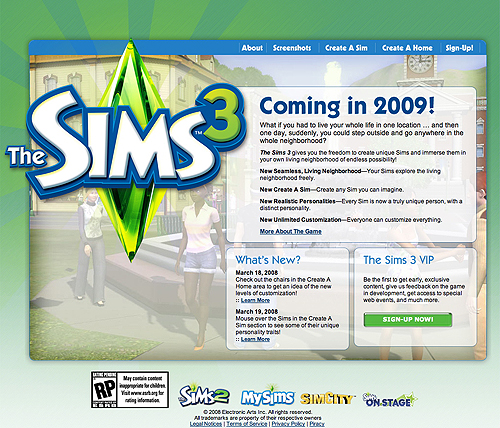
Electronic Arts Inc. has unveiled the first details on one of interactive entertainment’s most anticipated games, The Sims 3. Featuring a brand new engine that has been in development for nearly three years, The Sims 3 allows you to immerse your unique Sims in an open living neighborhood, right outside their door. The initial feature-set unveiled includes the new, seamless, open neighborhood, a new Create A Sim, new realistic personalities, plus unlimited customization. The Sims 3 will launch globally in 2009. The Sims franchise has long been recognized for its appeal to a universal audience, both male and female, and at any age. The sims broad appeal and loyal The Sims community has vaulted the franchise to an impressive 98 million games sold around the world and translated into 22 different languages. Celebrated for its creativity, humor, and community, The Sims franchise has become a global and cultural phenomenon since its inception in 2000. Now, The Sims 3 is being designed to be the next-generation flagship game from The Sims Label—Redwood City, California
-
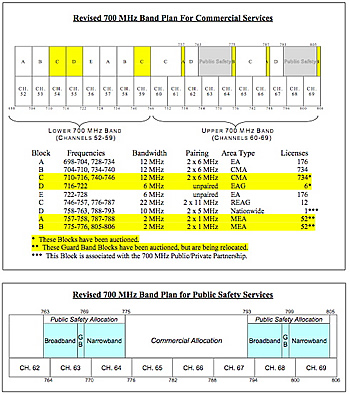
 The Federal Communication Commission’s Auction 73 is now closed. The auction assigned more than 1,000 licenses for most of the 700MHz band. Final bid amounts came in at just under 19.6B/USD, double the estimated amount for the auction. This auction also exceeded the final receipts of all previous U.S. spectrum auctions combined. Consumers with mobile broadband, mobile video and other services not yet realized will find the 700 MHz spectrum with excellent propagation characteristics and it will be useful in expanding advanced services in rural areas, which was a key goal of the FCC as mandated by Congress. The FCC will now turn its attention to the reviewing the options for the Upper 700 MHz D block. This is 10 MHz of spectrum designed to create a Public/Private Partnership to build a nationwide, interoperable broadband network to improve public safety communications. First responders need such advanced communication capabilities to provide critical, life-saving services to citizens across the country—Washington, D.C.
-
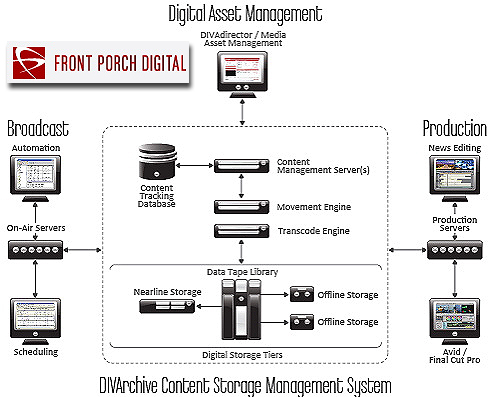
Storing up a partnership are Front Porch Digital (NAB: N1830), a provider of content storage management (CSM) solutions, and government contracting expert FedResults of Herndon, Virginia. The latter will support the former’s efforts to expand the reach of its DIVArchive line of products into the U.S. government and defense markets. “There’s a lot of video accumulated in government—in the intelligence community, at NASA, and in the Department of Defense, just to name a few examples,” said Jim Beaupre, FedResults chief executive officer. “Managing digital video content is an ongoing government challenge. Because a number of us at FedResults, myself included, have a background in the storage industry, we recognize that Front Porch Digital has an outstanding solution to offer. Now our charge is to bring challenge and solution together.”—Louisville, Colorado
-
Genesis Networks has established an independent point of presence (POP) in the United Nations’ Studio H broadcasting facility, located in the core of the U.N.’s New York City headquarters. The Genesis installation provides news bureaus covering U.N. events with a reliable and cost-effective means of delivering news feeds to their global affiliates. Genesis Networks connects seamlessly with the U.N.’s state-of-the-art Studio H broadcasting facility and enables the transmission of TV and radio signals entering and leaving the U.N. building, as well as the broadcast of its own productions. News organizations from around the globe maintain bureaus within the U.N. building. With the Genesis POP, large and small news bureaus can use Genesis to transmit their news feeds via direct fiber. The Genesis Networks POP is capable of transmitting and receiving multiple video channels. Plus, the network can service each bureau’s data requirements. Any news bureau can contract with Genesis to transport a signal in or out of the U.N., either via the POP or through a direct connection to Genesis’ global fiber network—New York, New York
-
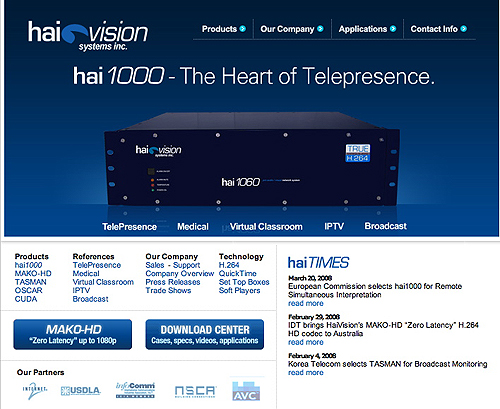
Not too shabby having the European Commission (EC) as a client! And that’s exactly what HaiVision Systems Inc. (NAB: SU11626) has managed to accomplish, as the EC has selected and installed HaiVision’s hai1000 high performance telepresence codes for remote simultaneous interpretation. This became the solution to the EC’s search for video devices and videoconferencing tools to assist interpreters and their work with remote participants through the uses of immediate and precise audio and video. The audio and video must be delivered in absolute synchronization with the lowest latency. The audio must be virtually noise free and have wideband frequency response in order to service the many, varied, European languages. The hai1000 multi-stream codec has been selected as it exactly meets these demands as well as delivers four unique audio channels. Initially installed in a test bed between facilities within adjacent building in Brussels, the hai1000 network within the EC is being expanded to incorporate facilities in Luxembourg and other EC centers. Such conferencing facilities are not only convenient for those who cannot travel and for ad-hoc meetings, but are critical in planning for crisis event response—Montreal, Canada
-
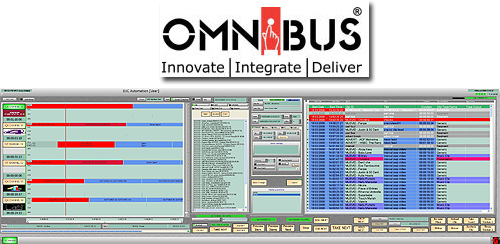
The latest Colossus multi-channel automation system has debuted from OmniBus Systems.. Colossus v.3.5 now has an extended feature set and support for 3rd party devices. These extra capabilities include support for a wide range of new video servers from Omneon, Quantel, Harris and Thompson/GVG. There also support for an increased range of master control systems and protocols, including Probel 520, Miranda Presmaster, GVG Maestro and Nvision. For multi-regional broadcasting, there are now regional break-outs and a sophisticated vision mixer control includes complex lead/lag audio control. There’s also scheduled multi-language playout from a single channel with track stacking and more. Also added to the mix is support for the SMPTE BXF (Broadcast eXchange Format) interface—Denver, Colorado
-
 The Telecommunications Industry Association (TIA) has published a suite of Ultra Mobile Broadband (UMB) air interface standards numbered as TIA-1121.000 through TIA-1121.008. The TIA-1121 documents form the compatibility specification for the UMB air interface systems, including requirements that a compliant access terminal can obtain service through any access networks conforming to the standard, without addressing the reliability, performance or measurement procedures of that service. The standards address design and implementation of access terminals to ensure uniform response to all access networks, and also include provisions for future service additions and expansion of system capabilities through the architecture defined in the documents. The new standards contain a basic overview of the UMB air interface (TIA-1121.000); a physical layer specification (TIA-1121.001); a medium access control specification (TIA-1121.002); a radio link layer specification (TIA-1121.003); an application layer specification (TIA-1121.004); a security functions specification (TIA-1121.005); a connection control plane specification (TIA-1121.006); a session control plane specification (TIA-1121.007); and a route control plane specification (TIA-1121.008). The TIA-1121 suite was formulated under the cognizance of the TIA TR-45: Mobile and Personal Communications Systems Engineering Committee’s TR-45.5: Spread Spectrum Digital Technology Subcommittee. To obtain copies of the document, contact Information Handling Services at (800) 854-7179 or visit this website
The organization has also announced the election to its Board of Michael C. Dumas, Vice President, Comm/Data Business, Graybar; and Fred McDuffee, President & COO, Sumitomo Electric Lightwave. Charlie Fox, General Manager, Tyco and Carlos Munoz, CEO, Cam Communications, were confirmed for their second terms as Board Members. The elections took place at the TIA Board meeting held March 2-3, 2008, in Tahoe, Nevada—Arlington, Virginia
-
Utterz (mobile posting service) has announced several new Utterz Connections, including YouTube, LiveSpaces, Drupal, Yahoo! Groups, and Twixtr. Connections automatically post voice, video, pictures and text instantly, on command, making Utterz a multimedia communication solution for blogs, socnets or a web site. Utterz also has Connections to WordPress, Blogger, LiveJournal, TypePad, MoveableType, Twitter, Tumblr and Flickr, and supports posting multimedia to almost any social network or web page with Utterz widgets. Utterz also has a Facebook application and uses open web standards to innovate and bring new services to market—Maynard, Massachusetts

-
 Volantis Systems has released its Mobility Server to the open source community, under the GNU General Public License (GPL), version three. The company opened 1.2 million lines of code, the result of seven years’ of development, to the community. The company also launched the Mobility Server Project to help developers build out the mobile platform. Volantis is the first mobile content delivery solutions vendor to open source its code and the effort is part of the company’s move to the enterprise market. In offering its Mobility Server to the community, Volantis hopes to drive adoption and encourage more companies to bring usable and compelling content to the mobile Web. The mobile web is the next major growth point for online communications, but the ever-growing variety of mobile devices on the market makes it difficult to develop powerful web apps. Volantis Mobility Sever makes it easy for companies to create this content and distribute it to the more than 5,000 mobile devices currently on the market—Guildford, United Kingdom
-
There’s a new process for embedding closed captions directly to MPEG video files. Just launched by XOrbit (NAB: Booth SL6226) is Xilex, which inserts captions directly into SD, HD, program, and transport stream MPEG files. There’s not need to encode physical media. Xilex receives captioning and video data in separate file formats, embeds the captions based on timecodes, and automatically restores the captioned MPEG to the DAM or a separate storage device. With Xilex, there’s no need for a VBI encoder to deliver video to air. The system can handle the program file and the transport stream, especially ideal for VoD apps. The Xilex server is packaged as a 1-RU solution with full API docs and development support. The system works with standard ATSC MPEG-2 files and supports an extensive list of caption file formats—Columbia, Maryland

PRIVACY POLICY
digiGO!™—The Digital World… does not sell or trade subscribers’ names or personal information to any interested parties.
DISCLAIMER
digiGO! and its agents and distributors used all best efforts to collect and prepare the information published herein. However, digiGO! does not assume, and hereby disclaims, any and all liability for any loss or damage caused by errors or omissions, whether such errors or omissions resulted from negligence, accident, or other causes.
Copyright 2006—2008 digiGO! | High Sierra Media Group (HSMG) & SatNews Publishers. All rights reserved.
