

Jules Verne is the first of a series of ATVs that will bring supplies, including food, water, and fuel as well as experiment equipment, to the crew on board the International Space Station. A crucial element of the ISS program, the ATV will also re-boost the Station’s orbit to overcome the effects of residual atmospheric drag. After six months the ATV will undock and be used to dispose of Station waste during a guided and controlled destructive re-entry into the atmosphere high over the Pacific Ocean.
The Jules Verne re-supply spaceship will dock with the Russian Service Module. This unique SDIL facility of 250 people replicates the complete ISS on-board avionics. The facility is being extended as new elements from the ISS’s international partners are attached to the Space Station. It is located at the Sonny Carter Training Facility, the site of the world’s largest indoor pool, which contains a fully immersed mockup of the ISS where astronauts can train for spacewalks.
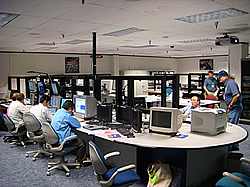
Test and verification of all ISS flight software is all completed at the SDIL, housing more than 800 computers, with the purpose to provide full confidence in the safety and efficiency between the different elements of the ISS for mission-critical software. The Jules Verne ATV is scheduled to be launched in early 2008. The ATV is known as the ‘fifth box’, in this five-box test, which includes the two Fault Tolerant Computers (FTCs) of the Russian Service Module, the two MDM computers of the US Destiny Lab and, for the first time, the ATV. Similar testing is required for ESA’s Columbus module and the Japanese Kibo module. On board the ATV, the FTC, which is the main 3-unit computer as well as its flight application software, play the role of a pilot that navigates the ATV mission.
The complexity of the different software and their compatibility will play a crucial role during the attached phases such as the re-boost operation, the debris avoidance maneuvers and the desaturation of the Space Station’s gyroscopic attitude system while the ATV is attached to the ISS. The safety of the whole 220-ton orbital outpost depends on smooth communication across the module software of the different partners. The flight code on the US side and the Russian side contains more than four million lines of code — there are about one million lines of code in the various computers of the ATV spaceship—Paris, France
